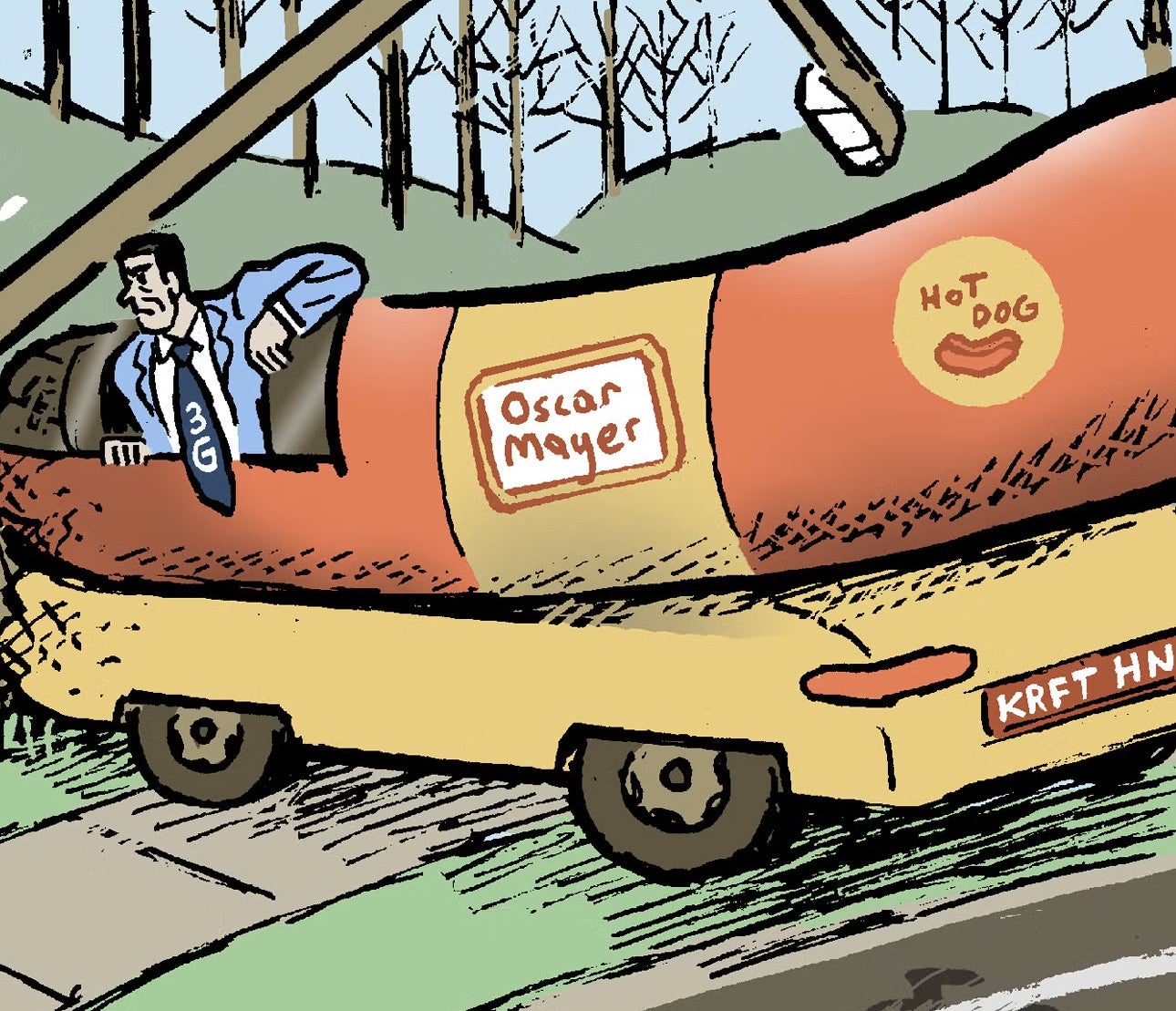
Driven Crazy
Here’s a short list of futuristic sci-fi tropes: flying cars, robotaxis, a genuinely useful AI assistant. Wanna guess which one might actually happen soon?
Nope, not the assistant. It’s robotaxis.
What started as Waymo’s city-by-city driverless taxi tests has now hit critical mass – and the industry is running (driving?) headfirst into an intimidating regulatory maze, The Verge reports.
Advertisers are licking their chops.
Widespread adoption of driverless cabs would be a gold mine for advertisers. Without a driver, the entire interior can be redesigned around screens and ad surfaces. From there, the possibilities are endless: sponsored rides, local discounts and promos – maybe even a cab that traps you inside and drives straight to Dave & Buster’s (just kidding … probably).
It’s no wonder advertisers are already picturing a fresh stream of premium inventory. The two biggest players in driverless taxis, Waymo and Zoox, are owned by Google and Amazon, respectively.
Give it time and those in-car placements will probably just be one more line item in Performance Max – or Performance+, which is Amazon’s version.
It’s worth noting, however, as The Verge does, that the main source of opposition to driverless taxis from consumers (and from voters and lawmakers) isn’t really safety or sustainability; it’s distrust of the Big Tech companies behind them.
Evolution’s Croc
Crocs exploded in popularity during the COVID pandemic, going from a roughly $1 billion dollar market cap in early 2020 to $10 billion by late 2021.
Since then, its share price has ping-ponged, and the company hit a major snag around a year ago when demand sagged and the market was flooded with excess footwear. Crocs ended up spending $45 million in late 2025 to buy back and destroy its own shoes, The Wall Street Journal reports.
One reason Crocs had a tough year is because it chose to sacrifice sales. The company got rid of discounts and retail media promos that would sell the glut of shoes, but cheaply and laden with marketing costs. It sold fewer shoes, but at a better margin and price for the brand overall.
Crocs isn’t alone in rethinking that trade-off. Many big CPG brands also admit to having overstepped over the past year or two with deep discounts and retail trade marketing. But they’re finding they often earn more profit, even on fewer units, when they hold the line on price.
Now, 16 months after Crocs shifted away from discount-heavy marketing and started prioritizing margin over volume, it’s back to year-over-year growth and no longer has to explain sluggish-looking sales.
Streaming, At What Cost?
Viewers are choosier and more cost-conscious nowadays about their streaming services. So streamers are opting not to raise subscription prices as much as they once did.
Netflix, Disney+ and Amazon Prime Video have all dropped their price increase rates to an average of 14% per subscription in the past year. That’s down from 24% between 2023 and 2024, according to a recent report from Ampere Analysis, which recently analyzed those three streamers.
On average, ad-free tiers are seeing larger price increases than ad-supported plans – which makes sense considering that average ad revenue per viewer is a metric prized by investors as a sign of sustainable profitability.
Of the three services in Ampere’s survey, Prime Video had the fewest price increases. Amazon can afford to be less aggressive on streaming prices because Prime Video is just one part of a much larger business, unlike Netflix and Disney+, which rely far more heavily on subscriptions and ad revenue.
But Wait! There’s More!
Private-equity-owned Yahoo, the internet’s “OG,” wants to win over Gen Z. [Financial Times] Microdrama advertising is surging along with downloads for microdrama apps, according to one report. [Marketing Dive]
ESPN is hiking its Unlimited tier pricing from $29.99 to $31.99 per month. [[Sports Media Watch](https://www.sportsmediawatch.com/2026/08/espn-unlimited-first-price-increase-september/)]

Why are marketers so intent on chasing fandoms? [[Digiday](https://digiday.com/marketing/wtf-are-fandoms-and-why-are-marketers-chasing-them/)]

A new proposed bill in New Zealand would ban children under 16 from having social media accounts. [[Mashable](https://mashable.com/tech/new-zealand-social-media-ban)]
BuzzFeed goes through another round of layoffs, this time cutting The Huffington Post’s national desk down to just three writers. [TheWrap]
Big Tech is sinking its teeth into American schools. [NYT] Trading quality for cost savings lost Wendy’s its No. 2 spot in sales among US burger chains. Its new marketing strategy: Focus on the “core menu,” says CEO Bob Wright. [WSJ]
You’re Hired!
Speaking of Wendy’s, the brand just hired McDonald’s alum Tariq Hassan as its CMO. [release]
Here’s today’s AdExchanger.com news round-up… Want it by email? Sign up here .