Swarm robotics systems rely on power architecture because energy distribution influences coordination efficiency and fault tolerance in multi-agent environments. Centralized models depend on unified infrastructure and coordinated energy management.
Meanwhile, decentralized approaches distribute power control and operational decision-making across individual robotic units within the swarm.
These architectural differences create significant operational trade-offs involving communication latency, synchronization precision, and adaptive responsiveness. They make power topology an important consideration for robotics engineers, artificial intelligence researchers, and industrial automation professionals.
Power architecture is a core layer in swarm intelligence #
Power topology is central to swarm coordination because autonomous decision-making and scalable task execution depend on how robotic agents distribute and manage energy resources.
Dynamic swarm environments require adaptive routing awareness to maintain operational continuity, particularly when robotic nodes frequently change position or communication range during deployment.
For example, in unmanned aerial vehicle (UAV) swarms, routing data to a base station without awareness of updated topology conditions can trigger link breakages and localized energy holes that disrupt real-time responsiveness. These operational challenges highlight why power architecture functions as a foundational systems-level consideration before evaluating the differences between centralized and decentralized swarm models.
Centralized power models in swarm robotics #
Centralized power models in swarm robotics rely on unified orchestration systems that coordinate energy distribution and charging schedules across the robotic fleet. This architecture often performs well in industrial automation and warehouse environments where structured layouts and predictable workflows allow centralized infrastructure to optimize synchronization precision and workload efficiency.
Shared control systems can simplify fleet diagnostics and maintenance scheduling. However, dependence on centralized coordination may also introduce scalability limitations, communication bottlenecks, and infrastructure vulnerability if failures occur within the primary control layer.
Decentralized power models in swarm robotics #
Decentralized power models in swarm robotics distribute energy management and operational coordination to individual robotic agents rather than relying on a single orchestration layer. This architecture improves fault tolerance and deployment scalability because robots can continue operating even when connectivity disruptions or localized failures occur within the swarm.
However, as swarm size increases, message traffic scales significantly. Additional nodes must continuously exchange routing updates and decision data to maintain decentralized coordination.
The resulting communication congestion can reduce real-time responsiveness, which remains essential for synchronized swarm behavior and cooperative task execution in dynamic operational environments.
Hybrid coordination and adaptive power management in swarm robotics #
Hybrid swarm architectures combine centralized orchestration with decentralized energy autonomy to balance large-scale coordination efficiency with localized adaptability across robotic fleets.
These systems often rely on edge AI processing and localized decision-making to improve resilience in dynamic environments where connectivity and operational conditions frequently change.
Hybrid models can distribute certain computational and energy-management functions closer to individual robotic agents while maintaining higher-level centralized oversight. This approach can reduce communication congestion, routing instability, and localized energy imbalance in large-scale swarm deployments.
Robotics companies apply swarm robotics #
Robotics brands in the logistics and manufacturing sectors are applying swarm robotics principles to improve coordination efficiency and autonomous decision-making.
These real-world implementations demonstrate how different power architectures influence adaptive behavior and operational performance in multi-agent robotic systems.
Amazon Robotics
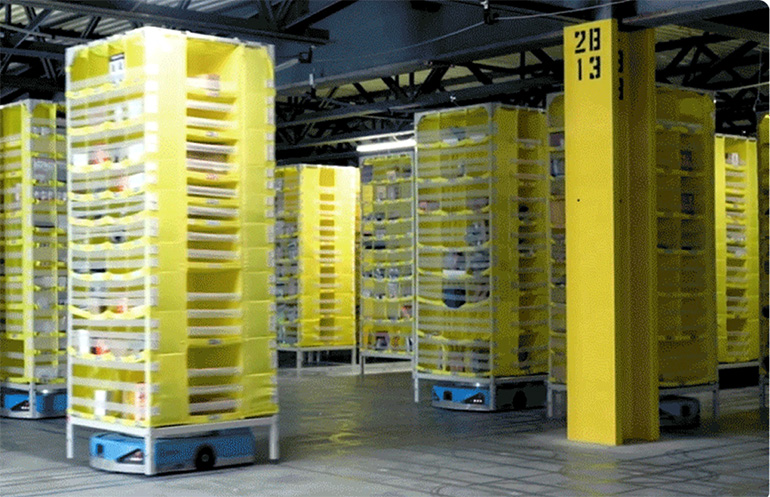
Amazon Robotics combines centralized fleet orchestration and AI-driven traffic management to coordinate robotic activity across high-density fulfillment environments. The enterprise deploys over 1 million robots to improve inventory movement throughout its many warehouses.
These machines deliver items directly to employees using mobile shelving systems, which allows centralized control platforms to optimize routing efficiency and synchronized task execution. This coordination model supports predictable operational throughput and real-time traffic optimization by continuously managing robot movement patterns and congestion in large-scale automated facilities.
Editor’s note: Bhavana Chandrashekhar, senior manager of applied science at Amazon Robotics, will speak at the Women in Robotics Lunch and participate in a keynote panel on “Beyond the Demo: AI in Production Robotics” at RoboBusiness 2026. The event will be on Oct. 20 and 21 in Santa Clara, Calif. Register now to attend.
Ocado Technology
Ocado uses grid-based swarm fulfillment systems and centralized energy coordination architecture to manage thousands of robots within densely automated distribution environments. Highly automated picking, storage, and dispatch allow a 50-item basket to be picked in under five minutes.
Meanwhile, 24/7 engineering support and high-performing service levels help guarantee consistent site throughput in large-scale fulfillment operations.
Centralized control layers continuously optimize robotic movements and order sequencing in real time. They enable the company to maintain synchronized swarm coordination, minimize congestion and support high-volume grocery fulfillment with predictable operational efficiency.
Hybrid power architectures emerge in swarm robotics #
Hybrid frameworks combine centralized AI coordination with decentralized energy autonomy to give swarm systems strategic oversight and local responsiveness. Edge computing and distributed battery intelligence can also enable individual robots to process data and manage energy states without constantly relying on a central controller.
As swarm-aware energy routing and autonomous docking systems mature, future deployments may support more resilient coordination within large-scale robotic fleets. These advancements can also improve scalability for autonomous warehouse systems and industrial robotics operating in dynamic environments.
Future robotic ecosystems will likely depend on hybrid frameworks that combine centralized coordination with decentralized energy autonomy to improve operational flexibility. As swarm robotics deployments become more complex in manufacturing and autonomous mobility applications, power topology can shape communication stability and system resilience.
Robotics engineers and automation professionals should evaluate power architecture as a strategic design variable that directly influences fault tolerance and large-scale deployment performance.
About the author
Lou Farrell, a senior editor at Revolutionized, has written on the topics of robotics, computing, and technology for years. He has a great passion for the stories he covers and for writing in general.
This article is posted with permission.