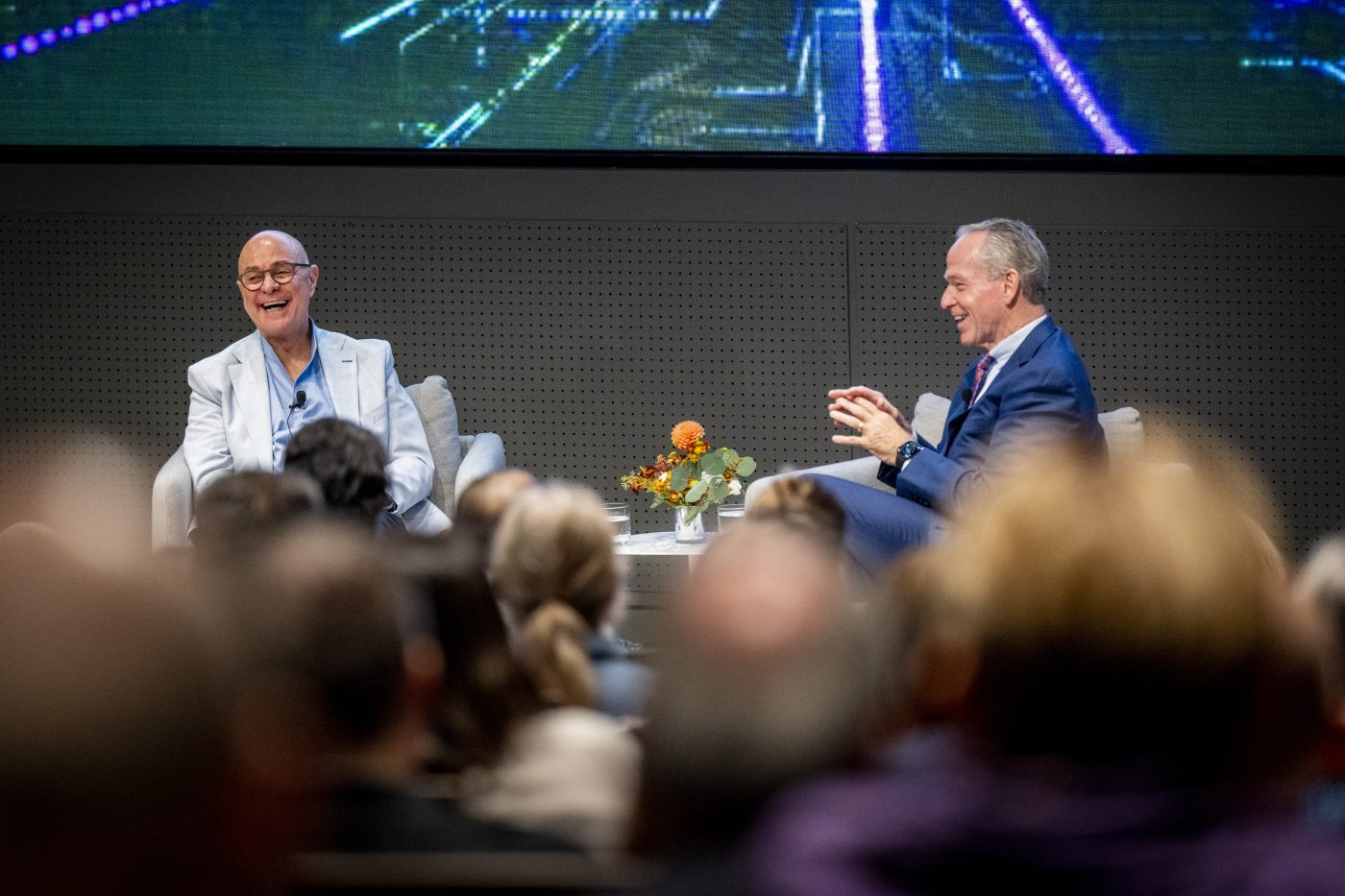
Suffolk CEO John Fish joined President Joseph E. Aoun for a fireside chat about AI’s transformational power
One builds buildings; the other builds minds.
But while their materials and products may differ, artificial intelligence’s transformative power presents opportunities for the construction industry and higher education as well, a recent fireside chat with Northeastern University President Joseph E. Aoun and Suffolk CEO and Chairman John Fish revealed.
“The opportunity for us is to learn with and from John and see how we can look at another industry that is very traditional and being disrupted,” Aoun told an audience during the fireside chat at the Interdisciplinary Science and Engineering Complex on Northeastern’s Boston campus on Monday.
Fish started Suffolk in 1982 with a $100,000 construction project in Fall River, Mass. and has grown the company to become one of the leading privately held builders in the country with $12 billion annual revenue.
But his business model changed during the COVID pandemic, as he said he “started feeling something wasn’t right” in the construction industry.
“For the first time in my 44-year career…construction costs were greater than the value of the building,” Fish recalled, citing sustainability costs, the price of materials and other expenses as contributing factors as well as reduced demand for large buildings as the world shut down.
He felt that the American dream of homeownership was becoming out of reach for many Americans, and that the situation was unsustainable.
Aoun and Fish concurred that similar discussions are happening in academia, as college tuition costs mount, technology transforms traditional jobs, and the promise of education as a path to a rewarding career is being reexamined.
So, what did Fish do? Similar to Northeastern, he leaned into data.
Fish invested $150 million into creating a database and hiring data analysts. He also embraced technology.
He adopted off-site manufacturing for building components and created the “jobsites of the future” where artificial intelligence is used to reduce “rework,” or redoing work over and over as working conditions change.
“The value of AI today is it’s not going to take your job; it’s going to take your paperwork at the end of the day,” Fish said.
Editor’s Picks #
He said the goal was to change the industry practice. He wanted to move from the builder as a manager of subcontractors to the historical “Master Builder” model where the builder is the architect, structural engineer, mechanical engineer and in charge of the whole supply chain.
It was riskier, Fish said, but also more streamlined and cut down on the project timelines.
“You need to have leadership in particular disciplines and then you need to leverage the AI, with the data and information that’s out there and bring it together in a much more efficient, cost-effective way,” Fish said.
“So, you’re increasing your market share, you’re saving money to the customer and to the company, and you’re making money,” Aoun summarized, to Fish’s confirmation.
But Fish said this couldn’t happen without a culture that accepts change and embraces vulnerability and empathy in personal relationships. For instance, Fish talked about having dyslexia, a lifelong learning difference that affects how the brain processes written and spoken language.
He couldn’t read until high school and said that this taught him that failure was to be supported as a lesson to learn from, not to be criticized. This is what spawned the so-called “No-Fault Culture,” or NFC, at Suffolk, a philosophy that emphasizes that people should not be disrespected for their failure, because that criticism leads to less curiosity and less innovation.
“I’m a firm believer that you cannot introduce any type of technological capabilities in an organization or dashboards – which I love – if people don’t live in a no-fault culture because then they’ll manipulate the data,” Fish said.
He praised Northeastern for its ability to build people: citing its collaboration with industry partners to prepare students for the jobs of the future; its combination of the liberal arts and science, technology, engineering and mathematics, STEM subjects, through combined majors; and its “ingenious” co-op program that offers students opportunities of real-world professional experiences.
He also compared Northeastern’s “playbook” of expanding globally and emphasizing lifelong learning with that of his company…and himself. Fish noted that for an hour every Friday morning, he takes a class on AI.
“Northeastern has such a leg up because you get the plan, and you get the technical side of things from the STEM side, and you can usher in a whole new belief and value system…and create the next generation of leaders,” Fish said.