Artificial intelligence has been built by robbing the collective work of humanity. The public built AI — we should own it, not a handful of billionaires.
Silicon Valley is still riding high on what seems like an unending wave of Wall Street enthusiasm. Investments in artificial intelligence continue to eclipse expectations, with Bloomberg reporting that financiers plan to plow some $700 billion into the industry this year alone. AI stocks now account for roughly a third of the entire stock market and 45 percent of the S&P 500’s total market capitalization.
Of course, the extraordinary investments in AI are driven by the technology’s promise to make large swaths of workers redundant. Tech leaders aren’t shy about saying as much. “It is not clear,” says Dario Amodei, chief of Anthropic, “where these people will go or what they will do, and I am concerned that they could form an unemployed or very-low-wage ‘underclass.’”
If that’s not anxiety inducing enough, the explosive growth of AI investment is suggestive of a speculative bubble, perhaps the biggest of all time. If it bursts — a very real possibility — it would take down the entire global economy. Anyway you slice it, the AI boom-and-bubble represents a tremendous social and economic liability, and one that the government must eventually reckon with. But how? In America, the modal policy response to any sort of economic crisis is to bail out failing firms while leaving the workers to fend for themselves. President Barack Obama’s auto industry policy is a paradigmatic example. In a sense, the reasoning was sound, if woefully incomplete. Letting Detroit fall would’ve meant destitution for hundreds of thousands of autoworkers and millions of other workers who depend on that industry. However, after the checks were cashed and the dust settled, the government and the governed received no great return on our public investment despite, at one time, owning 61 percent of General Motors. No dividends or profit sharing resulted. A few years later, General Motors launched a massive stock buyback program to the tune of $10 billion in 2023, then $6 billion in 2024. The welfare all went to the top, while workers were asked to make “shared sacrifices” on the shop floor.
This won’t work with AI. Not only will bailouts be economically insufficient to rescue wildly overcapitalized firms, but there exists no political and moral justification for rescuing them. In fact, it’s not clear whether AI’s success or failure would kill more jobs.
Dealing with AI, then, needs to start from a different, bolder premise. There are those who wish to simply halt AI’s progress. As someone who blames the smartphone for so much of our social pathology, these Neo-Luddites have my tremendous sympathy. However, as satisfying as it may be to shout “No!,” it won’t do much. For every small town that throws up a barrier to building a data center, there will be a dozen investment-starved ones begging for the ribbon cutting. And even if we were to somehow jail the heads of Anthropic, OpenAI, and Gemini, and make AI development illegal stateside, new firms would shortly take their place abroad — the economic incentives are just too irresistible. The cat really is out of the bag.
Opposite the Neo-Luddites are the tech-friendly progressive reformers who adopt the logic of the meteorologist. They insist that we cannot stop or alter the path of AI anymore than we can stop or alter the path of a hurricane. Our only recourse is to build up figurative levees to slow the rising flood of unemployment claims; mitigate the destructive effects of mass unemployment through cash transfers; and later clean up the mess. Of course, there is nothing wrong with trying to help those displaced by AI-induced automation, just as we would those displaced by a hurricane. But the pitch for reform along these lines concedes a great and destructive lie: that technological progress and its effects are inevitable and uncontrollable — a force of nature. Yet the reason we can’t stop, for example, a hurricane is because we don’t build hurricanes. Engineers don’t design their mechanisms. People don’t own hurricane companies.
The development of AI is nothing like a hurricane — it is not natural. The side effects of technological progress are the results of decisions, namely the decisions of AI’s ownership class. These men, in wildly destructive competition with one another for an unimaginable amount of riches, control the path of this thing and, with it, our collective economic fate. Arguing for reactive ex post facto reforms, like universal basic income or job retraining, make this basic fact invisible. And it gives credence to the Silicon Valley myth that whatever the destructive effect of any given technology might be, this is the unfortunate but necessary price to pay for progress. Worse, this essentially defensive posture will do little to quell the economic storm ahead.
This doesn’t mean there is nothing we can do. If we understand that technological progress cannot be altogether suppressed, and that such progress doesn’t have a single preordained path, then we can begin to think beyond moratoria and mitigation. Instead, we should look to direct this tool toward social ends. What, then, is a better foundation upon which to build a more proactive policy? Public ownership.
That may sound radical but it’s not all that unthinkable. Consider, if the AI bubble bursts, or if worker displacement results in such widespread depressed wages that the economy tanks, the public demand for some kind of social redress will grow louder, and big ideas will become more attractive.
More importantly, we have a moral claim to ownership: we, as a society, helped make AI possible. It’s not just that government investments have helped kick-start and sustain the tech sector; AI’s success is uniquely built on the up of our collective works. This year Anthropic ripped the spines off of, scanned, and then discarded millions of print books — including some long out of print — to “train” its large language models. It’s a scandal. And not just for bibliophiles. Machine learning tools have now “listened to” millions of hours of human-generated music in order to generate new, fully fabricated AI clones. The same is true for generative video which, after having sucked up the entire corpus of digitized video, can now mimic the style of any given director or produce the likeness of any given actor. The collective product of countless authors, thinkers, tinkerers, artists, photographers, filmmakers, craftsmen, farmers, gardeners, designers, architects, and so on have been uploaded into its “brain.” These millions of human “teachers” will forever be uncredited and certainly unpaid for their service. While their contributions, however modest, produce dizzying profits for Dario Amodei, Sam Altman, Elon Musk, Mark Zuckerberg, and others.
Not only do we have a moral case for public ownership, owed to our collective contributions to the thing, but we have a distinctly patriotic case as well. That is, the public ownership of artificial intelligence is in our national interest. In the press, the so-called AI race is portrayed as a geopolitical competition whereby the Unites States and China compete for who can invest the most, learn the fastest, and build the best models. But this too is a myth. With the partial exception of China, the AI race is a competition between private firms, not nation-states. As such, the spoils do not redound to the citizenry, or the popular classes, but only to the oligarchy. This is especially the case in the United States, where the state has directly invested in the technology and secured a prime business climate for AI expansion through a biased regulatory environment and enormous tax incentives. Meanwhile, the only benefit to the popular classes seems to be the privilege we now enjoy of paying a small sum to slowly cook our brains with vertical video slop.
Here lies a great contradiction between, on one hand, the popular classes’ rights and interests as expressed through the democratic nation-state, and, on the other hand, the liberal property rights upon which that state is ostensibly built. Despite our direct tax-funded investments in the infrastructure that made these tech developments possible, and despite the expropriation of our collective intellectual work by machine learning, we — as citizens — reap no reward. At the same time, the tech oligarchy, sitting high above us, maintains no abiding loyalty to the democratic state to which it owes its success. The evidence for these diverging interests transcends even partisan divides, as both Donald Trump and Bernie Sanders have now called for the nationalization of AI firms. On the other hand, the very fact that Amodei feels no compulsion to abide by Trump’s demand for Anthropic’s backend is confirmation of the tech elite’s power over and above the State.
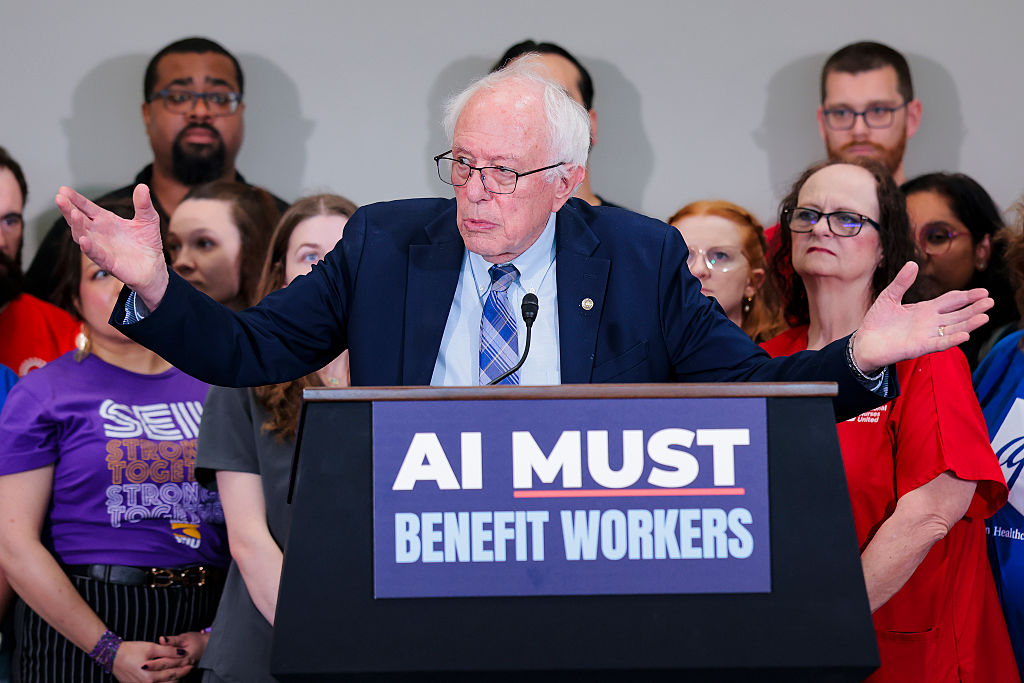
The simplest and fairest way to resolve this conundrum is to harmonize these conflicting interests through establishing the popular direction of AI firms. Not surprisingly, Sanders himself has introduced a bill that would require the largest AI companies to transfer 50 percent of their stock into a public fund. The American AI Sovereign Wealth Fund would function much like those set up by Norway and Alaska for their oil and gas reserves. Because natural resources like oil and gas do not owe their value to the ingenuity of any given company or individual, their value as such is rightly seen as common property. With AI it is just the same, except for the fact that the technology’s value derives from our collective work as human beings. Shouldn’t it be governed collectively, and its benefits distributed as such?
Despite what critics may claim, this isn’t a proposal for a handout — quite the opposite. Instead of charity, the public ownership of AI represents an effort at reclaiming, for social ends, wealth that was socially created. Along the way we just might be able to right the economic wrongs of knowledge-economy mismanagement writ large. A yawning wage gap has grown between the non-college-educated working class and that of college-educated workers who have broadly benefited from the technologizing of our economy. As AI developments now threaten the wage premium of college-educated workers, much the same way that free trade and the China Shock eroded the wages of industrial workers, we face a new crisis. In this way, AI — the apotheosis of the knowledge economy — could provide a road out of the total domination of our domestic politics by high finance and Big Tech.
As exploding public debt endangers domestic social policies, democratic leaders must begin to think again of ways toward social renewal that will provide the state and its citizens with independent means to achieve social ends. If the bubble bursts this time, the response must be one that aims to correct, rather than exacerbate, the balance of power between capital and labor. Wealth that is generated by AI-related developments can then be reinvested in socially regenerative programs: infrastructure to renew the built environment, funding for primary and secondary education, investments in new energy production, advanced manufacturing, social services, and more.
Public ownership of AI, then, is not just a moral way to address the coming jobs and social crisis but could be a transformational attempt at retooling the economy in the public interest. In that respect, the oligarchs are right to be afraid.