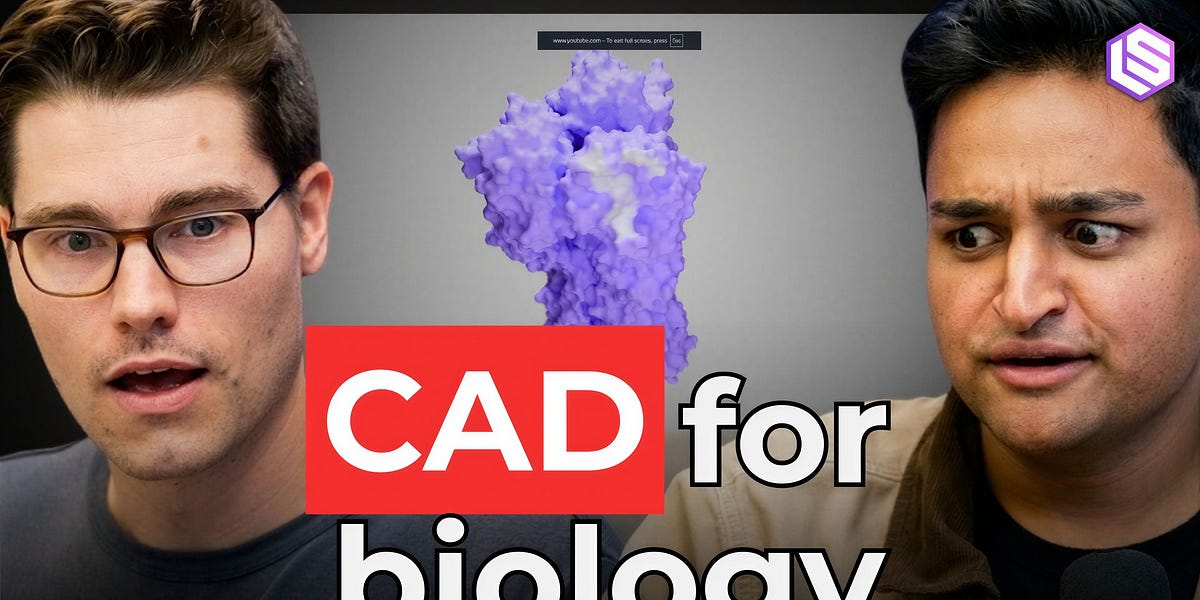
This January, four big AI × Pharma tools deals were announced at the huge JPM Pharma conference that takes over San Francisco every year. OpenAI-backed Chai Discovery (now worth $4B) was somehow at the heart despite being all of 2 years old.
The Science team is proud to bring you the first podcast with cofounder Matt McPartlon and product lead Neil Patil to tell the full story!
Editor’s note: not to be confused with[Chai AI], which was another top pod of ours.
Pharma suddenly doing big AI tools deals #
For the non-pharma people, JPM is JP Morgan’s annual conference for pharma deal-making that takes over San Francisco for a week in January with hundreds of side events, etc. It’s a big thing. Tools deals for pharma are also a big (new) thing: companies that start as AI for Pharma usually end up building their own drug pipelines instead, and the reason is something like this: convincing pharma to use your tool requires proof that your tool works. Proof means good targets, maybe with good clinical validation. If you have that, then it’s easier to raise money (with a known, if long path to commercialization) or sell (e.g payment in biobucks1) for a specific target than it is to sell to lots of companies on a promise that it will work across their portfolios.
The “we’ll just partner / build our own drug” optionality proved to be the only good path up until January. What changed? In short, the tools got good enough for drug design teams to trust.
Good-enough-to-trust unlocks the ability to scale discovery: get more, better candidates into the lab and animal trials faster. More screening for toxicity, better delivery, etc. This means that what you push to the clinic is more likely to succeed.
Tools also unlock new capabilities: mechanisms that are very hard or impossible to develop using lab-based discovery. Designing an antibody that precisely triggers a very specific molecular cascade takes many years of trial and error. Designing bi-specific antibodies (that bind to two different proteins) is similarly difficult. Good design tools can unlock this.
RJ:The fact that the quality of the model has jumped means you’re enabling things you just plain couldn’t do. So it’s a step change. It’s not an efficiency argument at all, or not so much.
Matt:Yeah, exactly. It’s kind of interesting, even for us — it took me a while to believe in the thesis, actually. I talked to Josh for months before Chai started... It’s like, can I beat a mouse, and then can I do what mice can’t do? And then how many levels of interaction can you just keep building on top of that?
Everyone playing in the structural / binding space has an angle here, and some will be better than others, but Chai is pointing to a different unlock: getting good molecules right out of the gate (meaning they don’t then need as much lab work) means that the iteration time is faster. This turns science into engineering: you can design your systems to reduce friction and hill climb towards one-shotting molecules all the way to the clinic.
This, per-se, is not a new thesis: a16z articulated a version of this in 2020. What has changed is that structural models became binding models (how well doesn’t this molecule bind to this molecule, aka “binding affinity). Binding models unlock design, which has been steadily improving. Chai’s observation is that for engineering problems the best product tends to win, and good technology is a necessary but not sufficient condition.
Photoshop for molecules2 #
With that in mind Chai has invested heavily in partnerships that allow them to learn from their Pharma counterparts.
What is kind of cool about working so closely and supporting so many of these partners is we get to really learn about what is the stuff that would be helpful in research. So rather than doing research in a vacuum, based on what would hypothetically be cool, we're able to do informed research based on what our partners have just been organically asking us for help with.
— Neil Patil, (Chai product lead) This means better UX, such as a molecule editor that is more like a CAD or graphics design program than a chatbot.
Their approach has paid off: since June, Chai has announced three more major deals: Lilly, Novartis, argenx, plus an expansion of their Eli Lily program. This episode is too full of quotable moments for a short blog, so tune in to learn about
Why protein tokens have the highest downstream value of any token
Climbing levels of abstraction as models improve
How Pharma, VC, and research are all just portfolio optimization
How better tech changes the whole portfolio
How relentless focus on simplicity leads to scale
Plus much more!
1 "Biobucks" is deal-value for milestone-heavy licensing agreements — the headline number (e.g., "$1.7B deal") is almost entirely contingent on hitting targets. Typically only 2–5% of the total is upfront; the rest pays out only if the drug clears each gate, and most drugs don't.
2 I actually think SolidWorks is a better analogy, but PhotoShop has better brand recognition ¯_(ツ)_/¯