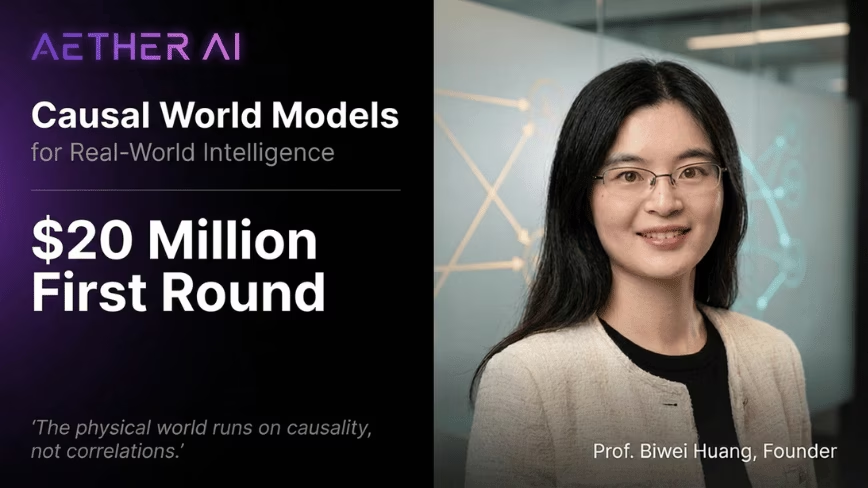
Most of the AI industry is betting that bigger models mean smarter machines. A new startup is betting the opposite.
Aether AI, based in San Diego, has raised a $20mn seed round to chase a different idea entirely. Its founder thinks the next leap will not come from scale. It will come from teaching machines cause and effect.
Correlation versus causation #
Today’s big models learn by spotting patterns in huge piles of data. That works well in the lab. But it can wobble in the messy real world, where a statistical shortcut quietly fails.
Aether wants machines to grasp the mechanisms behind events instead. Its “causal world models” are meant to let a system reason about what would happen if it acted, before it acts. The company says this makes AI more reliable and far less data-hungry. The thesis sits squarely in the wider debate over whether AI’s progress is starting to stall.
Why robots first #
The first target is physical AI and robotics. The logic is neat. Every move a robot makes is an intervention in the world, so errors show up at once as dropped objects or failed tasks.
That makes robotics a brutal test for causal reasoning. Aether’s long-term goal is a single “causal brain” that could steer many kinds of robots. It is a crowded ambition, with everyone from Google DeepMind’s world models to Jeff Bezos’s $10bn physical-AI lab chasing the same prize.
A serious pedigree #
The founder gives the bet credibility. Biwei Huang is an assistant professor at UC San Diego and a known name in causal discovery. She created the open-source tools Causal-Learn and Causal-Copilot, and has published widely at the field’s top venues.
Aether also invokes the founders of modern causality, naming Judea Pearl, Bernhard Schölkopf and others as supporters of its work. The round was led by MPCi, with Inno Angel Fund, SWC Global and Unity Ventures joining.
Why it matters #
Causality is one of AI’s oldest unsolved problems, and turning it into a product is hard. So the caveats matter. Aether’s early results are its own, not peer-reviewed, and $20mn is small against the billions pouring into rival labs. Its backers are mostly Asia-based funds, not the usual Silicon Valley names.
Still, the idea lands at a useful moment. Doubts about pure scaling are growing, and robots keep stumbling on tasks that look simple to humans. If causal models really do cut the data needed and improve reliability, they would matter well beyond robotics. That is a big “if”. But it is the kind of bet worth watching.
Get the TNW newsletter #
Get the most important tech news in your inbox each week.