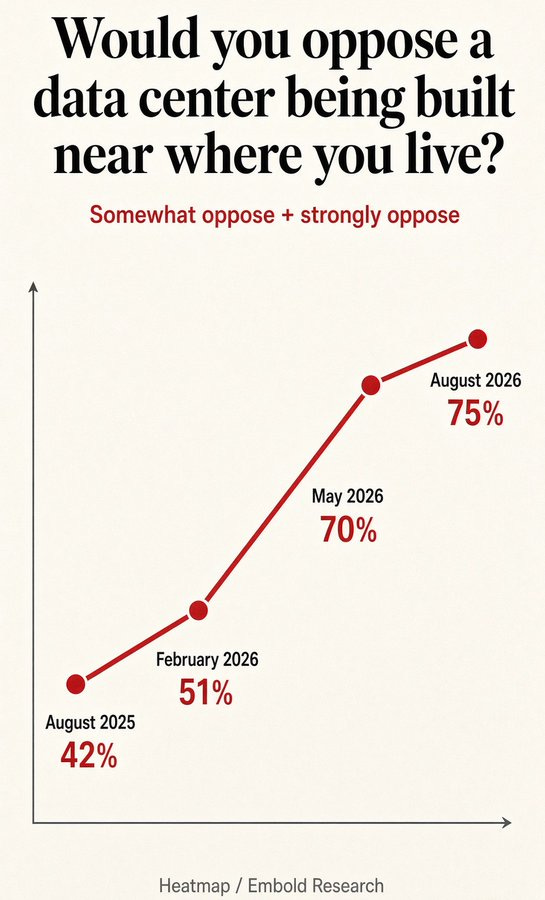
There are at least five different core questions around data centers and their politics.
- In what ways are specific concerns people raise about data centers legitimate?
- In what ways are specific concerns people raise about generative AI legitimate?
- Is it in general a good idea to build more data centers?
- How can we get America to build more (or less) data centers in a better way?
- Why do the American people increasingly really, really hate data centers?
This post focuses on question five, the latest in a series of such posts most famously Jasmine Sun’s road trip. It is mostly not about the first four questions.
Table of Contents
The American People Really Hate Data Centers.Transmission Lines Are The Control Group.Thesis: People Mostly Dislike Data Centers Because They Dislike and Distrust AI, Tech Companies, Big Money And Building Things.No It’s Mostly Not the Messaging About AI In General.No This Mostly Isn’t An Op.No This Isn’t Luxury Belief or Moral Panic.A Lot Of People Really Do Want To Stop AI.A Lot Of Other People Are Voting No On Tech Or The Man Generally.Locals Feel Entitled To Heavily Tax The Gains From Construction.Stupid Mistakes Like NDAs Don’t Help.People Don’t Like Building or Building New Tech.What About The Real Physical Concerns?Find A Place To Center Your Data.
The American People Really Hate Data Centers
Support for data centers keeps cratering. Americans really, really hate data centers, and 75% oppose local data center development, despite the economic benefits.
Cremieux illustrates that this opposition mostly does not get solved via arguments about the tangible benefits or costs of data centers. People don’t believe you, and even when they do believe you they don’t care because that wasn’t their true objection. Persuasion buys you a few percent support, but from new very high levels of opposition.
This clearly is mostly not about the physical impact on the community, given that this level of support is now well below that of a coal plant, which is bad enough that it substantially increases the surrounding death rate.
Transmission Lines Are The Control Group
Transmission lines are straight up good, with approximately zero downsides.
Transmission lines polling remarkably close to coal plants, when the coal plants actively not only cook the planet but poison the people around them, is crazy. This one absolutely is straight up moral panic.
When we see widespread opposition to transmission lines, and politicians shamelessly jumping on board, you know that a lot of this is simply about building anything new, of any kind, anywhere, especially anything that vaguely seems like it supports our technological infrastructure. And that people will invent phantom concerns, in order to have that not happen or to try and extract concessions or both.
Thesis: People Mostly Dislike Data Centers Because They Dislike and Distrust AI, Tech Companies, Big Money And Building Things
This is my central model.
Building data centers combines:
- AI.
- Big tech.
- Other people having data, especially on you.
- Big money.
- Building things, especially ugly things.
- Not offering that many jobs.
People dislike and distrust these six things. So they hate data centers.
They are also being asked to accept abstract arguments over concrete concerns, the reverse of the situation regarding things like existential risks.
The rest, as they say, is commentary. It is what people latch onto.
They mostly dislike these things for reasons that are wrong in their details, but highly understandable.
Why is opposition rising so quickly? What changed over the last year?
My answer is, mostly bandwagon effects, preference cascades and a rise in salience, combined with AI becoming vastly more visible and starting to impact the world including the job market, combined with a push to build vastly more data centers, which is forcing companies to push into communities that are less receptive.
No It’s Mostly Not the Messaging About AI In General
Many often try to pin the blame for people disliking and distrusting AI on botched messaging. They say the heads of the AI labs should have more often lied. Those CEOs should not have said that their products would take away people’s jobs, and definitely should have said that the product wouldn’t kill everyone, say these folks.
Those same people blaming everything on bad marketing, of course, mostly also think the claims that they say are terrible marketing were intended as marketing. They think everything is marketing. That everything is vibes. That reality doesn’t matter.
They are wrong. People very much are noticing things about underlying reality, especially locally as it impacts them and people they know. They are using empiricism and first principles reasoning, and picking up vibes from each other. It is possible to intentionally steer this process with the right words, but it is a lot harder than it looks.
This is because they don’t like AI, and also ‘I don’t like the Computer Man,’ and also they don’t like The Man.
- They fear for their jobs because it is sensible to fear for your job given what AI can clearly do, and how people are planning for and reacting to AI.
- They fear that humanity will be usurped or wiped out because that is an obvious thing to worry about when building smarter artificial minds, as illustrated by every story and thought experiment about such minds ever, without any need to get into the more detailed and technical reasons for worry.
- They fear their culture and things they care about will be wiped out, because they’ve seen it before and can see it happening again in real time in some ways.
- They fear that big tech and big money are full of false promises and there will be a catch, because of the entire history of everything, as one would observe from the average person’s point of view. They don’t know economics, and never have. They do notice that in many cases communities allowing such construction look like they’re getting screwed out of their ‘fair share’ although in some cases not.
- They fear building and care about relative position. They are not abundance libertarians.
People’s concerns about tech are often coming from very basic places, you know?
[PoIiMath]: I believe that data center opposition is not so much about AI and more about the fact that your grandma doesn’t understand 2FA authentication or that you need a mobile phone to pay for downtown parking.
That level of concern seems right, but young people oppose data centers more than old ones, so it mostly isn’t about lack of tech proficiency.
I do not think that the CEO messaging around AI much mattered. No one knows who Dario Amodei is or what he is saying. They might know who Sam Altman is, but they are forming impressions based mostly on other things.
Thus, shots like this from Senator Murphy are good lines but I don’t think people ‘just’ believe them. People don’t just.
Senator Chris Murphy: I don’t know…the AI industry has been basically promising to destroy jobs at scale and poison our kids with addictive products and it feels like people are just believing them.
The messaging on various levels definitely hasn’t helped, and I do think that messaging on data centers in particular is bad and is making things worse, but even then it is not the main thing.
I don’t want to go beyond scope, addressing this is a distinct post I plan to write soon, but in brief the ‘the fears are all marketing’ theory is Obvious Nonsense. The whole point is that this is beyond terrible as marketing, yet they say it anyway. So even if you (highly reasonably) do not trust these labs or CEOs at all, the reason they say these things is that they believe them, and in these instances they are trying to be helpful. To the extent that they did tell us, this is to their credit.
Whereas to the extent they stopped and lied due to marketing concerns, and especially to the extent they give false reassurances, that is to their discredit.
Yet people keep trying to frame this as about the message, rather than the facts.
[Daniel]: The anti-datacenter movement is literally the most rational response imaginable to an industry whose leaders have publicly said the best case scenario for their product is to get everyone fired. If you can’t see this then your brain is in late stage tech rot.
[Michael Druggan]: The best case scenario is everyone gets fired because automation creates such abundance that we can all live in luxury and no one will have to work.
That is an extremely good best case scenario.
[Daniel]: Say that to a group of people with a keen sense of societal power dynamics and a knowledge that their labor is the only card they hold in this world
[PoIiMath]: Yes yes, getting fired creates abundance. Tell that to the 170,000 tech workers who were fired this year due to AI. They are all just swimming in abundance.
Druggan here is being even more terrible than usual in terms of how he pitches this, but the pitch is not the problem.
No This Mostly Isn’t An Op
Logic like this is not good in general, or here in particular:
[Paul Graham]: If the Chinese government were sufficiently organized, they’d be funding opposition to data centers in the US. But the Chinese government is very organized. So they presumably already are.
The Chinese government makes active dumb mistakes all the time, the same as every other government and large group and also individual, no matter how well organized. That’s to say nothing of the vast errors of omission. The argument that your rivals or enemies are taking advantage of their best opportunities, or must be taking advantage of all the good opportunities you happened to notice, is basically never correct outside of compact literal games.
The world is not a rationalfic, where suddenly one person starts acting optimally. That’s a special brand of fiction for a reason, it changes everything, and even then it’s, like, one dude.
I also would not, if I was China, be funding the movement against data centers, because the money isn’t needed and the downside of being seen doing this is too high.
No This Isn’t Luxury Belief or Moral Panic
I absolutely believe that luxury beliefs and moral panics are common.
But centrally, that isn’t what is going on here.
[Sam Lyman]: “Ban data centers!” is the “Defund the police!” of the current moral panic. It’s a luxury belief policy idea that, if actually implemented, would have disastrous downstream consequences for the country. Love them or hate them, the entire global economy runs on these bad boys.
[Garry Tan]: Hate to say it but the luxury belief industrial complex is alive and well
[Erik Telford]: I posted this [about water use concerns being fake] and many people are telling me “I don’t use AI and I don’t want it” …like they don’t realize that unless they divorce themselves from participation in the economy, their daily lives are supported by AI in countless ways.
People understand that data centers power AI. That is why they are against it.
They understand that AI is ‘good for the economy.’ They don’t care about an abstract economy. They care about their experiences, locally, and they fear for their futures.
A luxury belief is when you are wilfully blind to the downsides, but use those beliefs as signaling and to seek positional goods. I don’t think either half is true here.
A moral panic is when people have an unjustified and disproportionate fixation on the dangers of something, especially something that doesn’t exist or is extremely rare, that one would look back upon as rather silly.
Water use by data centers, in particular, is a classic moral panic, but that’s a symptom, the same way that an endless stream of sexual or religious moral panics are a symptom, including today’s such panics.
Do these people understand the full economic, strategic or service implications if everyone were to ban data centers? No, but they’re not being wilfully blind to it, and often would be fine with it on reflection.
A Lot Of People Really Do Want To Stop AI
[dan]: the people in The Capitol have a poor mental model of the anti-ai crowd. you are reading them at the wrong level.
… they know the actually correct target and they’re going to burn it down. you’re going to have to build them in space and on boats and in maximum security, self-sovereign, self-defended untouchable regions
then you’ll have the AI, and they won’t
—
maybe we should reflect for a moment and listen to what the people are trying to tell us?
[Judd Rosenblatt]: Pretty interesting pov on anti-data-center people:“like for all the poor reasoning, they actually got it right on the one thing that could choke it off… this speaks to some pre-reasoning intuition”
A Lot Of Other People Are Voting No On Tech Or The Man Generally
The way democracy and public action work is typically kind of blunt.
If they’re unhappy with how things are going, they tell you no. Throw the bums out, oppose the things The Man wants or that Big Tech wants, and so on. It’s not so much about evaluating detailed consequentialist arguments. As I said before, concerns about tech often come from very basic places. [Zac Hill]: I think the data center fight is at best tangentially about AI, for a few reasons. First of all, that same Gallup report I just cited about how 70% of Americans oppose data center buildouts suggests at maximum 41% of that opposition is driven by AI-related concerns, with only 14% pertaining directly to negative views about AI itself.
I don’t think people know why they’re opposed, and would caution against such a breakdown.
I do get the argument that AI is not a salient issue outside of data centers, while data centers are highly salient. I think that is because the data center is a physical thing you can hope to act against or do something about, which makes it salient, and this is largely fueled by people being against AI, plus that combines with the other aspects.
Similarly, Zac Hill points in the same post to a past outcry over a 1965 proposal for a ‘National Data Center.’
[Zac Hill]: The privacy scholar Arthur R. Miller supplied the line that explains the last sixty years of this unease better than anything published in the last sixty days. The National Data Center proposals were, he observed, a “lightning rod for the vague feelings of discontent generated by the computer revolution.”
Right. Computers themselves never directly faced that kind of lightning rod or fury. Whereas a central collection with an ominous name, as the embodiment of the thing that was otherwise low salience. People suddenly felt like they had the ‘right to say no.’ This extended to other sources of data elsewhere.
The other parallel here is people being uneasy, basically on general principles, about data collection and storage and use. That was driving the opposition back then, and this paranoia remains. People often freak out to a seemingly absurd degree about their particular data being used to train an AI, or it being on some server, or whatever.
That’s not something you can hope to answer. If you’re the embodiment of amorphous fears, your popularity profile will be kind of cooked, and nothing you say is trusted.
Locals Feel Entitled To Heavily Tax The Gains From Construction
Locals feel like if they aren’t the primary beneficiaries, or at least don’t get heavily bribed and treated as key stakeholders, they are being cheated, and are now worse off.
This need to pay so much extortion money is coming as a surprise to many.
A lot of this is The Copenhagen Interpretation of Ethics. Once you are building, they see you as interacting with the community, and as The Man you are better off than they are, thus you are blameworthy for everything, including for ‘not doing more.’
This is true even if objectively they are better off than before. They often don’t care, or don’t trust and don’t believe you, or are now thinking about relative wealth levels even more than they were before, not absolute levels. Part of this is that they expect to be screwed over in various ways in the future, so they need compensation for all that.
This is especially bad for data centers because they don’t sufficiently ‘create jobs’ directly. You could of course use the money to ‘create jobs.’
Early data center efforts often served communities well, but also often didn’t, and locals have noticed that they’re not getting the kinds of consideration they feel they deserve, whether or not you think they deserve it.
In other cases the results are fantastic, such as much higher tax revenues, but locals basically don’t believe in that until they see money in the bank.
Remember that they expect to be screwed over, and promises not kept.
Also, they don’t really ‘believe in money’ or that money is fungible, and don’t always want the tax to be in money, as in:
[PoliMath]: A tech company will spend $10 billion building a data center outside of a Wisconsin town but they won’t sponsor a little league team. They won’t support the local Girl Scouts. They won’t build a park.
Actually, they do this. Meta and Google have such programs. Meta has such a program at Mount Pleasant. They don’t do as much per dollar or square foot as local businesses, but that’s an impossible standard.
This is the kind of thing people say when they’d already decided you were The Outgroup, the kind of thing you say to someone you’re rejecting for entirely unrelated reasons. There is always some local detail you did not do. If you sponsor a team they say you weren’t in the parade. If you were in the parade they complain about you not building a park, even though that doesn’t actually make any sense. Or that you did these things wrong, in a done deaf way. Or they just move on to something else entirely.
When you read Jasmine Sun’s accounts it’s always pure ‘what do I think of this building and proposal.’ The real messaging issues with data centers came while trying to build the data centers, and from politicians, and also the broad history of what locals see as broken promises from elites.
This is the unavoidable politics. It is being played badly, or alternatively it is being played well from a selfish local standpoint in ways that poison the well down the line. But a lot of that is that the situation is tough.
If what they want are broad, deep, sustained, detailed costly signals of ‘respect’ then that is super expensive to deliver, they’re not going to get that. If you want to tax people you need to set a tax rate. [PoliMath]: Flipping the script, there can’t be any form of compromise if the data center opposition can’t even tell us what changes they would accept in exchange for permission to build. If what they really want is to be treated with respect, they might not get that. Respect might simply not be on the table.If that’s the case, they will end up in a place where they don’t get the respect but they also don’t get the fringe benefits of boosted tax revenues.
One would assume what happens is the data centers end up in the places that know to ask for money, and those places end up with a lot of money.
[PoliMath]: To their credit, many in the tech community are trying to figure out what will work. To their detriment, most of these strategies assume that their opponents are stupid and that we can just deftly out-maneuver them with money and power and the fact that they are oh so much smarter than those flyover hicks. Which is exactly the attitude that makes negotiations pointless.
The thing about ‘we can outmaneuver these people with power and money’ is that, as much as it pisses off the flyover folks, it’s mostly true most of the time. We are potentially approaching a notably rare exception.
Stupid Mistakes Like NDAs Don’t Help
Other times, it is unforced errors, like making government officials sign NDAs, which makes people think there is corruption involved.
But also there is a tendency to blame the thing people latch onto to get mad about as having been stupid, when the real cause is the suspicion that makes them latch onto every little suspicious thing. The NDA is only a problem because you lost trust.
People Don’t Like Building or Building New Tech
We have a huge YIMBY problem even for things like houses.
[Matthew Yglesias]: It’s unsurprising that people have turned against data centers in a world where it’s illegal to build midrise apartments — or in many cases even just single family homes on small lots — on the most in-demand parcels of land.
We also have a history of people opposing moonshot projects, and yes I do also mean that literally. We can forget that the Apollo Project was not popular at the time.
What I don’t think this has that much to do with, yet, as much as it pains me, are the existential risks. I do think it is a contributing factor, but not as big as it should be.
[Cassie Pritchard]: Even the people who are building AI (who hope to build AGI/ASI/RSI) keep saying “yeah there’s a 5-40% chance it kills everyone.”That’s not the same proposition as the Apollo Project. People are entirely rational to want democratic input/a slowdown/a /a ban.
It’s not only Apollo, where people saw it as a waste of money, ‘whitey on the moon’ and all that. This also happened to excellent pitches.
[Seth Burn]: Light at night was a pretty good sales pitch. An algorithm will put you out of a job (and might end all life on Earth) might need a little work.
[nicole ruiz]: in 1937 the federal government ran poster campaigns to convince rural Americans electricity was a good idea. people were protesting the towers. @mattyj612 and I talked about what those fights say about the data center backlash.
Electrification is about as obviously good as it gets. Whereas today locals often oppose even things like wind farms even if the national theoretical numbers there look solid, don’t want to be ‘bribed’ to accept them or other projects, and are much easier to get to oppose things via argument than convinced to support them.
In terms of tech impacts, think more about how people see the Internet, despite it being essentially the greatest thing ever.
Cassie Pritchard: The internet comparison is also apt but in the way of justifying hesitancy; the buildout of internet infrastructure and Big Tech happened largely without democratic input or oversight. It remains a very under-regulated sector, and it has led to both a myriad of negative social externalities that people perceive every day (colonization of attention, social isolation, erosion of privacy, polarization/loss of social cohesion, etc) and a massive concentration of wealth/power in very few firms with relatively few employees.
It’s entirely reasonable that the industry which transformed the world rapidly (and which people have ambivalent feelings about) without popular input is now prompting people to think “hey, maybe let’s not give them a blank check again to build the Replace Every Human Machine.”
I do think the Replace Every Human Machine aspect is doing a lot of work, but more in the I Do Mean The Impact On Jobs sense.
What About The Real Physical Concerns?
There are real concerns about electricity, aesthetics, noise and property values, and mostly not real but concrete physical concerns about other things like water. The water claims in particular are notoriously resistant to pointing out they are false.
A lot of the ‘real’ concerns are factually misplaced, or much smaller deals than people act like they are. They have arisen and been emphasized because of the bad vibes and track records. When you read how people talk about them the concerns do not typically make logical sense.
People want to oppose, they assume there is a catch, so they latch onto reasons.
Whether real or not, whether motivated or not, those should be directly addressed. In some cases addressing them means pointing out that the concern is not real.
In other cases a real fix is needed. Electricity prices will need to be locked in. Aesthetics and noise are skill issues. Property values may need to be made whole, whether or not that seems justified, perhaps via put options. And so on.
Not that any of these things is going to much matter.
[Jasmine Sun]:My conversations make me wonder if the technical content of data center deals is mostly beside the point.Closed-loop cooling systems? “I don’t believe them.” Paying millions in taxes? “I don’t believe them.” Creating a thousand jobs? “I don’t believe them.” I hear a reflexive skepticism of every claim.
I won’t go into the details more here, as that too would be a distinct post.
Find A Place To Center Your Data
This post was meant to be descriptive. I don’t have a great solution to propose.
I am very much in the ‘more data centers in America would be good’ camp, because chips are highly economically valuable, the physical concerns are highly solvable when they’re not outright fake, and if we don’t put the chips here then someone will have to put them somewhere else. That would be worse.
To the extent this opposition is successfully forcing chips overseas, it is very bad. One can route around the places that say no, but only up to a point. Lack of domestic placement has been used to justify putting massive numbers of chips in places like the UAE and KSA. That is way worse. It is not hard to imagine a world in which that bites us very hard, up to and including existentially.
There are those I respect who are very worried about existential risk from AI and see that dynamic differently, and think the anti-data center movement is a good thing and want to support it. I get why, but I believe that they are wrong even on their own terms, because I think the dynamics of shutting down construction within America would shift construction elsewhere rather than reducing it overall.
Solving these issues will not be easy. It is a lot easier to not lose trust and not trigger such a panic in the first place, than it is to repair the damage once it happens. The politics could easily turn into a runaway train here.
But there are also a lot of marginal ways to make progress on the logistics or the politics, a lot of which are low-hanging fruit. We shall see.