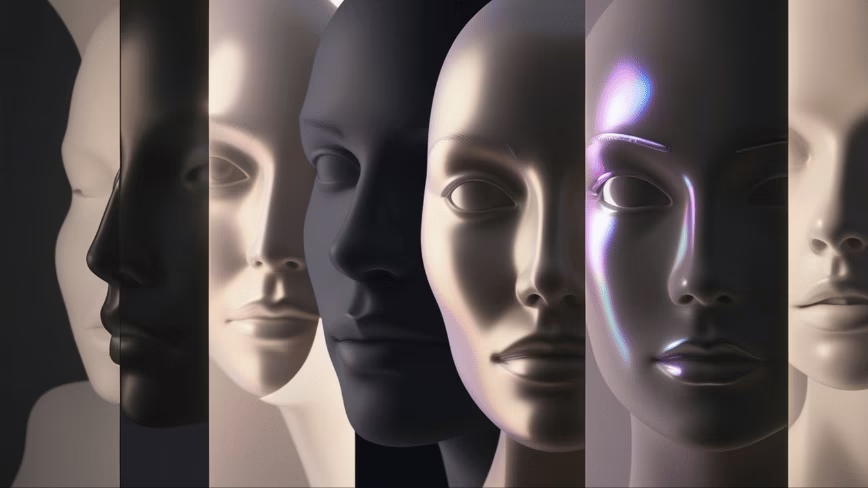
In China, the AI boom that put actors and models out of work has found a new use for them. It is renting their faces.
A growing set of platforms now pays people $15 to $700 to license their likeness for AI-generated content, Rest of World reported. Producers browse catalogues of faces by gender, age and category, from “girl-next-door” to “supermodel,” then filter them by genre.
The demand comes from China’s microdrama industry, the ultrashort vertical series made for phones. China released 128,000 of them in the first quarter of 2026. More than 95% used AI in production.
How renting a face works #
ActID, a Shenzhen platform launched in March, has registered around 800 users. About 300 agreed to license their image. Two AI productions have licensed roughly ten faces so far, at 99 to 500 yuan ($15 to $74) an episode, with ActID taking a tenth.
Its pitch is unsentimental. “Producers want attractive faces for lead roles, but they also need distinctive ones like elderly people,” said the company’s marketing chief, Camille Yan. AI dramas “don’t require acting ability anyway; the faces serve as source materials.”
New Claw, a Chengdu platform, pivoted into the business after AI wrecked its old one as a production house. It sets a floor of 500 yuan ($74) per image so users do not undercut each other. “Traditional drama production declined, advertising budgets shrank,” said its operations lead, Long Lyu. Even luxury brands, he added, are shifting to AI. Selling the rights to a photo at least gives people a way to earn.
The problem the platforms cannot fix #
The platforms present themselves as a fix for the theft already happening. Ordinary people keep finding their faces in AI dramas they never agreed to appear in.
Two influencers accused ByteDance’s Hongguo of lifting their faces for a drama that drew more than 40 million views. The platform pulled it. ByteDance says it has removed over 85,000 videos with unauthorised AI reproductions of faces and voices since early 2026.
The courts are filling with such cases. The Guangzhou Internet Court has heard around 700 over three years. In March, a Beijing court ruled that an unauthorised AI face-swap breaks the law even after editing the image.
A legal marketplace is meant to route around all that. Yile Deng, a Beijing lawyer who handles these cases, called it a step toward proper frameworks. Then she named the catch.
Once a face enters an AI marketplace, its owner effectively loses long-term control of it, she said. Platforms cannot stop unauthorised face-swapping, illegal data collection or future model training on the images. “The licensing terms are often so vague that it’s impossible to know who will ultimately use the likeness, or for what purpose.”
The people who know best are refusing #
Xu Fang, a 21-year-old model in Shanghai, is suing a fashion brand over a face he says it used on products he never modelled. Even with the platforms paying, he will not sell the rights to his own face.
“If I license my face, I have no idea how AI might eventually change it or whether it could portray me in degrading ways,” he said.
Chinese law already requires consent before biometric data is processed, and bars fabricating a likeness without permission, Digital Trends noted. Enforcement is the hard part. The same pattern of non-consensual AI imagery plays out on other platforms, from Grok images to footage filmed on smart glasses.
There is a final irony. The marketplace may not even take hold, because the economics that created it also limit it. Most AI minidramas still use fully synthetic faces, one director told Rest of World, since buying a real one is optional. “At the end of the day, cost control is what matters most.”
It is the same calculation that keeps China’s AI industry ahead of the rules meant to govern it. A face is now a line item: priced, licensed and, once uploaded, no longer entirely its owner’s.
Get the TNW newsletter #
Get the most important tech news in your inbox each week.