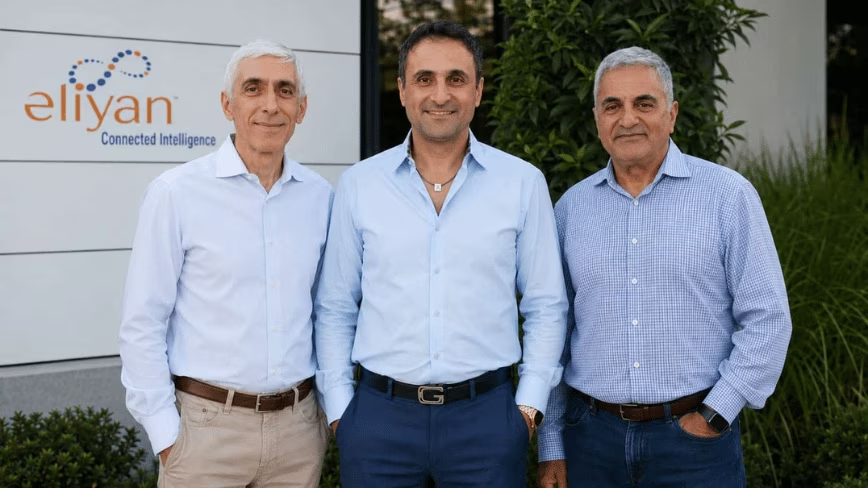
For three years, the AI race has been a race for faster chips. Eliyan just became a $1bn company by pointing out that the chips are now too fast for their own wires. The Santa Clara startup said it closed an oversubscribed $145m Series C at a $1bn valuation, making it a unicorn, the company announced. Seligman Ventures led the round. Two strategic investors joined, Cisco Investments and Lumentum.
The bottleneck moved #
Modern AI accelerators can crunch numbers far faster than they can be fed. So they sit idle, waiting for data. Eliyan’s chief executive Ramin Farjadrad put a number on it to Reuters: “Today we are at the point that we are maybe 30-40% of the GPUs is being used, and is being mainly limited by how fast they can receive the data to process. We’re solving that problem.”
Eliyan sells the plumbing, not the compute. Its NuLink links and NuGear chiplets shuttle data between chips, between packages, and across racks. The pitch is simple. Faster, lower-power connections let a data centre’s expensive silicon run closer to full tilt.
An independent alternative to the giants #
The biggest players already solved this in-house. Nvidia bought the networking firm Mellanox for $6.8bn in 2019, and has since turned that into its own interconnect lock-in. Google and Amazon lean on Broadcom and Marvell instead.
Eliyan wants to be the neutral option, licensing its technology and selling chiplets to anyone building their own AI chips. That is why its share register reads like a customer list. Earlier rounds drew AMD, Arm, Meta, Intel, Micron, Samsung and SK hynix. The new money adds Cisco and Lumentum, both from the optical world.
From electrical to optical #
The two new backers point to where Eliyan is heading. It made its name in electrical links between dies, using standard packaging rather than pricier silicon interposers. Now it is pushing into optical interconnects, the light-based links that hyperscalers increasingly need to move data between racks without burning huge amounts of power.
The founders framed the raise as a bet on a deeper shift. “AI infrastructure is undergoing one of the largest architectural transitions in computing history,” Farjadrad said. “As compute, memory, packaging, and networking become increasingly interconnected, traditional approaches to system connectivity are reaching their limits. Eliyan was founded to address these challenges at the architectural level.”
What the money buys #
The cash will fund development, ecosystem partnerships and manufacturing. Eliyan expects to start shipping chiplets this year, and told Reuters it forecasts hundreds of millions of dollars in sales by the end of 2027, up from “low millions” in 2025. It holds more than 100 patents.
Investors are paying up for the unglamorous part of the stack. Umesh Padval of Seligman Ventures, who sat on Mellanox’s board when Nvidia bought it, is joining Eliyan’s board. He argues the connections now decide the winners.
“As AI systems continue to scale, efficient electrical and optical interconnects that enable future scale-up and scale-out networks between compute and memory are becoming the performance-defining technologies of modern AI data centers. Eliyan has developed a differentiated architecture to address this challenge, combining deep semiconductor expertise and a scalable approach to the evolving needs of next-generation AI systems.”
He is not alone in the bet. In March, the optical-interconnect startup Ayar Labs raised $500m at a $3.75bn valuation. The memory and chip suppliers now on Eliyan’s cap table have a direct stake in the same idea. As AI systems grow from single chips into rack-sized machines, the wires between the chips may command as much attention as the chips themselves.
Get the TNW newsletter #
Get the most important tech news in your inbox each week.