The Study · Economics
Last week we paid $99 for an AI ad tool’s Pro plan and pointed its flagship feature, an agent that clones a competitor’s ad with your product in it, at a real listing. The agent worked for close to an hour. It planned, it scraped, it rendered scene by scene, and it assembled a 40-second ad we would genuinely run after a trim. Then we opened the transaction log.
The run had consumed 173 credits, more than half the month’s 300-credit allowance, spent half a credit at a time for the thinking and several credits at a time for the scene renders behind it. At the Pro rate that is about $57 for one ad. A tightly scoped revision, swap the presenter and change nothing else, cost another 43 credits, about $14. Nothing in the interface shows you a total before you commit. The agent spends as it goes, and you find out afterward, in the log, the way you find out about a hotel minibar.
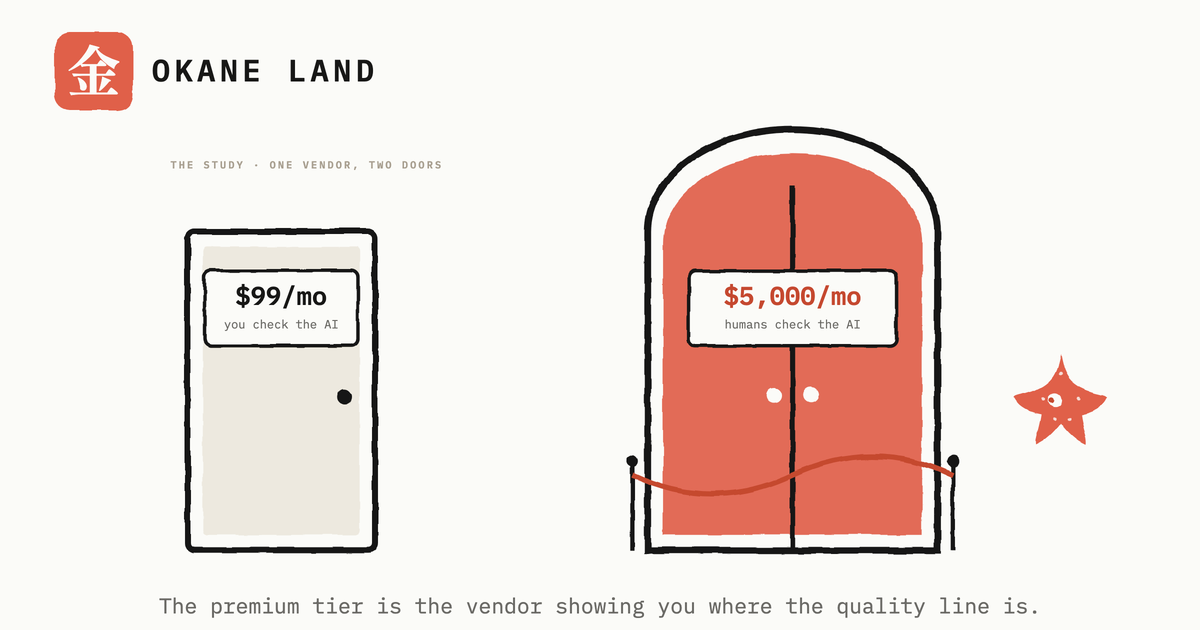
The log gave up two more things the marketing does not mention. The line items carry Anthropic tool-call IDs: the agent doing the cloning is Claude with a toolbelt. And sitting above the whole self-serve product, on the vendor’s own pricing page, is a tier called Studio: humans making your videos for $100 to $200 each, from $5,000 a month, promising, in the vendor’s own words, human QA on every asset and zero hallucinations.
Read that pricing page the way you would read a company’s org chart. The company that sells AI-generated ads prices the removal of AI mistakes as its premium product. We think that one line is the most useful signal in the entire category.
The short version #
Four things the meter taught us, portable to any AI tool you rent:
Agent autonomy multiplies the bill. Templates and the flagship agent share one meter and land 100-to-1 apart, because a loop pays for its plans, retries, and rejected drafts.The $5,000 tier is the vendor pricing its own trust gap. Fifty times the software, for the same output with a human check on it.Derive the real cost from the log. Push a single job through and divide the credits burned into the plan price; a vendor with no legible log has told you something too.The cheap tier bills your attention too. Review hours, retries, and the risk of shipping a bad take ride on top of the meter before any comparison witha $185 human videoholds.
The full meter reading is below.
The receipts, briefly #
The full teardown lives in our hands-on Creatify review, so here is just the arithmetic that matters. The same subscription that sells the $57 agent run also sells four finished static ads for 2 credits, about 66 cents, and a 15-second avatar video for 5 credits, about $1.65. Those cheap tools are excellent, and they are what the subscription is actually for.
So one product, one meter, and a 100-to-1 spread in what a deliverable costs depending on how much autonomy you hand the machine. The statics are a template with a model inside. The agent is a loop: plan, act, check, retry, spend. Every step of that loop is a metered model call, and some of the steps are full video generations that exist only so the agent can look at them and decide they were not good enough. You pay for its drafts the way you would pay for a junior editor’s, except the junior editor does not bill you per thought.
That is what agent economics look like everywhere once you meter them, and Creatify is just where we metered it, and we say that as a publication that has run the same math on wrapped LLM products from the seller’s side. Autonomy is a multiplier on inference, and inference is the cost of goods. A vendor can hide that behind a subscription for exactly as long as you do not use the flagship feature.
The tell, and how to read it #
Here is the part worth generalizing. When a vendor sells you an AI product at $99 and a human-checked version of the same product at $5,000, the vendor has published a number for something they will never put in a benchmark chart: the price of trusting their own AI’s output, unsupervised, with your brand on it.
That number is fifty times the software.
You can call that hypocrisy if you want a cheap headline. We think it is candor, and unusually precise candor. Every AI tool has a quality line somewhere: the point past which the output needs a human eye before it ships. Most vendors leave you to find that line yourself, in production, with your customers watching. A vendor with a human tier has drawn the line for you and taped a price to it. The $5,000 is the vendor’s own estimate of what the last mile of reliability is worth, sold to the customers who can least afford to gamble on it.
Once you start looking for this shape, it is everywhere in the 101 tools we track in the price index. Relevance AI, an agent-platform darling, deleted its self-serve tiers outright this month; the pricing page is now a single enterprise card and a sales call, which is another way of saying the product ships with mandatory humans now. The support-bot vendors price per resolved ticket, which quietly prices the unresolved ones back onto your team. The pattern repeats because the economics repeat: the model is cheap, the loop is expensive, and the guarantee is the only thing that commands a margin.
What this means if you are the buyer #
Three rules fall straight out of the receipts.
Budget agents like productions. A subscription price tells you what the templates cost. It tells you nothing about the flagship agent, which spends per attempt, retries included, with no quote up front. Before you point an agent at anything, find the transaction log, run one job end to end, and derive the real per-deliverable number the way we did: total credits burned, divided into the plan price. If the vendor does not expose a log granular enough to do that, that is your answer about the vendor.
Price your own eyeballs into the self-serve tier. At $99, you are the QA department. That is fine, and often still a bargain, but it is a real labor line on your side of the ledger. The true comparison against a human contractor is never $57 versus $185. It is $57 plus your review time, your retries, and your risk of shipping the take with the mangled product claim, versus a human’s invoice that has all of that priced in. We ran that comparison for the whole ad category in the AI UGC ad math, and the punchline is the same: the clip is the cheapest line on the bill.
Use the human tier as a spec sheet. The distance between a vendor’s AI price and their human price measures exactly how much supervision the vendor believes their own output needs. A small gap says the output mostly ships. A 50x gap says the output mostly needs an editor, and the vendor knows it. Either way, the vendor has done your risk assessment for you and published it. Very few industries are this legible. Read the number and plan your workflow around it: cheap tools for volume, your own judgement on everything that ships, and the agent reserved for the jobs where an hour of machine time genuinely replaces a day of yours.
The part that is genuinely good news #
None of this is an argument against the tools. We gave the tool in question a worth-it verdict and meant it: fed one product listing and $99, it returned a month of usable creative, and the cheap end of its menu embarrasses what agencies charged for statics two years ago. The argument is about reading pricing pages the way vendors write them.
An industry that sells its own error correction as a premium tier is an industry telling you, in dollars, exactly where the technology stands. The models write the words and render the frames. The margin lives in the checking. For anyone building or buying in 2026, that is the map: the closer your use case sits to the guarantee, the more the humans still cost, whoever employs them.
The vendors already did this math. The $5,000 is them showing their work. We suggest reading it.
One email, when there's something worth sending
Get the research in your inbox. #
No fixed schedule, no filler. You get an email when we've tested something, run the numbers, or found a tool worth your time.
Free. Double opt-in, unsubscribe in one click.
Got numbers of your own? Compare notes in the forum ↗
Sources & how we researched this #
- Okane Land (2026), Creatify hands-on review: one month on the Pro plan, full transaction log. okaneland.com/proof/creatify
- Creatify (2026), official pricing page: free, Starter $39, Pro $99/300 credits, Studio from $5,000/mo. creatify.ai/pricing
- Okane Land (2026), AI tool price index: 101 tools, vendor-verified, dated. okaneland.com/palette/ai-tool-price-index
- Relevance AI (2026), pricing page as of 2026-07-07: self-serve tiers removed, enterprise sales only. relevanceai.com
- Intercom Fin (2026), pricing: $0.99 per resolution, the per-outcome support-bot model. fin.ai/pricing
- Okane Land (2026), the AI UGC ad math: $2 a video, and the bill nobody prices in. okaneland.com/study/ai-ugc-ad-economics