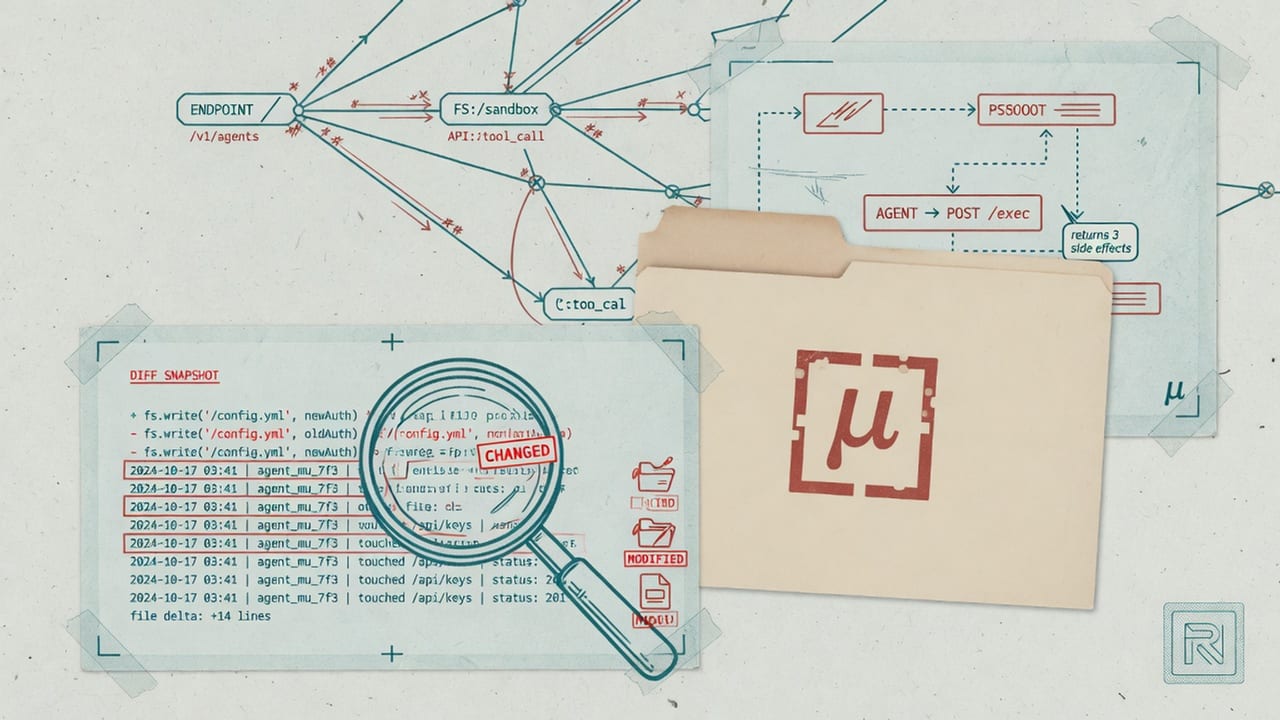
TestMu AI, founded by Asad Khan, Jay Singh and Mayank Bhola, has launched Agent Assurance, extending its software-testing platform to AI agents that can alter files, call tools, access APIs and open pull requests.
The new product evaluates the observable effects of an agent's work. TestMu AI says it reads an agent's codebase, generates functional, nonfunctional and adversarial scenarios, runs the agent and checks the resulting files, artifacts and tool calls. That moves the test away from an agent's final answer or self-reported activity and toward the systems it actually touched.
For Khan, the launch carries TestMu AI deeper into the field where he began his career. TestMu AI's biography says he worked as a lead engineer at GlobalLogic before co-founding 360logica, a software-testing services business later acquired by Saksoft. Khan and Singh started LambdaTest in 2017 as a cloud service for running web and mobile tests across different browsers, operating systems and devices. Bhola, TestMu AI's co-founder and head of products, previously held product and engineering roles at Zomato, PressPlay TV and Juggernaut Books. Singh brought the sales and customer side, having previously founded BusinessMojos and VisualMojos and held roles at LeadSquared and Harman International.
That mix explains the direction of the product. TestMu AI is applying familiar quality-assurance practices, including regression tests, smoke tests, CI gates and evidence retention, to agents whose behavior can change between runs and whose failures can reach beyond a chat window.
A third verdict for what the system cannot verify
The most useful part of Agent Assurance may be its treatment of missing evidence.
TestMu AI's launch materials assign validation criteria one of three outcomes: Pass, Fail or Unable to Verify, and describe the unverified portion of the results as an assurance gap. That gap is excluded from the pass rate and can be reduced by making agents more observable.
That distinction matters because an agent can appear successful while leaving little proof of what happened. A test harness may see the final response without being able to establish whether the correct file changed, the approved API was called or an undeclared tool was used. Marking a criterion Unable to Verify keeps that uncertainty visible rather than treating it as a pass.
"The story an agent tells about what it did is the weakest evidence available about its actions," Vipul Verma, TestMu AI's senior vice president of group engineering, said in the launch announcement.
An Unable to Verify result also sets a limit on TestMu AI's claim. It shows that the testing system lacked enough evidence to confirm a criterion. It does not establish that an agent is safe in production, and TestMu AI has not published independent results connecting its validation outcomes to fewer security incidents or operational failures. Stronger evidence will have to come from tests against agents operating across real corporate systems.
From requirements to the CI pipeline
TestMu AI's documented agent-testing workflow starts with an agent API endpoint and requirement materials such as prompts, product requirement documents, knowledge bases, PDFs or DOCX files. The platform uses those materials to generate test scenarios. The launch announcement says teams can invoke an agent through a command, HTTP endpoint, MCP server or a workflow built on a platform such as n8n.
The generated scenarios include prompt injection, instruction overrides and tool misuse by default, according to the announcement. TestMu AI also says its reports distinguish newly failing, newly fixed and flaky scenarios. The launch release says its CI commands distinguish an agent failure from an environment failure.
This is a deliberate move into territory already served by evaluation and observability products. LangSmith, for example, supports pre-deployment and production evaluations, regression testing and assessments of agent trajectories and tool calls.
TestMu AI's proposed distinction is the evidence layer. The launch announcement says Agent Assurance checks files, artifacts and tool calls against the agent's declared tool interface, while its product materials flag validation criteria it cannot confirm. Those claims currently rest on TestMu AI's product materials; the launch includes no customer case study, comparative test or independent audit of the autonomous-agent system.
LambdaTest's rebrand starts to earn its name
Agent Assurance follows LambdaTest's rebrand as TestMu AI on January 12. The rename promised a shift from browser and device testing toward an AI-native quality platform where agents plan, write, execute and analyze tests.
The founders financed that expansion before the rebrand. In December 2024, LambdaTest raised $38 million in a round led by Avataar Venture Partners, with Qualcomm Ventures and existing investors participating. Singh told Moneycontrol that the capital would fund engineering and research for the AI product line. Earlier backers named by TestMu AI include Peak XV, Premji Invest, Blume Ventures and Titanium Ventures.
The original cross-browser service gave the company an installed base for the next act. TestMu AI says it has more than 3 million users globally. That company-reported figure covers the broader platform and does not establish adoption of Agent Assurance.
TestMu AI says its conversational-agent category is available for chat, voice, telephone, images and video. Its video-agent testing product places a simulated person into a live video session and ties each verdict to the relevant moment in the recording. The launch announcement says autonomous-agent testing runs from a terminal tool called Rook, with models operating through TestMu AI's controller so developers do not need local provider keys.
The founders are betting that the testing layer they built for browsers and mobile devices can become a control point for software that acts on its own. Agent Assurance gives that bet a credible organizing idea: passing criteria should carry observable evidence, while criteria the system cannot confirm should remain plainly marked. The difficult work begins when teams point it at agents capable of changing real corporate systems.