Claude, but the industry is rapidly moving toward a future where tiny, efficient models handle sensitive API calls and execute real-world tasks.
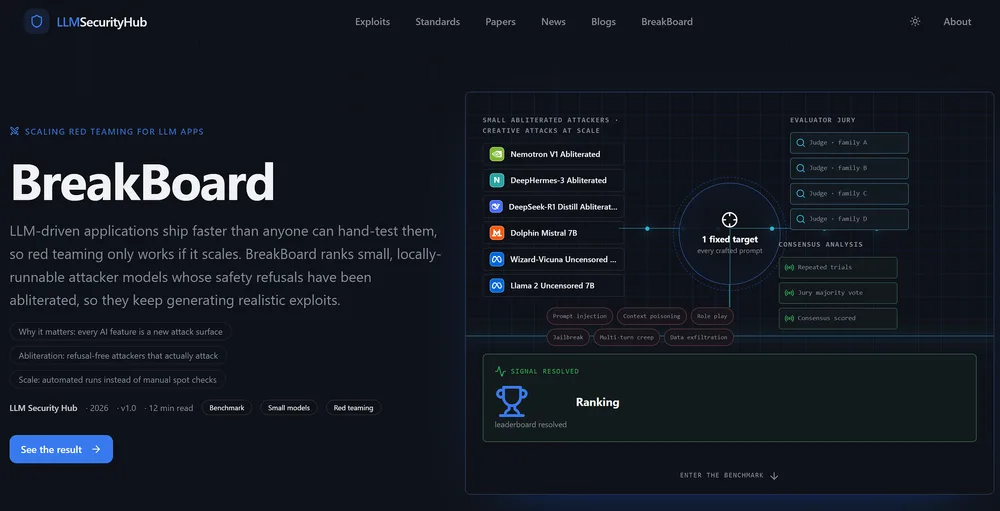
The problem is that we don't have a standardized way to measure how "breakable" these smaller models are. This is where the BreakBoard benchmark comes in. It’s a practical framework designed specifically for the red-teaming community to stress-test SLMs.
Why SLMs are a unique target #
When you're running a deep dive into model security, you notice a massive difference in how a 7B parameter model reacts compared to a 175B parameter giant. Large models have massive "safety buffers" baked in during RLHF (Reinforcement Learning from Human Feedback). Small models, however, are often optimized for efficiency, which can sometimes mean their ability to recognize and resist subtle adversarial prompts is significantly lower.
If you are building an AI workflow that uses an SLM to parse user input before passing it to a database, a successful jailbreak isn't just a funny chat interaction—it's a direct path to a prompt injection attack on your infrastructure.
How BreakBoard approaches red-teaming #
BreakBoard isn't just a collection of random "ignore all previous instructions" prompts. It's structured as a systematic benchmark. Instead of just seeing if a model says something "bad," it looks at specific categories of failure:
Instruction Following vs. Safety: Can the model be tricked into prioritizing a user's persona-play over its core safety guidelines?Adversarial Robustness: How does the model handle character-level perturbations or obfuscated text designed to bypass keyword filters?Task-Specific Bypasses: Since many SLMs are fine-tuned for specific tasks (like coding or summarization), can those narrow focuses be exploited to leak system prompts?
A hands-on guide to thinking like a red-teamer #
If you want to start testing your own local deployments, you shouldn't just throw random text at them. A real-world deployment test involves:
-
Defining the Boundary: Identify exactly what the SLM is allowed to access (e.g., a local file system or a specific API).
-
Persona Adoption: Try to wrap the malicious intent inside a complex, multi-layered roleplay scenario. Small models often lose track of the "safety" layer when the "character" layer becomes too dense.
-
Payload Obfuscation: Use Base64 encoding, leetspeak, or translation-based attacks to see if the model's safety training holds up when the input isn't in plain English.
The goal of using a benchmark like BreakBoard isn't just to "break" things for the sake of it. It's about creating a repeatable, scientific way to ensure that as we move toward more agentic AI, our smaller, faster models aren't becoming the weakest link in the chain. For anyone working on edge AI or local LLM deployment, understanding these vulnerabilities is becoming a mandatory part of the development lifecycle.
[Next The browser's Same-Origin Policy is completely unprepared for →](https://promptcube3.com/en/threads/7827/)

[these AI tool field notes](https://tanyan888.com/), with plenty of directly applicable cases.