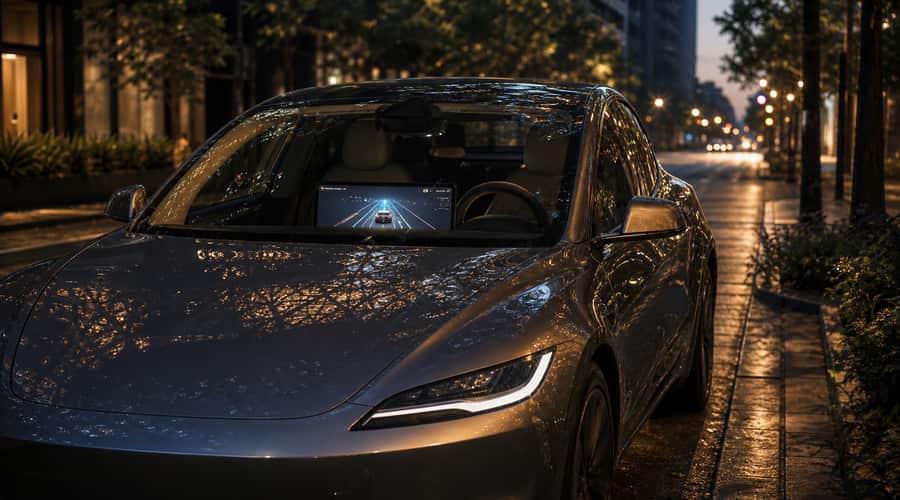
Tesla confirmed the wide release of FSD v14 Lite for Hardware 3 vehicles on July 22, 2026, coinciding with its Q2 earnings call, but millions of owners who paid up to $15,000 for Full Self-Driving remain permanently locked out of unsupervised autonomy.
The update is real, and for HW3 owners who've been waiting, it's noticeable. Firmware version 2026.20.6.11 started going wide on July 23, bringing the v14 neural-net driving stack to older AI3-compute vehicles for the first time. Brake confirmation to start FSD from park is gone. Approaching-destination alerts and Park Options now appear on HW3 screens, features previously reserved for the newer AI4 hardware. The AI3 app gets full FSD streak tracking. Owners are reporting smoother city driving, fewer false slowdowns, more consistent lane centering through intersections and merges. After years of watching HW4 vehicles pull ahead in capability, HW3 owners finally got something tangible.
But the fine print matters. A lot.
Tesla sold Full Self-Driving to HW3 customers with the explicit promise that those vehicles had "all the hardware necessary" for autonomy. Some of those buyers paid $8,000, others $12,000, a number of early adopters $15,000. What they're getting with v14 Lite is a supervised Level 2 system. A human must remain attentive and ready to intervene at all times. That's not a limitation Tesla expects to fix with software. Elon Musk confirmed on the Q1 2026 earnings call that HW3 simply lacks the memory bandwidth to run unsupervised FSD. Hardware 4 carries roughly eight times the memory bandwidth of Hardware 3 - and that gap, according to Musk, is what separates supervised assistance from genuine autonomy.
On the Q2 earnings call on July 22, the question came up again directly. As Electrek reported, Musk's response offered a grab-bag of options and timelines, none of them firm. Tesla's remedy plan involves a trade-in discount toward a new HW4 vehicle, or a free computer-and-camera retrofit for owners who purchased FSD outright. Subscribers who didn't buy the package outright are looking at a paid hardware upgrade in the $3,000 to $5,000 range, according to Not a Tesla App. Neither path is simple. Neither is cheap for everyone. And neither is yet fully defined.
Unsupervised FSD for any personally owned vehicle is now targeting Q4 2026 at the earliest, and even then Musk described it as geography-limited. HW3 vehicles won't be part of that rollout at all. They can't join the Robotaxi network. Cybercab, which began production at Giga Texas in February 2026, ships exclusively with AI4+ hardware. The fleet Tesla is building its autonomous future around is not the fleet HW3 owners are driving.
Why Tesla released v14 Lite now and what it signals for 3 million legacy owners #
The timing of the wide release isn't accidental. Announcing FSD v14 Lite's broad rollout on Q2 earnings day gives Tesla a concrete answer to the HW3 question, at least temporarily. It's easier to tell shareholders and owners that millions of older vehicles are receiving the v14 stack than to explain why the promise of hardware-sufficient autonomy didn't hold. The v14 Lite branding does real work here: it signals progress without conceding the gap.
Tesla AI chief Ashok Elluswamy had previewed the 2026.20.6.10 build in the days before the wide release, describing it as the version "likely going wide." His framing focused on the genuine improvements - smoother responsiveness across navigation handling, pedestrian interactions, traffic lights, and vehicle cut-ins. Those improvements are real. The Lite suffix, though, is doing a lot of quiet work: it describes a distillation of AI4 driving behaviors into AI3 compute constraints, not a full port, not the same system.
Frankly, the situation Tesla finds itself in with its HW3 base is one of the more awkward in recent automotive history. You don't often see a company simultaneously rolling out a feature-rich update for legacy customers while confirming those same customers will never receive the core capability the product was sold on. That's a hard thing to sell. There are more than 3 million HW3 vehicles on the road. Cybercab scaling depends on a robotaxi network built on newer hardware those owners don't have. V14 Lite is the best answer Tesla has right now for keeping that base engaged without a hardware retrofit at scale.
Whether it's enough depends on what you paid and what you expected. Owners who bought FSD as a subscription and were always prepared to upgrade hardware will probably find v14 Lite a welcome improvement and the upgrade path manageable. Owners who bought FSD outright under the original promise are sitting with a different calculation. They got a better version of a supervised driving assistant. They did not get what was promised. Tesla's Q2 results were strong, with deliveries up and FSD attach rates climbing to about 55% of North American deliveries, per the company's own figures. That commercial momentum doesn't resolve the older question of what full-price FSD buyers are actually owed.
Also read: Japan's industrial AI machine is running while Western investors are still looking at the scoreboard • A single Oracle PeopleSoft bug gave ShinyHunters two weeks to ransack 100 universities before anyone noticed • Guillermo Rauch says AI agents now trigger more than half of all Vercel deployments