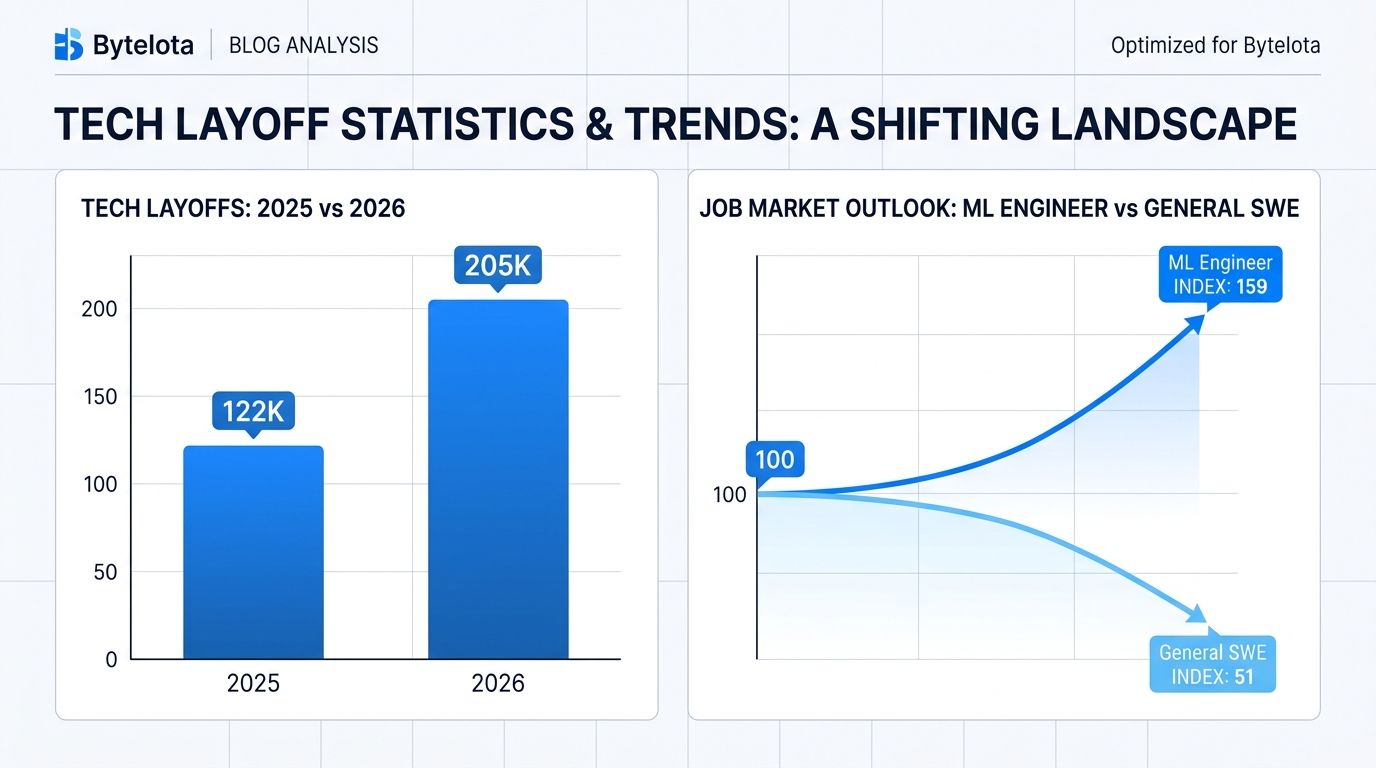
This month, the 2026 tech layoff count crossed 205,832 — surpassing every job cut made in all of 2025 with four months still to go. The pace is roughly 891 jobs lost every single day. Unlike the 2022 overcorrection, this wave has a specific driver: by spring 2026, 40% of layoff announcements explicitly cited AI automation as the reason for cuts. Executives are no longer hedging. The tech layoffs 2026 data now makes the shape of the profession’s transformation clear.
The Numbers — And What’s Driving Them #
The 2025 full-year total was 122,606 jobs across 278 companies. By August 6 of this year, 2026 had already crossed that figure. Layoffs.fyi now tracks 322 layoff events in 2026 — the fastest sustained pace since the 2022-2023 post-pandemic correction. Oracle made the largest single cut: 21,000-30,000 positions. Amazon followed with 16,000 reductions, Meta with 8,000, Microsoft with 4,800. Cisco, LinkedIn, and Salesforce all made significant cuts as well.
However, the mechanism matters. These companies are not struggling — they are redirecting capital. Amazon eliminated 16,000 mid-management and non-AI roles while committing $200 billion to AI infrastructure. Meta cut 10% of its workforce while funding $125-145 billion in AI and data center investment. According to analysis of 2026 layoff announcements, AI attribution jumped from 7% in early 2026 to 40% by spring. Companies are now willing to say it plainly: generative AI tools are handling work previously done by mid-level and junior engineers.
The Software Engineer Job Market Is Splitting in Two #
The most important signal in the current data is not the headline number — it is the bifurcation. According to Indeed Hiring Lab’s analysis, machine learning engineer job listings sit at an index of 159 relative to the February 2020 baseline, while general software engineering listings sit at 51. That is a three-to-one ratio between two tiers of the same profession. At the same time, AI/ML engineering roles globally exceed 500,000 open positions with a 63% talent shortage — roughly 3.4 open roles per qualified candidate. Current hiring data shows Google posting 62% more engineering roles in H1 2026 than H1 2025 — but those openings concentrate in AI infrastructure, ML platform engineering, and applied science.
The profession is not collapsing. It is splitting. Moreover, whether a developer lands on the growing side or the shrinking side of that divide is increasingly determined by a specific set of skills — not years of experience or seniority.
Related:[AI Made Devs 78% Faster. Teams Are Still Shipping Slow.]
Entry-Level Hit Hardest in 2026 SWE Market #
Junior developer job postings are down 40% from 2022. CS graduates in 2026 face a 6.1% unemployment rate despite broader market strength, and new grads now account for only 7% of Big Tech hires. Stanford HAI’s 2026 AI Index found entry-level software developer employment fell nearly 20% from its 2024 peak in a single year. The roles at highest displacement risk are those that have historically been starter jobs: junior frontend, QA and test automation, boilerplate backend work, and content moderation.
The career ladder used to look like this: entry-level role, then mid-level, then senior. That model assumed companies would hire junior engineers as a pipeline. Consequently, the current data suggests that pipeline is closing — not because companies are rejecting junior developers specifically, but because they are rejecting the category of tasks junior developers were hired to do.
What the 2026 Tech Layoff Data Says to Do #
Engineers with two or more AI skills earn 43% more than peers without them. LLM integration and RAG architecture generate 3-5x higher interview callback rates. Security engineering job postings are up 124% year-over-year. MLOps and model serving roles pay $200,000-$250,000 at the mid-level. Furthermore, the skills generating the most traction in 2026 — production-grade Python, cloud infrastructure at scale, AI tool proficiency with Cursor and GitHub Copilot — are learnable and not gated behind a graduate degree.
The 43% salary premium is not for AI researchers. It is for engineers who can ship AI features in production environments. There is a meaningful difference. Demand is for people who understand LLM APIs, can build and maintain RAG pipelines, know how to integrate AI into existing systems, and can reason about the operational concerns of running models at scale. Roles least exposed to displacement — staff and principal engineers, security engineers, infrastructure engineers with AI integration experience — share a common thread: they require judgment and cross-system context that current AI tools do not replicate well.
Key Takeaways #
- 2026 tech layoffs have already surpassed all of 2025 by August, with 205,832 jobs cut across 322 companies at a pace of 891 per day.
- 40% of 2026 layoff announcements now explicitly cite AI as the driver — up from 7% in January — signaling that automation-driven cuts are no longer being euphemized.
- The SWE market is bifurcating: ML engineer listings are indexed at 159 vs general SWE at 51 — a three-to-one gap that continues to widen.
- Entry-level is hit hardest: junior postings down 40%, CS grad unemployment at 6.1%, new grads only 7% of Big Tech hires.
- Engineers with two or more AI skills earn 43% more than peers without them; LLM integration and RAG experience generate 3-5x higher callback rates.