A coalition of public interest and consumer advocacy groups has urged the Federal Trade Commission (FTC) to investigate leading artificial intelligence (AI) developers over allegations of buying, scanning, and systematically destroying physical books to train large language models.
In a letter sent Friday to FTC Chairman Andrew Ferguson and Commissioner Mark Meador, organizations including the Demand Progress Education Fund, the Consumer Federation of America, and the Institute for Local Self-Reliance termed the industrial practice of “destructive scanning” as both anticompetitive and destructive to human history.
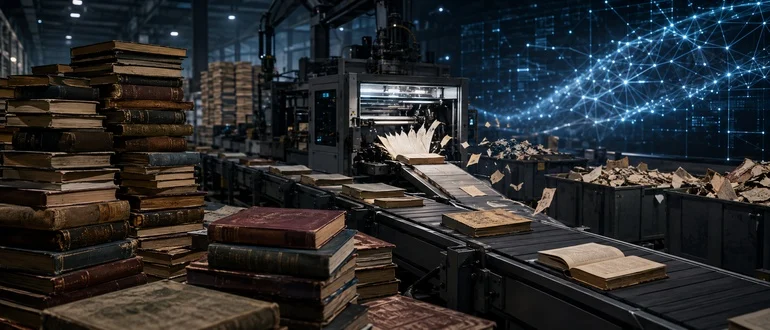
Advocacy groups allege that AI firms are acquiring physical books en masse through brokers, cutting open their spines to feed pages into high-speed automated scanners, and disposing of the remains. In multiple cases, the shredded volumes represent some of the last surviving physical copies of original works.
“Through their practice of permanently destroying books en masse and thus removing those nonrenewable resources from broader access, AI companies are engineering a future where only the wealthiest incumbents can build high-quality AI models,” the advocacy groups wrote, arguing the tactic violates Section 5 of the FTC Act.
The complaint comes amid heightened scrutiny of how AI developers source high-quality, pre-2022 human text to avoid “model collapse,” a technical phenomenon where AI systems degrade after being trained on internet data polluted by synthetic, AI-generated content.
Details of the industrial-scale processing emerged through unsealed filings in Bartz v. Anthropic PBC, a federal copyright lawsuit in California. Internal documents revealed Project Panama, an Anthropic initiative executed by former Google Books executive Tom Turvey, designed to “destructively scan all the books in the world.” Proposals disclosed in the litigation contemplated processing up to two million books in a six-month period.
While a federal judge ruled in 2025 that Anthropic’s use of legally purchased books did not violate copyright law under the first-sale doctrine, independent investigations reveal the practice extends across the tech sector. A report by digital outlet 404 Media tracked a 1,000-book order embedded with an Apple AirTag from an independent bookstore directly to an Amazon.com Inc. logistics facility in Las Vegas. Workers at the secured site described an assembly-line operation using hydraulic paper cutters to dismantle books before feeding them into digitizers. Similar indiscriminate, high-volume purchases have been reported by independent booksellers in Australia, Britain, and Ireland.
Literary historians and legal experts warn that converting physical books into corporate-controlled digital data poses severe long-term risks. Unlike physical volumes — which serve as permanent, immutable reference points — digital text controlled by private corporations can be silently altered, summarized, or deleted.
“A book that survives only as data controlled by someone else is not quite the same thing as a book that survives on a shelf,” critics noted, drawing parallels to Ray Bradbury’s “Fahrenheit 451.” The groups are calling on the FTC to determine the total volume of books destroyed so far and to identify how many unique, irreplaceable works have been lost permanently.