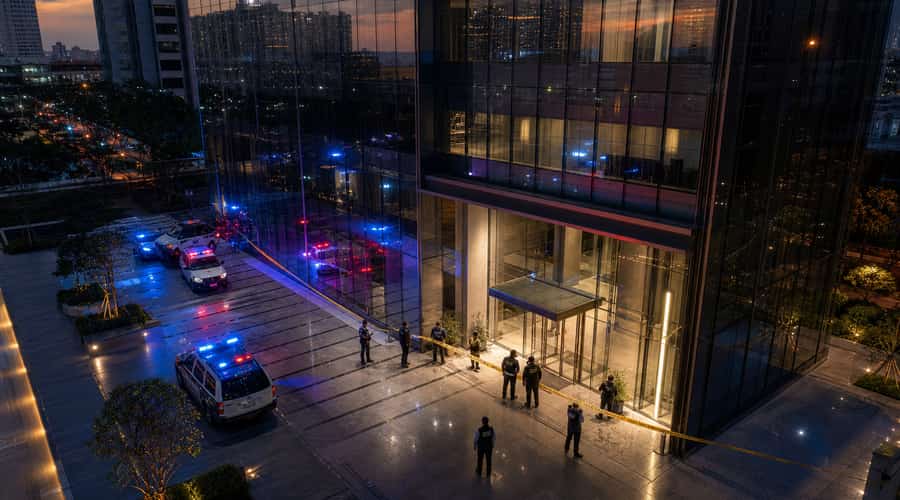
Taiwan's Nvidia chip smuggling case has not been shown, in public reporting, to include a detained Nvidia employee. The verified story is still serious: prosecutors have moved from forged export papers to raids on Super Micro and its Taiwan supply chain.
For months, Taiwan's probe into AI servers allegedly routed toward China looked like a distributor problem. Then it got closer to the manufacturers. Bloomberg reported that Taiwan's Keelung District Prosecutors Office widened the case on June 29 by searching homes and company sites tied to Super Micro Computer, Albatron Technology and Chief Telecom. That is not the same as a confirmed Nvidia employee detention. It matters, because you don't get to turn a supply-chain investigation into an Nvidia employee case unless the record supports it. The verified Taiwan case began in May, when prosecutors sought to detain three people accused of using false declarations for AI servers made by Super Micro. The servers contained Nvidia chips. Officials suspected shipments were being routed through Japan before ending up in Hong Kong, Macau or mainland China. That matters enormously. Washington has restricted exports of Nvidia's high-end AI hardware to China since 2022, so the paperwork was not a side issue. The paperwork was the route.
Local reporting cited by Vision Times said investigators seized about 50 AI servers and more than NT$9 million in cash during the first stage of the case. That is the kind of detail you should sit with. Fifty servers is not a stray package at a dock. It suggests planning, coordination and enough confidence in the paperwork trail to keep moving expensive machines through ports and warehouses.
The trail runs through Super Micro #
By late June, the inquiry had widened. Bloomberg reported that investigators searched the residences of six people and sites tied to three companies. Super Micro said it was cooperating with authorities. Albatron told the market it had been searched and said it did not expect a material operational or financial impact. Chief Telecom said its operations remained normal. Dry statements, yes. But dry statements are useful here, because they show which companies have publicly acknowledged the enforcement activity and which claims still need proof.
The US case gives the Taiwan investigation a sharper edge. On March 19, the Justice Department unsealed an indictment against Yih-Shyan "Wally" Liaw, Ruei-Tsang "Steven" Chang and Ting-Wei "Willy" Sun. Prosecutors alleged they conspired to divert roughly $2.5 billion worth of US-assembled servers with advanced AI technology to China between 2024 and 2025. The indictment described false documents, a Southeast Asian pass-through company and dummy servers staged to fool compliance checks.
That case is still alleged conduct. Say it plainly. Liaw and the other defendants are presumed innocent unless proven guilty, and Super Micro itself was not named as a defendant in the indictment. Super Micro said in a March statement filed with the SEC that Liaw was its senior vice president of business development and a board member, Chang was a Taiwan sales manager, and Sun was a contractor. The company said it placed the two employees on administrative leave and ended the contractor relationship.
Nvidia is in a different position. Its chips are the prize, but the public record does not show that Nvidia has been charged in the Taiwan or US cases. Jensen Huang did address the Taiwan matter in May. According to Bloomberg reporting carried by the Taipei Times, Huang told reporters in Taipei that Nvidia is "rigorous" in explaining regulations to partners and said he hoped Super Micro would improve compliance. "Ultimately Super Micro has to run their own company," he said.
That's a careful line. You can understand why Nvidia wants it. The company sells the hardware that every AI lab and cloud buyer wants, but it relies on server makers, distributors and resellers to move that hardware around the world. When prosecutors start finding false end-user documents and repackaged servers, the question for Nvidia is not whether it personally packed a box. The question is how much visibility any company can honestly claim once its chips leave the clean room and enter the channel.
Taiwan has a legal gap to close #
Taiwan's problem is also legal. Bloomberg reported in June that officials were considering stricter export controls to align more closely with Washington, because unauthorized exports of AI chips to China are not currently treated as a standalone crime under Taiwanese law. Prosecutors have leaned on document-forgery allegations instead. That can work for a case built on false paperwork, but it is a weak tool for a chip war.
Frankly, Taipei cannot stay in that halfway position for long. Taiwan sits at the center of the AI hardware economy, from chip manufacturing to server assembly and logistics. If its laws leave prosecutors chasing forged forms while the real strategic question is where restricted hardware ends up, smugglers will read that gap faster than lawmakers do.
So the real story is not a confirmed Nvidia employee detention. That claim does not check out in available public reporting. The real story is still big enough: Taiwan has moved from its first arrests in an AI chip diversion case to raids touching Super Micro's local network, while the Justice Department is already pursuing a separate multibillion-dollar server-smuggling indictment in New York. If you follow AI hardware, this is where compliance stops being paperwork and starts becoming a test of whether the supply chain can be controlled at all.
Also read: SpaceX is buying Cursor for $60 billion while the AI coding startup makes its boldest bet on India yet • How Claude Code and VS Code turned Anthropic from a safety lab into a developer phenomenon • China is giving its best AI models away free and that should worry OpenAI