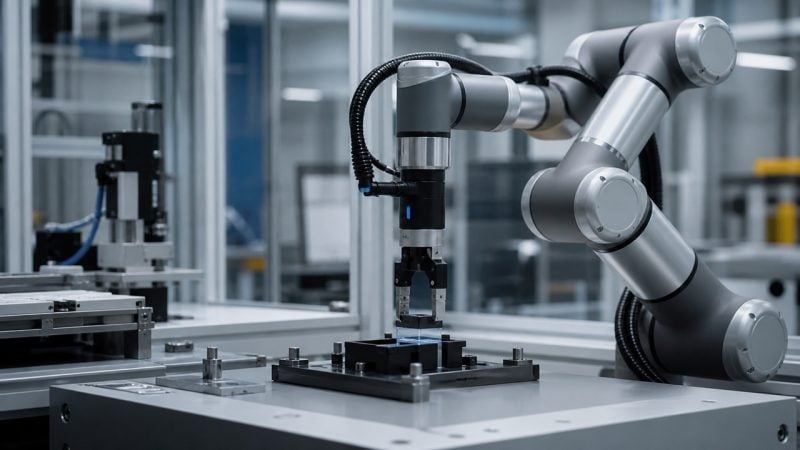
A closed-loop system from Chalmers University of Technology handles everything from hypothesis to interpretation, and it has already found something new in brewer's yeast
Researchers in Sweden have built an AI system that can run the full scientific method on its own. It forms a hypothesis, designs an experiment, runs it with robots, and interprets the results, all with minimal human input.
The test subject was humble: brewer’s yeast. The system still found a protective effect that human researchers had not previously noticed.
How the AI scientist works #
The work comes from Chalmers University of Technology, with collaborators from the University of Gothenburg. Affiliations also include the University of Cambridge.
The findings were published on September 30, 2026, in the Journal of the Royal Society Interface. Contributors include postdoctoral researcher Ievgeniia Tiukova, Professor Ross D. King, Daniel Brunnsåker and Alexander H. Gower.
The team describes the setup as a closed-loop system. It takes a reading, acts on it, checks what happened, and adjusts. Here, the readings are experimental results and the adjustments are new hypotheses.
The system pairs modern large language models with automated reasoning. The language models help generate ideas. The reasoning layer keeps those ideas tied to logic and existing evidence.
Underneath sits a large knowledge base. It draws on genomic data, metabolic data and prior research, adding up to approximately 60,000 interconnected relationships.
Once it picks a question, robots do the physical work. They grow yeast cultures and measure both growth and metabolites, the small molecules cells produce and consume. The AI then reads the data, updates what it knows and starts the loop again.
AI, tech, and the markets they move—in one daily briefing.
Daily. Free. Join 34,000+ readers across crypto, finance, and policy.
What it actually found #
The headline discovery involves a compound called aminoadipate and a stressor called formic acid.
Formic acid makes life hard for yeast. The AI found that aminoadipate helps protect yeast under that stress, improving growth by approximately 7% per millimolar.
This protective effect had gone unnoticed before. The system did not just confirm something humans already knew. It surfaced a relationship that was hiding in plain sight inside a very well-studied organism.
Building on Eve #
The new system builds on an existing platform called Eve, a robotic scientist. Eve already provided the lab automation backbone. The new work adds the AI layer that lets the loop run with far less human steering.
The project was partly supported by WASP, the Wallenberg AI, Autonomous Systems and Software Program.
Not a replacement for human scientists #
The researchers are clear that this tool is meant to augment human scientists, not replace them.
In their framing, humans still own three big jobs. They prioritize which research directions are worth pursuing. They handle the broader interpretation of what findings mean. And they deal with the ethical considerations that come with research.
What this means for labs and the research pipeline #
The researchers point to biology, medicine and biotechnology as fields that could benefit as labs become more autonomous.
The aminoadipate result illustrates one concrete advantage: a system working through approximately 60,000 known relationships can probe corners people tend to skip.
Disclosure: This article was edited by Diego Almada Lopez. For more information on how we create and review content, see our