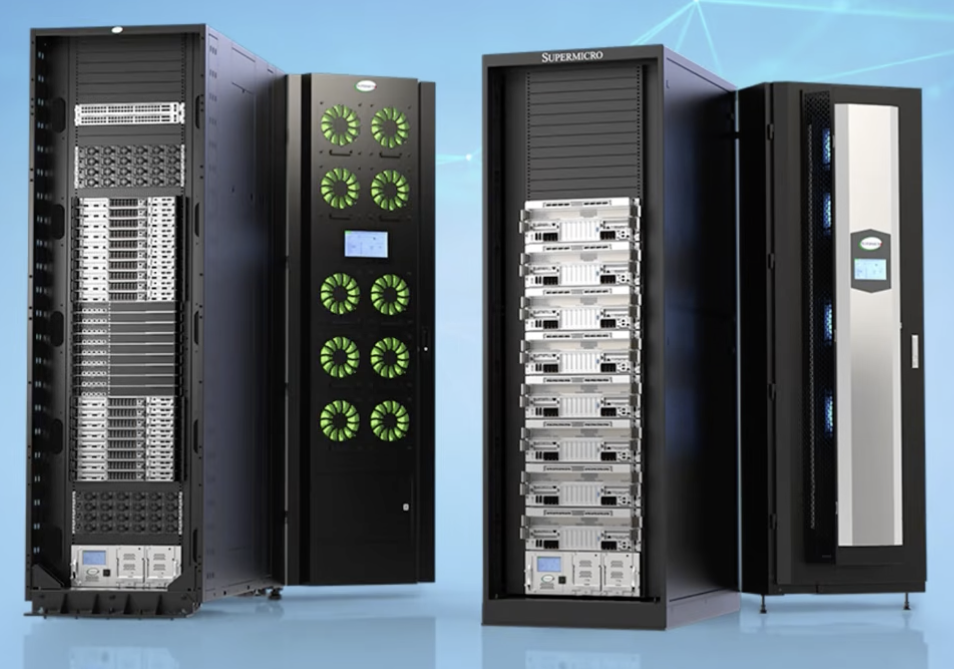
Supermicro has expanded its Data Center Building Block Solutions liquid cooling lineup with a ten-model Rear Door Heat Exchanger (RDHx) portfolio, spanning 10kW to 120kW of cooling capacity at the door level and up to 240kW at the rack level. The expanded portfolio is aimed at data center operators who need a fast, low-disruption path to liquid cooling, whether they are standing up new AI infrastructure or trying to squeeze denser racks into facilities that were never designed for them.
The doors mount to standard EIA, ORv3, and MGX racks and can serve as the primary liquid cooling solution or run alongside Supermicro’s direct-to-chip (D2C) cold plates as part of a complete DCBBS deployment. Because the doors neutralize exhaust heat at the rack, they also eliminate the need for dedicated hot- and cold-aisle containment, which is a meaningful chunk of most retrofit budgets. In its video summary, Supermicro says the lineup is sized for rack platforms spanning NVIDIA’s GB300 and B300 systems through Vera Rubin and AMD’s upcoming Helios, which explains the 240kW rack-level ceiling. Supermicro offers DC-powered models that tie into rack busbars and AC-powered models for broader infrastructure compatibility, with intelligent fan control, N+1 fan redundancy, and anti-condensation protection across the line. Monitoring runs through Redfish, SNMP, a web interface, or Supermicro’s SuperCloud Composer, and the doors can be deployed without dedicated facility chilled water, which removes one of the classic blockers for retrofits.
As with the rest of DCBBS, the doors can be delivered as part of a validated rack-scale package with accelerated systems, rack integration, facility power and cooling, management software, and deployment services, with the usual pitch of simplified procurement and reduced time-to-online.
Why Rear Doors, and Why They’re Back #
Rear door heat exchangers are among the older ideas in data center cooling, and the AI buildout has made them relevant all over again. IBM shipped the first commercial version in 2005 as the “Cool Blue” Rear Door Heat eXchanger, a passive, water-cooled coil that replaced a rack’s rear door and absorbed roughly 15kW, enough to neutralize more than half the heat from the densest racks of that era. The problem it solved then is the same one it solves now: once rack power climbs past what hot-aisle/cold-aisle air distribution can absorb, you either capture the heat at the rack or spend enormous energy chasing it around the room.
The mechanics are simple; server exhaust passes through a liquid-filled coil on its way out of the rack, transferring heat to the facility water loop before the air ever reaches the room. Passive doors rely on the servers’ own fans to push air through the coil; active designs like Supermicro’s add fan arrays to handle deeper coils and higher capacities. Because the heat never enters the data center, the room stays thermally neutral, which means no aisle containment gymnastics and far less load on AC units. Most importantly for operators with existing facilities, none of it requires touching the servers themselves, which is why rear doors have become the standard on-ramp to liquid cooling for retrofits.
In the AI era, rear doors have taken on a second job: finishing what direct-to-chip cooling starts. Cold plates on CPUs and GPUs typically capture 70 to 80% of a server’s heat into liquid, but the remainder, from memory, NICs, drives, and power supplies, still exits as hot air. Pairing D2C with a rear door catches that residual heat too, pushing all of the rack’s thermal output effectively into the facility loop where it can be rejected efficiently or, increasingly, reused. That is the same math Dell was chasing at Dell Technologies World last year with its PowerCool Enclosed Rear Door Heat Exchanger, a sealed-airflow design Dell claims captures 100% of IT heat while cutting cooling energy costs by up to 60%, part of a broader industry push we covered in [Liquid Cooling is Coming to Your Data Center: Supermicro’s approach is more modular than Dell’s enclosed door, but the destination is the same: get every possible watt of heat into water, because water is where heat becomes manageable, and potentially valuable, again.
Availability #
The expanded RDHx portfolio is available now as part of Supermicro’s DCBBS offerings, deployable from individual racks to full data center buildouts.