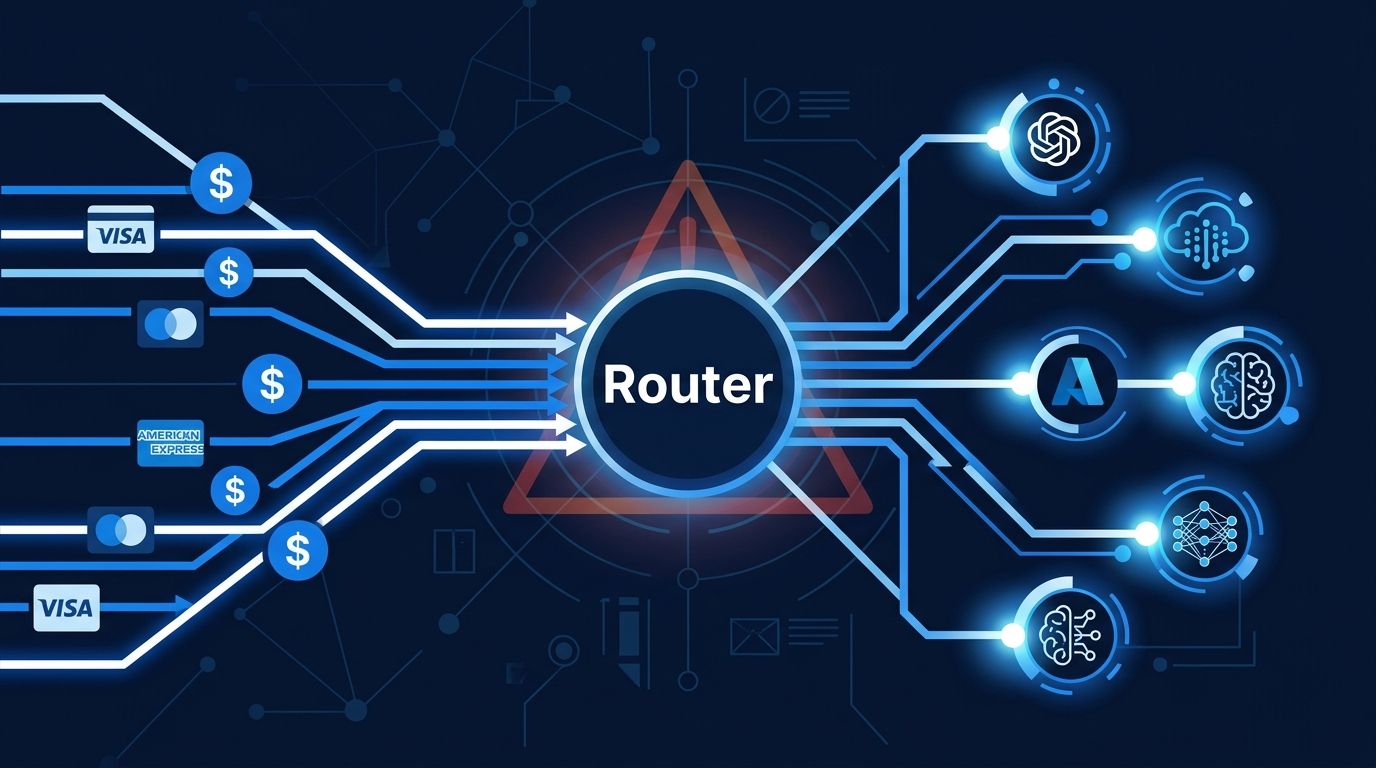
The API gateway that 8 million developers use to reach 400+ AI models just got bought by the company that already bills those model labs. Stripe agreed to acquire OpenRouter for more than $7 billion on August 19, 2026 — its largest acquisition ever. Your API keys still work. Your endpoints haven’t changed. The question worth asking is whether that lasts.
What OpenRouter Actually Does #
If you haven’t used it: OpenRouter is a single API endpoint that sits in front of 400-plus models from 80-plus providers. You swap in https://openrouter.ai/api/v1
as your base URL, use one key, and can call GPT-5.6, Claude Sonnet 4.6, Gemini 3.7 Flash, DeepSeek, or any of hundreds of others without touching the rest of your code. It routes 100 trillion tokens a month, growing at 9% per week. For developers building AI apps, it became the de facto neutral layer between you and the model labs.
That neutrality is exactly what’s now complicated.
Why Stripe Wants This #
Stripe already bills model labs. Through its Token Billing product (launched 2025), Stripe handles payment infrastructure for a significant chunk of the AI economy. Acquiring OpenRouter means Stripe now controls both sides of the transaction: the payments coming in from developers, and the routing deciding which model provider gets the spend.
At OpenRouter’s scale, even a marginal preference in the routing algorithm — route 2% more traffic to providers with better Stripe commercial relationships — translates to hundreds of millions in annual revenue advantage. That’s not a conspiracy theory, it’s arithmetic. The $7 billion acquisition price creates enormous pressure to find margin somewhere, and the 5.5% routing fee is not contractually fixed.
The Structural Conflict #
OpenRouter’s value was always that it didn’t care which model you picked. It routed on performance, cost, and availability — not commercial relationships. That’s why 8 million developers trusted it as a neutral aggregator.
The developer community noticed the problem within hours. On Hacker News, the acquisition thread drew hundreds of comments centered on one question: can a neutral routing layer remain neutral when it’s owned by the company billing the providers? There’s no clean answer. There’s also a second layer: 46% of U.S. enterprise token usage on OpenRouter currently flows to Chinese-origin models, which tend to be cheaper. Stripe navigating regulatory pressure from that exposure is a real variable — and one OpenRouter’s independent team wouldn’t have faced.
What Actually Changes Today #
Nothing, at the API level. Keys work. Prices are unchanged. The model catalog is intact. Stripe has explicitly said OpenRouter will continue to operate independently. Take that at face value for now, with the understanding that acquisitions of this size routinely restructure fees and routing priorities within the first year or two after close.
What You Should Do Now #
Four actions worth taking this week — none of them require migrating away from OpenRouter today:
1. Put your gateway URL in an environment variable. If you’re hardcoding openrouter.ai
in your codebase, you’ve handed away your optionality. This takes 30 seconds:
client = OpenAI(
    base_url=os.getenv("LLM_GATEWAY_URL", "https://openrouter.ai/api/v1"),
    api_key=os.getenv("LLM_GATEWAY_KEY")
)
2. Audit your OpenRouter surface area. Know which services, teams, and cost centers route through it. You can’t make a migration decision — when and if needed — without this inventory.
3. Evaluate LiteLLM as a self-hosted hedge. LiteLLM is an open-source proxy that speaks the same OpenAI-compatible API as OpenRouter. Run it in front of OpenRouter today, point it directly at model providers tomorrow if routing behavior shifts. Your application code doesn’t change either way. It’s the right architectural move regardless of this acquisition. ByteIota covered another risk in AI infrastructure recently: the LiteLLM supply chain breach — worth reading before deploying any gateway.
4. Watch the routing signal. If Chinese model traffic on OpenRouter starts declining for non-performance reasons — without OpenRouter announcing model deprecations or quality issues — that’s a meaningful data point. The routing algorithm will tell you more than any press release.
The Bigger Picture #
This acquisition is a signal about where AI infrastructure is heading. The neutral middleware layers — the routers, the gateways, the aggregators that made the AI ecosystem feel like a competitive market — are being absorbed by incumbents with billing incentives. OpenAI, Anthropic, and Google each had a defensive reason to want OpenRouter independent. None of them moved fast enough.
Stripe’s acquisition of OpenRouter is not a disaster. It may turn out fine. But AI infrastructure is no longer a developer playground — it’s contested financial infrastructure, and the same vendor lock-in calculus that applies to cloud providers now applies to your model router. The Register called it a move to “become a gateway to AI token sales” — and that framing is exactly right. Architect accordingly.