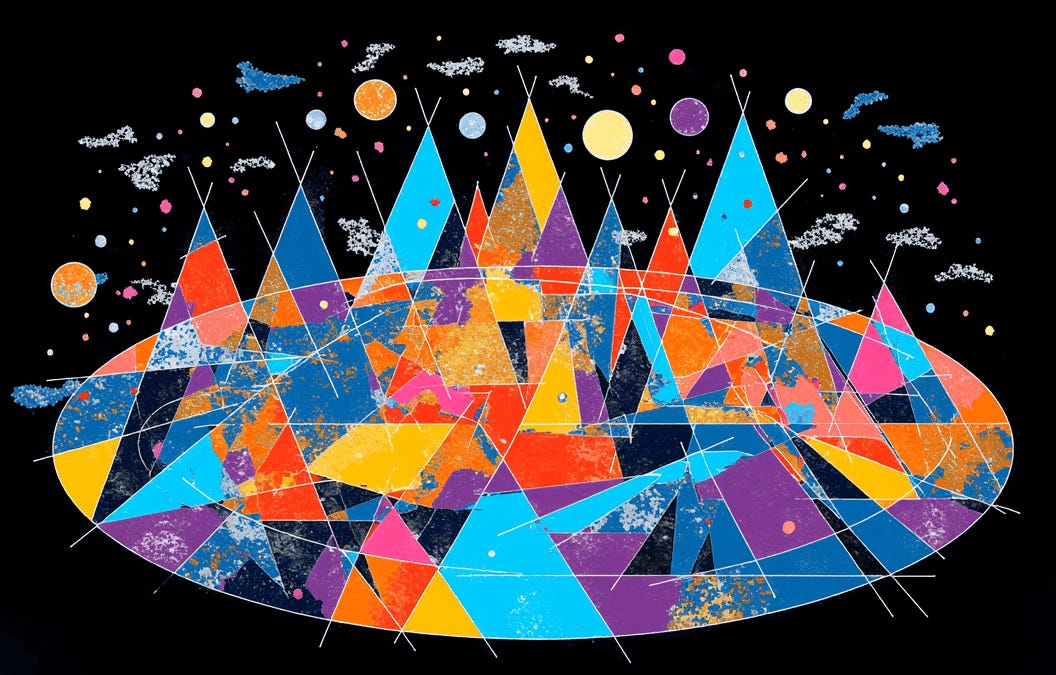
Human knowing in perspectival encyclopedicity
The book club pick for June was a bit of a wildcard. Robert Darnton’s *The Business of the Enlightenment, about the first modern encyclopedia, Diderot’s 18th century * Encyclopédie, ou dictionnaire raisonné des sciences, des arts et des métiers. I’ve just finished, and it’s left me with a lot of weird, perhaps ill-posed questions, and strange new beliefs about knowledgeability and a funhouse-mirrors new angle on AI.
I’ve always found the notion that you don’t need to know as much stuff when you can just google everything to be silly. I’ve found the opposite to be true. The more there is to know, the more you need to know. The marginal value of knowing stuff does hit diminishing returns, but the point is much further out than most people realize, and it moves out further with time, as the knowledge environment evolves, not closer. The zero-sum idea that the more Google knows, the less you need to know, is wildly wrong. And it goes beyond the Google-fu (or now prompt-fu) of knowing what specific query to use to probe the knowledge environment. What you know shapes what you can see.
LLMs have pushed this co-evolution between internal and external whats and ways of knowing to a point of crisis, which is what I want to talk about. But first, encyclopedias.
The Darnton book has given me one weird new belief in particular: I now think that the Enlightenment wasn’t so much about a few specific big ideas that challenged medieval orthodoxy, but about *an encyclopedic way of knowing *about reality. For the first time, it became possible to know so much, you could entirely contain and exhaust normal human levels of uninspired curiosity. You could at least roughly cover your experience of reality with a map of reality. And you didn’t need to be a discoverer of knowledge to do so. Merely an accessor.
You could become post-curious and most people in fact did just that.
It didn’t start with Google. Already in the 18th century, people were forced to ask the same questions we do today. How knowledgeable *should *you be in an encyclopedic environment? Should you aim to know as much as possible, or as little as possible? Are there things you should try to *not *know, like Sherlock Holmes with his studiously cultivated lack of astronomical knowledge and all other subjects unrelated to detecting?
Why bother knowing anything when it’s in your personal budget quarto edition of the encyclopédie, which you bought for just a few hundred livres; only a few months of your middle-class income? This quarto edition is what the Darnton book is about. You’d think the publishing history of a particular cheap bestseller edition of an archaic encyclopedia would be a dull subject, but it’s fascinating.
Holmes’ knowledge, as described by Watson, is ironically a rather good example of what I think of whenever I hear the adjective *encyclopedic *applied to a human’s knowledge:
Dr. Watson’s summary list of Sherlock Holmes’s strengths and weaknesses:
Knowledge of Literature: Nil.
Knowledge of Philosophy: Nil.
Knowledge of Astronomy: Nil.
Knowledge of Politics: Feeble.
Knowledge of Botany: Variable. Well up in belladonna, opium, and poisons generally. Knows nothing of practical gardening.
Knowledge of Geology: Practical but limited. Tells at a glance different soils from each other. After walks has shown me splashes upon his trousers, and told me by their colour and consistence in what part of London he had received them.
Knowledge of Chemistry: Profound.
Knowledge of Anatomy: Accurate but unsystematic.
Knowledge of Sensational Literature: Immense. He appears to know every detail of every horror perpetrated in the century.
Plays the violin well.
Is an expert singlestick player, boxer, and swordsman.
Has a good practical knowledge of British law.
Sherlock Holmes’ knowledgeability was exceptional, but relied on an environment that offered a more banal encyclopedic way of knowing as a foundation. The genius of Holmes could not easily have been expressed in a pre-encyclopedic culture. He had a cache optimized for fast inference in the detection game.
The conflict between Enlightenment and pre-Enlightenment ways of knowing, I suspect, had more to do with the quantity and comprehensiveness of available knowledge than with specific bits of knowledge. The subversion lay in the encyclopedic way of knowing available to all, rather than in specific shocking doctrines held by a few.
Religions don’t have answers to most questions a normal human might think to innocently and lazily ask, so they tend to view unbounded curiosity as a threat and act to curtail, dismiss, or trivialize it. *What kind of bug is that? *a child might ask. *Another of God’s creatures, now get back to your Bible! *is no answer at all.
This works pretty well so long as there aren’t that many answers within easy reach anyway. Constraints on curiosity lend a certain sacred mystique to the questions which *are *permitted, and to which there *are *answers on offer. The curious mind takes what it can get. When only some questions have answers, those answers seem profound and the bunny trails they open up invite nerdy obsession. Other questions can be marked the work of the devil. Products of an idle mind. One paying insufficient attention to labor and prayer.
But the post-curiosity mind presents a different challenge to religion.
Once an encyclopedic way of knowing becomes available, it takes exceptional coercion — think the Inquisition — to limit attention to a few questions. And it takes an exceptionally imaginative person working quite hard to ask well-posed questions that don’t actually have answers. Few people even try, and rarely by accident. The post-curious become the normal type of human. Watch a cat or a monkey. Post-curiosity isn’t a normal state at least for complex mammals.
Starting with Diderot’s encyclopedia, it became possible for even the middle class to own complete encyclopedia sets, and keep inquisitive children fully absorbed until they ran out of energy and attained the nirvana of post-curiosity. To a first approximation, arrival at post-curiosity *was *enlightenment. A very different notion of it than the one offered by religious mysticism. Illuminated exteriority instead of illuminated interiority.
You didn’t have to beat the curiosity out of children. Thanks to the encyclopedic way of knowing, the frontier of the unknown receded far enough away that most exhausted their curiosity long before they reached it. Most humans became trained to expect that most questions in fact have answers. To believe that there is a place — the library, Google, or an LLM — where one may Enquire Within About Everything, reducing the urgency of actually enquiring about anything.
In an encyclopedic environment, we generally recognize questions as interesting only after they’ve been demonstrated to have interesting answers. We consider it a mark of genius to ask interesting questions now, where once any child could think of one. In a society where an encyclopedic way of knowing is available, to defy post-curiosity and keep asking questions at all is rather remarkable. To stumble upon an unanswered question that isn’t obviously confused or incoherent is even more remarkable. To actually find interesting answers is the mark of genius.
Religion faces quite a different challenge in a post-curious environment — the questions and answers it offers must compete with a lot of other questions and answers that it cannot successfully starve of attention. When religions compete with an encyclopedic context, the greatest threat they face is not that of contradiction or heresy, but marginalization. The revelation of their sheer lack of interestingness or significance to the majority, relative to the encyclopedic landscape of the knowable.
Diderot’s encyclopedia in its most widely published form in fact pulled most of its punches where religion was concerned. Though it sparked religious tensions, and the conflict with religion was the main source of drama surrounding its diffusion, it did not directly challenge religion for the most part. It contented itself with subtle subversions in a small proportion of its entries. The rest of the encyclopedia was about stuff religion simply did not even address. The problem with it, theologically, was that it meaningfully created and held a vast new space for non-religious curiosities. Religion could no longer monopolize creative attention. The religious imagination began to seem small.
Anton Chekov’s *The Bet *is a sort of wishful portrait of spirituality in an encyclopedic environment. The plot (spoiler alert) involves a guy who accepts 15 years of solitary confinement for a bet, and spends his time reading. His curiosities converge from encyclopedic in the beginning to just reading the Bible in the final year.
The history of the actual modern world is mostly the opposite story. People discovering that there’s far more to reality than any one book can possibly cover, and fundamentalists finding it ever harder to claim that one book is all you need.
But maybe a 36-volume “Enquire Within Upon Everything” destination is enough for most humans. Once you live in a world that has one, what do you do next? How do you respond to a curiosity-satiating cognitive environment? How do you stay intellectually alive? How do you transcend the encyclopedic way of exhausted knowingness?
We used to describe people who seemed to know a lot as having “encyclopedic” levels of knowledge. The phrase does not indicate that the person has literally read and retained an encyclopedia (that would be rather sad) but that their curiosity has encountered and survived an encyclopedic environment. Something like Sherlock Holmes’ inventory of knowledge is the right picture to hold of an encyclopedic mind. He could get to the questions nobody else asked, and unmask murderers, because of what he chose to know, which was vast in quantity, but weird in quality. A fictional character yes, but not a bad portrait of an effective mind in an encyclopedic environment.
*Encyclopedic knowledge *was a compliment because it suggested that the knowledge was a side-effect of grand and ambitious intellectual explorations to the very edges of the known; of unseen worlds traversed; of ways of knowing that the inept questioning of the post-curious could not even begin to probe. And it didn’t have to be as idiosyncratic or focused as that of Holmes.
Oliver Goldsmith’s The Village Schoolmaster* *presents a different portrait of encyclopedic knowing — a portrait at once satirical and admiring of someone with a mind that’s still alive and open in an encyclopedic age.
The village all declar'd how much he knew;
'Twas certain he could write, and cipher too:
Lands he could measure, terms and tides presage,
And e'en the story ran that he could gauge.
In arguing too, the parson own'd his skill,
For e'en though vanquish'd he could argue still;

While words of learned length and thund'ring sound
Amazed the gazing rustics rang'd around;
And still they gaz'd and still the wonder grew,
That one small head could carry all he knew.
Notably, the poem contrasts his way of knowing with that of the parson.
What might be a comparable archetype for the age of LLMs? What does it mean to be post-encyclopedic? How would you rewrite the Village Schoolmaster poem today? Who would you feature in place of the parson? Perhaps the schoolmaster of the original is now the parson?
We’re clearly at the beginning of a new arc in our relationship with disembodied knowledge media, just as in Diderot’s time. That AIs are encyclopedic is not the most important thing about them, but it is a necessary* *feature. Their other affordances would not be worth much if they weren’t first reliably encyclopedic most of the time.
But the defining feature of AIs is that they offer *many ways *of encyclopedic knowing. There isn’t just one canonical way to know everything, in alphabetical order, as in Diderot’s encyclopedia. There isn’t even the claim of a particular superior or best way, such as the way claimed by the *Encyclopedia Methodique ,*which boasted a thematic organization rather than lexicographic as its advantage over Diderot’s original. Or more recently, Wikipedia’s claims of the superiority of folksonomic encyclopedism over the scholarly kind offered by the Encyclopedia Brittanica.
No, an LLM offers you effectively *infinite *ways of encyclopedic knowing. You can come at what it knows from virtually any direction you can think of, with any ontological orientation, and it will offer meaningful traction. It will not be surprised, though it may flatter you and compliment you on your originality of perspective. You cannot easily catch an LLM wrong-footed, even if you can catch it hallucinating and bullshitting. It groks every way of coming at anything. You cannot nonplus it.
LLMs offer *perspectival encyclopedicity. *
I used to write a blog with the tagline “experiments in refactored thinking.” That wouldn’t be a good tagline today. LLMs have always-already refactored everything, every which way. You just have to Enquire Within Upon Any Perspective. You will find resonance for any private, half-formed insight, and assistance making it fully legible to yourself.
Back in the day, the most common compliment I got was something like “you put words to what I was thinking.” Now that function is well served by LLMs.
In such an environment, finding new ways of knowing that nonplus LLMs is the equivalent of finding questions that could not be addressed by encyclopedias or search engines a decade ago.
If encyclopedias made most humans post-curious, LLMs are going to make most humans post-perspectival. Uninterested in uncovering novel perspectives because all perspectives an average human might consider are actually within reach. Are there going to be strange new ways* *of knowing things now? Or strange new ways of *not *knowing things? Genius ways? Richard Hamming once wondered whether computers might think think thoughts humans cannot think. The complementary thought is: Can humans adopt perspectives for which LLMs cannot offer ready views? Holes in latent space?
When you possess more knowledge than you can meaningfully deploy in a lifetime, even as a human, ways of knowing become more important than the whats of knowing. This has been true since Diderot’s time. But when the post-encyclopedic environment seems to embody *all *ways of knowing, getting to a new way of knowing is the mark of post-perspectival genius.
Just like after encyclopedias, it took exceptional minds to ask questions that didn’t yet have answers, it’s now going to take different sorts of exceptional minds to uncover ways of knowing that haven’t been tried before, and we’ll have ourselves a new definition of genius.
Perhaps in the age of LLMs, to be knowledgeable, you have to develop strange* new *ways of knowing things. Perhaps strange *knowledgeability *is the quantity and quality of interest.