If your engineering team is actively using autonomous coding agents like Claude Code, Cursor, or Aider, you have probably noticed a startling line item creeping into your monthly cloud bill: runaway token consumption.
A seat license for an AI tool typically costs $20 to $40 a month. That is not what hurts.
What hurts is the token invoice. A quarter of engineering organizations already burn between $200 and $500 per developer each month on frontier model tokens. Some high-output engineering teams are already blowing past $2,000 per engineer per month. Gartner recently projected that by 2028, enterprise AI coding token expenses could surpass the average software developer’s base salary.
Why are coding agents so expensive?
The answer is simple: most of what an AI coding agent does during an average work session is not high-level reasoning. It is basic file I/O.
Consider what happens when a developer asks an agent: “Which method handles user authentication in this service?”
The agent pulls five 1,500-line source files into its context window. It ingests 30,000 tokens of boilerplate code, interface declarations, and import statements, burns ten cents of frontier compute, and outputs a one-sentence answer: “It is handled by validateToken() on line 412.”
You just paid for an ultra-expensive frontier reasoning model (like Claude 3.7 Sonnet or OpenAI o3) to act as a glorified grep.
Last week, the engineering team at Spotify published a remarkable architectural case study showing how they solved this problem: The Shunting Pattern.
By using pre-tool execution hooks to intercept heavy file I/O and routing the grunt work to lightweight worker models, Spotify slashed their agent token consumption by 90%.
Here is how the shunting architecture works, the three layers of enforcement, and how to implement it in your own agent harness.
1. The Core Paradigm: Brains vs. I/O #
The foundational insight behind Spotify’s approach is a clean separation of concerns:
Save the frontier model for the thinking. Let lightweight workers handle the I/O.
Frontier reasoning models are wildly overqualified for reading raw configuration files, ingesting repetitive test suites, and formatting boilerplate code.
When you analyze a typical coding agent’s token consumption, you find that over 80% of tokens fall into two non-reasoning buckets:
- Bulk File Reads: Ingesting thousands of lines of context across multiple files just to extract a single dependency name, method signature, or schema shape.
- Boilerplate File Writing: Generating unit test scaffolding, configuration files, and type stubs that follow the exact same visual pattern as twenty existing files in the directory.
Spotify realized that if you can divert those two operations away from your primary reasoning model, you can run an agent for an entire day while paying for only a fraction of the tokens.
2. The 3-Layer Shunting Architecture #
To make delegation work reliably without requiring manual developer intervention, Spotify built an automated system called Shunt.
Here is how the architecture routes execution:
The architecture operates across three distinct functional layers:
Layer 1: Pre-Tool Execution Hooks (The Traffic Cop)
The biggest mistake teams make when trying to reduce agent token waste is writing advisory instructions in their system prompts (e.g. telling the model in CLAUDE.md: “Please do not read large files directly”).
LLMs regularly ignore advisory instructions when they feel a task requires more context.
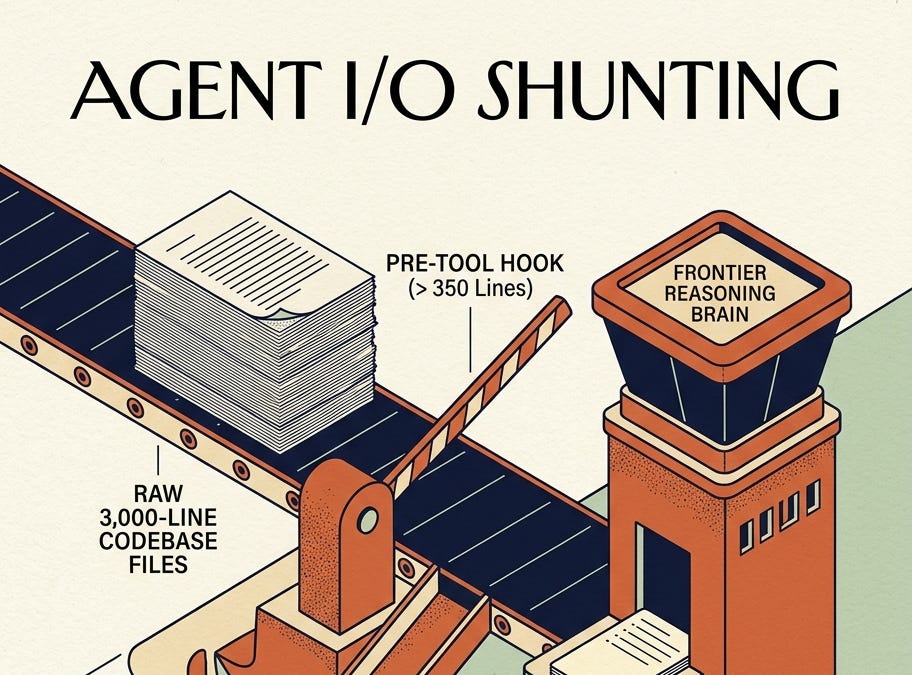
Instead of asking politely, Spotify implemented programmatic PreToolUse hooks that enforce rules at the operating system level:
check-file-sizeHook: Intercepts every file read command. If the target file exceeds a configurable threshold (e.g. 350 lines), the hook activelyblocks the read operation and directs the agent to call an external delegation worker. Targeted reads with explicit line offsets pass through unimpeded.check-bash-readHook: Monitors the shell environment, catching attempts to run commands likecat,head,tail, orlesson large files, while allowing piped filtering commands (likecat file | grep pattern) to proceed.
Layer 2: Dedicated Worker Modes (The Grunt Labor)
When a heavy I/O action is blocked, execution is diverted to two specialized, lightweight worker agents running fast, cost-effective models (such as Gemini 2.5 Flash):
- The
bulk-readerMode: The primary agent sends a raw question alongside file paths (e.g.bulk-read --question "What does this service do?" --paths src/Service.java src/Handler.java). The worker model reads all 3,000 lines, extracts the answer, and returnsstructured bullet points only . The 3,000 lines of raw code never enter the frontier model’s context window. - The
code-writerMode: When generating repetitive files (like unit tests or mock configs), the primary agent supplies a brief specification and an existing reference file. The worker model generates the code and writes itdirectly to the local filesystem . The frontier model never sees or parses the generated output tokens.
Layer 3: Progressive Disclosure Skills
To ensure the primary agent knows how to interact with the worker scripts, two lightweight skill files define the exact CLI syntax and invocation rules.
Even if the model forgets to check the skill definition, Layer 1’s execution hook still blocks the raw file read, ensuring the system degrades gracefully with zero financial leakage.
3. The 3 Production Scars: What Fails in Practice #
Delegating agent I/O sounds straightforward, but in production, naive implementations introduce three severe traps:
Scar #1: You Cannot Delegate Fine-Grained Code Editing
While you can easily delegate reading for comprehension and writing brand-new boilerplate files, you cannot delegate precise code modifications.
Lightweight worker models produce summarized outputs that lack strict, byte-level line number precision. If a frontier model attempts to apply a surgical search-and-replace patch based on a worker summary, it frequently corrupts surrounding code blocks.
- The Guardrail: Targeted file reads (using explicit
offsetandlimitline parameters) must always bypass the shunting hook. The frontier model must see the exact, raw lines it intends to edit.
Scar #2: The Context-Free Generation Disaster
If you ask a lightweight worker model to write a new unit test from a high-level prompt alone, it will generate generic, tutorial-style code that completely ignores your team’s internal mock libraries, naming conventions, and assertion helpers.
- The Guardrail: Mandatory reference grounding. The
code-writertool must strictly enforce a required--referenceparameter pointing to an existing file in the same directory. The worker model mirrors the reference structure exactly.
Scar #3: The Markdown Wrapper Bug
When smaller models generate code files, they have a frustrating tendency to wrap output in conversational preambles and markdown fences (e.g. “Certainly! Here is your test file: python ... “).
If an agent writes that output directly to disk, your test runner breaks with syntax errors.
- The Guardrail: Strict system instructions on worker models commanding:“Output raw executable code only. Zero markdown fences. Zero greetings.” Combine this with an automated post-processing regex in your CLI script that strips markdown fences before writing to disk.
4. How to Prototype This Weekend (Bash Hook Blueprint) #
You can implement the core of Spotify’s shunting pattern in standard bash and Python:
#!/usr/bin/env bash
FILE_PATH="$1"
MAX_LINES="${SHUNT_MIN_LINES:-350}"

if [ ! -f "$FILE_PATH" ]; then
    exit 0
fi

LINE_COUNT=$(wc -l < "$FILE_PATH" | tr -d ' ')

if [ "$LINE_COUNT" -gt "$MAX_LINES" ]; then
    echo "BLOCKED: $FILE_PATH has $LINE_COUNT lines (threshold: $MAX_LINES)." >&2
    echo "Do NOT read this file directly into context." >&2
    echo "Use the bulk-reader worker: bulk-read --question '<QUESTION>' --paths '$FILE_PATH'" >&2
    exit 1
fi

exit 0
By adding this simple pre-execution check to your agent harness, any attempt to dump a 1,000-line file into your frontier model is instantly blocked and redirected to an inexpensive worker script.
5. The Strategic Bottom Line #
For engineering leaders, Spotify’s shunting pattern is a critical lesson in AI FinOps:
Runaway AI coding costs are not caused by model pricing: they are caused by lazy routing.
Treating every file operation as a job for a $15-per-million-token frontier reasoning model is the modern equivalent of spinning up an 8-GPU cluster to run a basic SQL query.
By implementing execution hooks that enforce automated delegation:
- You slash developer token consumption by up to 90%.
- You reduce context window clutter, allowing your frontier model to maintain sharper, deeper reasoning over multi-hour coding sessions.
- You future-proof your engineering budget against the coming surge in autonomous agent adoption.
The most productive engineering teams are not the ones with the largest AI budgets. They are the ones that route their tokens with architectural discipline.
Further Reading & Resources
- Spotify Engineering: Portal by Spotify Cut My Claude Code Token Usage by 90% : The original technical post detailing their Shunt plugin and AiKA modes.
- Spotify Portal & Backstage : Documentation on Spotify’s developer portal and internal developer platform architecture.
- Claude Code PreToolUse Hooks : Official documentation on configuring programmatic interceptors and tool validation gates.
- Gartner: Predictions on Developer AI Costs : Industry forecasts on enterprise token consumption and engineering budgets.
If you enjoyed this breakdown, subscribe to MLnotes for weekly, bite-sized systems engineering and AI architecture deep-dives. If your team is tracking runaway AI coding costs, share this article with your lead.