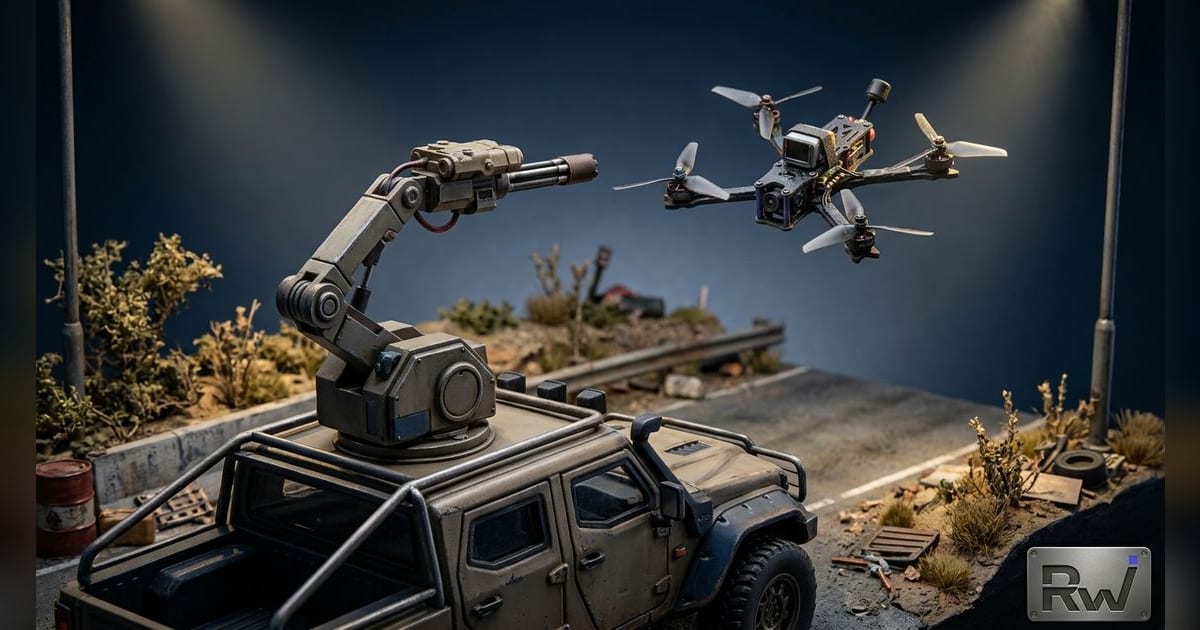
https://www.youtube.com/watch?v=PEgJkZTNcks Russell Smith (@rhs), Roman Khomenko and Bogdan Pyzh's 9 Mothers is selling Edda, an AI-powered point-defense turret built to stop small FPV suicide drones at close range.
The Austin, Texas defense startup is part of Y Combinator's Spring 2026 batch, where YC lists 9 Mothers as active, founded in 2024, and operating with a 19-person team. YC's company page says 9 Mothers has sold $1.6 million of systems to the Department of War and delivered multiple systems. 9 Mothers' own site says U.S. government buyers and prime contractors are buying its systems now.
Smith is not a first-time founder trying to learn procurement through a pitch deck. YC also lists him as co-founder and former CTO of Rainforest, the no-code testing company from YC Summer 2012. On YC's 9 Mothers profile, Smith's one-line description is blunt: "Making AI weapon systems." Khomenko's YC bio says he previously worked as a data scientist at Rainforest QA and is now building AI-driven counter-drone systems; his LinkedIn profile links to a Kaggle profile and GitHub account. YC lists Pyzh as 9 Mothers' co-founder and COO.
The founder bet is narrow and deliberately tactical: 9 Mothers is not trying to build another radar-first, long-range air-defense platform. 9 Mothers is aiming at the last 10 to 100 meters, where cheap FPV drones are fast, low, small, and often close enough that a missed track becomes an immediate casualty problem.
Edda is the wedge product
https://www.youtube.com/watch?v=KBGBUmwgpL0 Edda is 9 Mothers' first product and the clearest expression of the strategy. 9 Mothers describes Edda as an AI point-defense turret for fast-moving 7-inch drones in cluttered urban and base-perimeter environments. The system combines passive acoustic detection with an onboard visual model, then hands the track to a high-speed motion platform paired with a shotgun effector.
9 Mothers says Edda can engage drones at 10 to 100+ meters, slew 5 degrees in less than 15 milliseconds, track at better than 1.5 arcminutes, and fit in a roughly 0.5 cubic meter, 23 kg package. The passive acoustic stack is central to 9 Mothers' pitch: Edda is designed to detect and track without emitting RF, with optional radar only as an add-on.
That choice matters because FPV-drone warfare has made jamming an arms race. Fiber-optic FPV drones and autonomous navigation reduce the value of RF denial. 9 Mothers' answer is to listen first, then use computer vision for fine targeting. That is a very different architecture from systems optimized around radar, RF detection, or electronic attack.
The market is moving toward low-cost shots
The market context is no longer theoretical. The Congressional Research Service has noted that both Russia and Ukraine have produced growing numbers of FPV one-way attack drones armed with explosives, and the Department of Defense has elevated counter-small UAS work through the Joint Counter-Small UAS Office and Replicator 2. In January 2026, Defense News reported that Ukraine said drones accounted for more than 80% of enemy targets destroyed.
That environment has shifted defense-tech investing toward a basic question: can a system defeat cheap drones without requiring defenders to spend missiles, power, or operator attention at a losing exchange ratio?
9 Mothers is selling into that gap. The company says one-way FPV drones can be assembled for hundreds of dollars and flown at roughly 30 meters per second. Edda's job is not to win a theater air-defense engagement. It is to protect a vehicle, position, base perimeter, or critical asset from the small drone that has already made it through the outer layers.
Traction is the number to watch
9 Mothers' most important claim is not the turret spec sheet. It is the revenue. YC says 9 Mothers has sold $1.6 million of systems to the Department of War and delivered multiple systems. TechCrunch separately reported on June 18 that 9 Mothers had booked $1.6 million in sales, with a single contract expected to expand to $35 million later in 2026. TechCrunch also reported that 9 Mothers was promising investors a $1 billion contract pipeline and that one VC said the valuation was upward of $200 million.
Those figures should be read carefully. The $1.6 million in booked sales is the hard signal. The $35 million expansion and $1 billion pipeline are forward-looking. In defense, the distance between operator demand, contract options, budget authority, and scaled procurement can be long. But for a YC company in hardware, paid delivered systems are a better proof point than letters of intent or demo-day enthusiasm.
The valuation signal is also part of the story. If 9 Mothers is being priced north of $200 million weeks after YC's Spring 2026 Demo Day, investors are not paying only for Edda. They are paying for the possibility that 9 Mothers becomes a product family for close-in drone defense.
Four systems, one kill chain
9 Mothers' public roadmap shows that Edda is only the first node. 9 Mothers lists Vor, a passive acoustic sensor, as available separately in Q1 2027. Vor is designed for 360-degree acoustic detection with zero RF signature, handing off coarse tracks to downstream systems.
9 Mothers also lists Atla, a belt-fed shotgun platform, with a Q4 2026 demo target and Q1 2027 order availability. Atla is aimed at sustained drone-swarm engagements where magazine depth matters. Gleipnir, planned for 2027, targets Group 2 and one-way attack drones with a stated cost-per-shot goal below $10,000.
That product map reveals the broader company design: detection, tracking, and engagement as a modular stack rather than a single turret. If 9 Mothers can make Edda credible in the field, Vor gives it a sensing grid, Atla gives it volume fire, and Gleipnir gives it a path into larger drones and more expensive air-defense economics.
The hard part is field reliability
9 Mothers' strongest advantage is also its biggest execution risk. A close-in autonomous-capable turret has to work in dirty conditions: clutter, dust, weather, decoys, acoustic noise, false positives, moving vehicles, changing drone designs, and operators who cannot baby-sit the system while under attack.
That is why delivered systems matter. Field data becomes the moat only if the product survives contact with the field. 9 Mothers is trying to learn from real deployments while moving at startup speed, a combination defense buyers want but rarely get from traditional procurement cycles.
The company is also hiring like a hardware startup under time pressure. 9 Mothers lists open roles in machine learning, computer vision, robotics, electrical engineering, embedded systems, mechatronics, perception, and test engineering. The hiring pattern matches the technical bottlenecks: acoustic ML, visual tracking, motion control, embedded reliability, and manufacturing.
9 Mothers' June rollout puts Smith, Khomenko, and Pyzh into one of the most crowded and consequential categories in defense tech. The company has a clean wedge, a founder with prior YC company-building experience, and early paid sales. What 9 Mothers has not yet proven publicly is whether Edda can scale from delivered systems to procurement volume, and whether close-in AI point defense can keep pace with the drones it is built to stop.