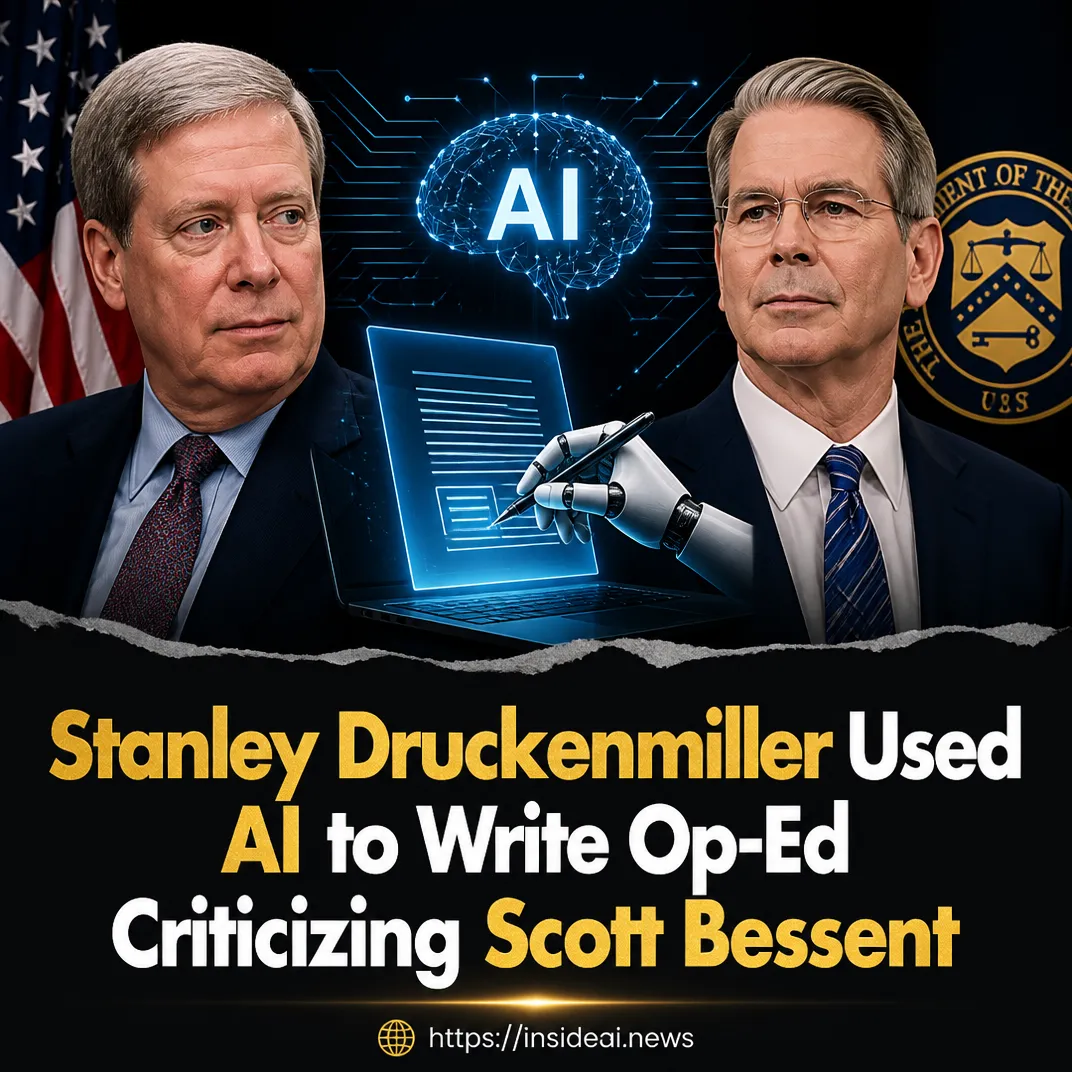
August 26, 2026, (Inside AI) — Billionaire investor Stanley Druckenmiller has confirmed he used artificial intelligence to write a widely circulated opinion piece criticizing his former protégé, Treasury Secretary Scott Bessent. The admission adds a new layer to an already heated debate over AI's role in financial commentary and journalistic ethics.
Druckenmiller, 73, told Notus on Tuesday he was "not embarrassed" by using AI for the Wall Street Journal op-ed, in which he opposed the Treasury's plan to double government debt buybacks. The piece drew attention not only for its policy stance but for rhetorical patterns some readers flagged as machine-generated.
The disclosure comes as newsrooms and publishers face mounting pressure to define acceptable AI use. Just this month, a UC Berkeley math professor faced scrutiny for using AI to edit an op-ed, and in March, the New York Times cut ties with a freelancer whose AI use led to plagiarism. Druckenmiller's case is distinct: he owned the technology openly, framing it as a tool rather than a shortcut.
Veteran Investor Defends AI-Assisted Authorship #
Druckenmiller's op-ed targeted Bessent's market interventions, specifically the Treasury's buyback expansion. He argued the move distorts bond pricing and undermines fiscal discipline. The argument itself was not new; Druckenmiller has voiced similar views for over a decade.
"At 73 I'm kind of proud of using it," he told the Wall Street Journal. "These are my ideas and I've been speaking about them for over 15 years, as anyone who knows me knows. Would I prefer that I was a great writer? Yes, but that's not who I am."
His candor contrasts with typical corporate hedging around AI. Druckenmiller treated the technology as a writing assistant, not a ghostwriter. The distinction matters in an industry where authorship carries weight and credibility is currency.
Paul Gigot, the Journal's editorial page editor, defended the publication's decision. "The question for us is whether what we publish from contributors reflects an author's original argument, and if the author has the standing and credibility to make it. In Stan Druckenmiller's case, we have had a relationship with him for many years, and nobody can doubt that his op-ed is his genuine opinion," Gigot said.
Gigot also called AI "a fact of modern life," signaling that legacy outlets may accept AI-assisted content when the author's expertise is beyond dispute.
Media Scrambles to Set AI Boundaries #
The Druckenmiller episode is not isolated. Zvezdelina Stankova, a UC Berkeley math professor, faced backlash this month for using AI to edit an op-ed in the San Francisco Standard. She maintained the piece, arguing test-blind admissions produce under-prepared students, resulted from "intensive human work." The Standard said the piece reflected her "original analysis."
In March, the New York Times severed ties with a freelance journalist whose AI use led to plagiarism from a Guardian book review. The Times added an editor's note citing a violation of its standards. These cases show a spectrum: from undisclosed AI editing to outright misuse.
What sets Druckenmiller apart is disclosure after the fact, not before. He did not hide the AI involvement once questioned. That transparency may become a template for high-profile contributors who lack writing polish but possess domain authority.
The financial world has long accepted ghostwriters and speechwriters. AI merely automates that function. Yet the stigma persists because readers equate prose style with intellectual rigor. Druckenmiller's admission challenges that assumption, forcing a rethink of what authorship means when ideas are human but expression is algorithmic.
For now, the Journal stands by its contributor. The broader media industry remains split, with no unified standard for AI disclosure in opinion journalism. Druckenmiller's case may push that conversation forward, whether newsrooms are ready or not.