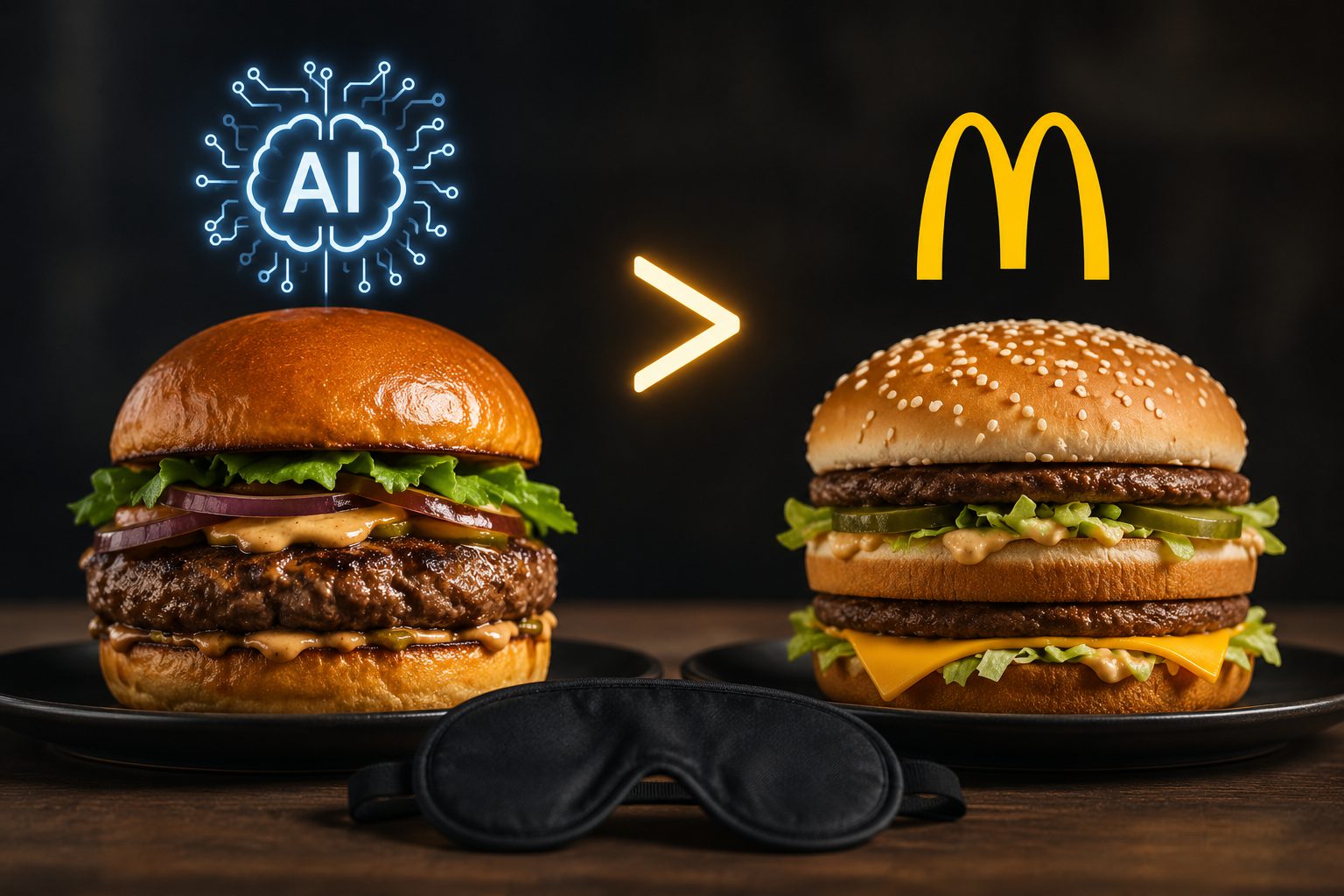
A hundred and one diners in San Francisco sat down to a blind taste test and picked an AI-designed burger over a Big Mac. Not a simulation. Not a survey. A real restaurant, real plates, real chewing. Stanford’s BurgerAI system — trained on
2,216 recipes across
146 ingredients sourced from Food.com — generated original burger recipes from scratch, and two of them scored higher on flavor and overall liking than the Big Mac reference. Texture? No significant difference. Think of it as AlphaGo for condiment ratios.
Here’s what the system actually did:
- Learned ingredient patterns across 2,216 existing recipes and 146 ingredients
- Independently reconstructed a close approximation of the Big Mac without access to McDonald’s proprietary formula
- Produced two “Delicious Burger” recipes that matched or beat the Big Mac on flavor and overall appeal
- Created a mushroom-based sustainability burger with an environmental impact more than an order of magnitude lower — but with worse taste scores
- Designed a bean-based nutrition burgerscoring roughly twice as high on the Healthy Eating Index — also rated lower on flavor and appeal
“Most AI systems are trained to predict what already exists. We wanted AI to invent what should exist next.” — Stanford scientist Ellen Kuhl.
That quote sounds ambitious. The results partially back it up. The delicious burgers genuinely won on flavor. But the sustainable and nutritious versions told a different story — diners rated both lower on flavor, texture, and overall appeal. Better for the planet doesn’t automatically mean consumers reach for it.
Beyond the Burger: What Stanford Actually Built #
BurgerAI is a proof-of-concept for multi-objective AI design, not a restaurant pitch.
Stanford’s real play isn’t a burger empire. Kuhl’s team frames BurgerAI as a test case for generative design — the same multi-objective optimization framework could target pharmaceuticals, advanced materials, or personalized nutrition. It’s less “AI replaces your chef” and more like how text-to-image tools shifted generation from reproducing existing art to proposing entirely new compositions. The distinction matters: this is generative AI as inventor, not AI as archivist.
Kuhl has suggested the burger is just a beginning — a familiar, easy-to-judge format for proving the methodology works before applying it to harder problems.
The taste wins here are genuine. So is the sustainability gap. Generative AI can design things that didn’t previously exist and that real people actually prefer. But closing the distance between “better for you” and “consumers still reach for it at lunch” remains stubbornly, irreducibly human.