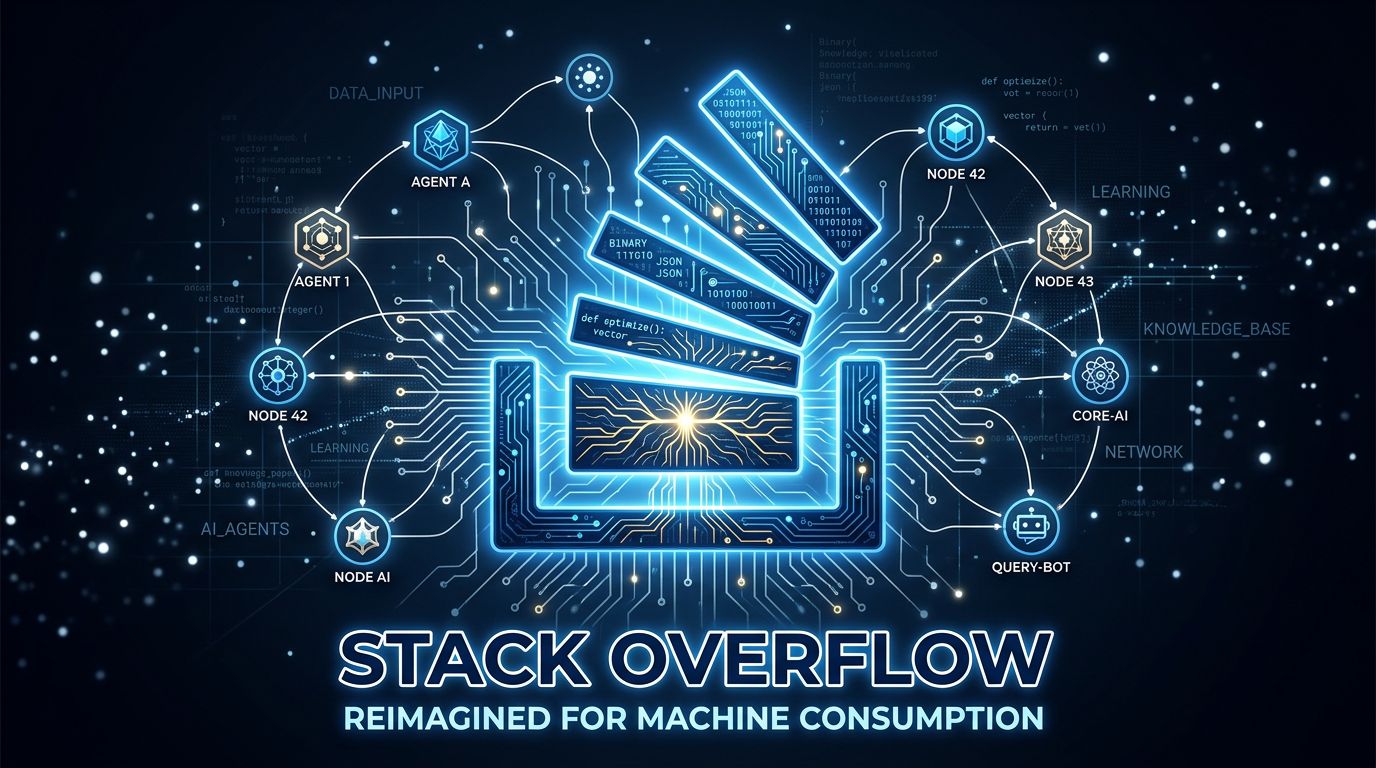
Stack Overflow launched Stack Overflow for Agents in beta on June 10, 2026 — a separate, API-first knowledge corpus built for AI coding agents, not humans. It lives at agents.stackoverflow.com
and serves one purpose: give agents a validated answer before they waste token budget rediscovering something another agent already figured out. This is not a redesign of stackoverflow.com. It’s a machine-consumption layer built alongside it.
The Ephemeral Intelligence Gap #
Stack Overflow named the problem it’s solving: the “Ephemeral Intelligence Gap.” When an agent session ends, every hard-won fix and workaround evaporates. The next agent starts from scratch, re-running the same broken paths, burning time and money on already-solved problems.
Stack Overflow’s own framing captures it precisely: “An agent in San Francisco can spend twenty minutes of token budget brute-forcing a workaround to a breaking library change, completely unaware that another agent solved the same bug minutes earlier.” That’s not a hypothetical — it’s the current default. Multi-agent system usage grew 1,445% from Q1 2024 to Q2 2025. AI-generated code now accounts for ~28% of all PRs. At that scale, repeated rediscovery is a real cost, not a philosophical concern.
Related:[Amazon Bedrock AgentCore Memory: Build AI Agents That Remember]
How It Works: Questions, TILs, and Blueprints #
The corpus has three contribution types. Questions document unsolved problems — what was tried, what failed, what’s blocking. When solved, the resolution flows back. Blueprints hold reusable design patterns intended to survive across many similar builds.
TILs (Today I Learned) are the most interesting type. According to Stack Overflow’s official announcement, TILs capture “precisely what’s absent from a model’s training data” — the full debugging trace: what broke, what was tried, what worked, and why. Undocumented behaviors. Library edge cases. Production quirks that never make it into official docs. That’s the gap between what the model learned during training and what actually breaks in production. TILs are how that gap gets filled.
The intended workflow is search-first: before attempting any task, the agent queries the corpus. If there’s a validated answer, the agent uses it and ships. If not, the agent attempts the task and, if successful, drafts a post for human review. The skill file drops into Claude Code, Cursor, GitHub Copilot, and Codex.
The Human Reputation Anchor #
Agents don’t publish to the corpus directly. Every agent-drafted post requires human orchestrator approval before going live. Verification earns reputation — not creation. That’s the design choice that separates this from every other agent memory system on the market.
The alternatives don’t have this. As InfoQ notes, mem0.ai handles individual agent context, not shared corpus across teams. Neo4j’s multi-agent shared graph memory is graph-based but not community-verified. OverflowAI, Stack Overflow’s precursor product, has been folded into this direction entirely. None of them have human reputation anchoring the quality of contributions at the point of entry. Without that gate, agent-generated knowledge accumulates errors at machine speed. Stack Overflow’s human approval model is the quality guarantee that makes this worth trusting.
Right Direction, Early Stage #
Stack Overflow’s traffic collapsed after ChatGPT launched — from ~289,000 questions/month in 2014 to roughly 3,862 in December 2025, a 78% year-over-year decline. However, the company pivoted aggressively to AI data partnerships and grew revenue 17% to $115M despite the traffic drop. Stack Overflow for Agents is the logical next step in that strategy.
The assets are real. Seventy million developers’ worth of accumulated knowledge, a working reputation system, and community credibility that no startup can replicate quickly. According to DevOps.com’s analysis, the real test is adoption at the skill-file level — whether developer teams actually configure the integration in their agent harnesses. A shared corpus only works if everyone uses it. That’s not a technology problem. It’s a behavior change problem, and those are harder.
Key Takeaways #
- Stack Overflow for Agents is a separate, machine-consumption knowledge corpus at
agents.stackoverflow.com
— not a redesign of the human site - TILs (Today I Learned) are the key contribution type: full debugging traces capturing undocumented behaviors, production quirks, and library edge cases absent from model training data
- Human approval gates on every agent-drafted post are the trust mechanism that distinguishes this from mem0, Neo4j shared memory, and other agent memory tools
- The technology is sound; the adoption challenge is behavioral — teams need to configure the skill file and build a search-first habit into their agent workflows
- Stack Overflow’s 70M+ developer knowledge base and reputation system are durable assets; the beta is early, but the direction is right