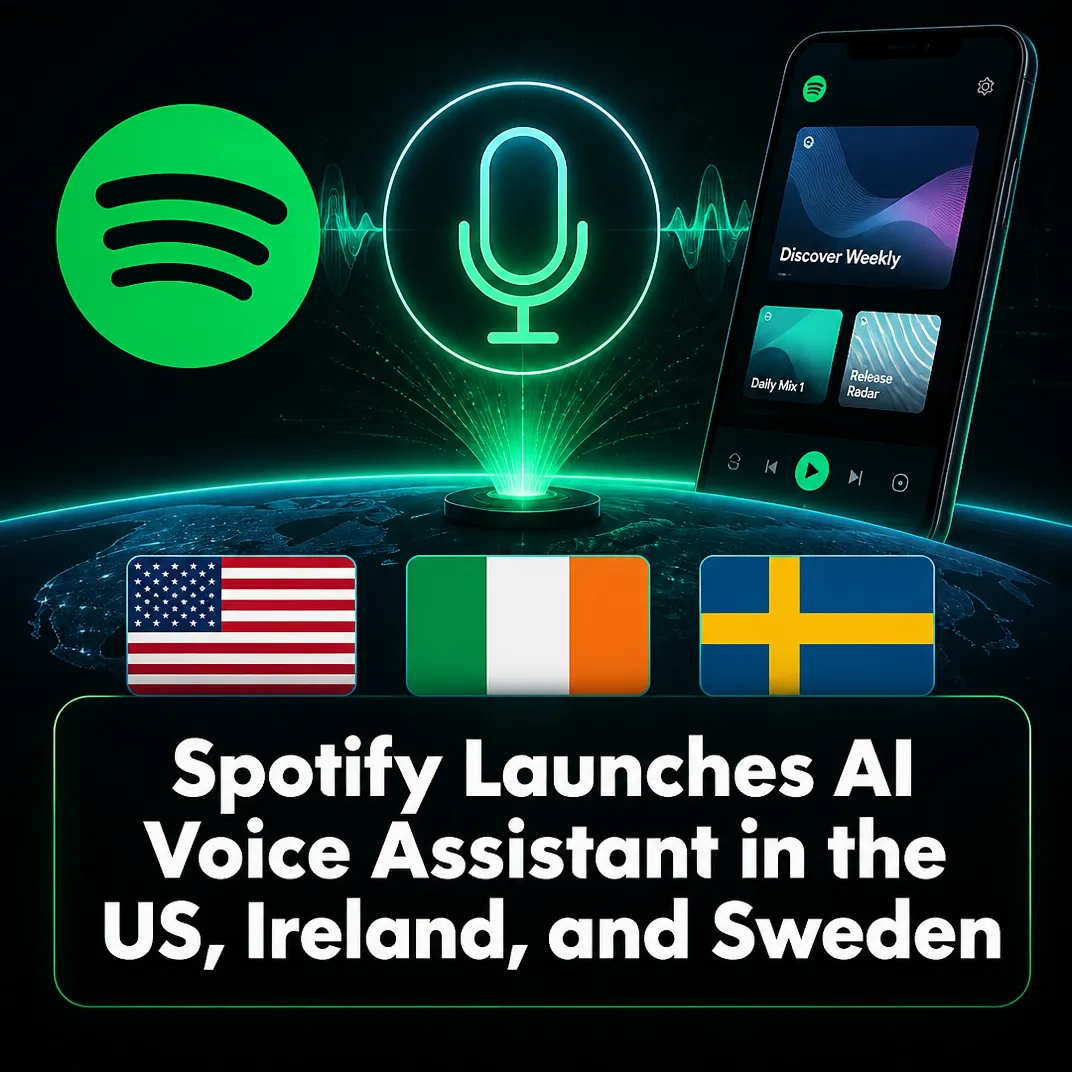
July 15, 2026, (Inside AI) — Spotify has launched an AI-powered conversational assistant in beta, letting users control the streaming service with natural voice or text prompts. The feature is available to eligible Premium subscribers aged 18 and above in the United States, Ireland, and Sweden on iOS and Android, currently supporting English.
Users can access the assistant from the Home screen and Now Playing view. It enables back-and-forth conversations to play songs, discover artists, refine recommendations, and manage playback. For instance, a user might say, “Play some artists I haven’t heard before,” then ask to add a specific artist or change the mood.
Voice commands can save tracks, add songs to the queue, or follow artists. The assistant also handles queries about album release dates, artist backgrounds, genres, and song inspirations. It works with podcasts and audiobooks, letting listeners ask about authors, guests, or related content without pausing playback.
Spotify says the assistant taps into users’ listening history to answer personal questions. Users can ask when they first heard a song or which genres they’ve explored lately. This builds on the platform’s existing data on playlists, favorite artists, and repeat listens.
The move intensifies competition in AI-driven music discovery. Apple Music and Amazon Music have integrated voice assistants, but Spotify’s approach focuses on conversational depth and personalization. Industry analysts note that Spotify’s vast user data gives it an edge in tailoring responses.
However, the beta rollout is limited. Only three countries and one language are supported, and the company warns responses may not always be perfect. This cautious approach mirrors past feature rollouts like AI DJ, which also started small. Spotify has not disclosed the underlying AI model, but it likely uses a mix of proprietary and third-party technologies.
The Race for Conversational Music Discovery #
Spotify’s assistant arrives as streaming platforms battle for user engagement through AI. YouTube Music recently added generative AI for playlist art, while Deezer experiments with mood-based recommendations. Spotify’s edge lies in its recommendation engine, trained on over 600 million users’ behaviors.
Privacy concerns linger. The assistant requires access to listening history, raising questions about data usage. Spotify states the feature is optional and users can stick to traditional controls. Yet, the company’s history with data-driven features, like Wrapped, shows users often trade privacy for personalization.
Early testers report mixed results. Some praise the natural language understanding, while others note occasional misunderstandings. A Spotify spokesperson said, “The assistant is still under active development, and because it is currently in beta, responses may not always be perfect.”
User feedback will shape future updates. Spotify plans to expand to more markets and languages, though no timeline is given. The company is also working on integrating the assistant with CarPlay and smart speakers, according to sources.
This launch follows Spotify’s recent updates to Release Radar and Podcast Clips. The assistant could become a hub for all audio content, blurring lines between music, podcasts, and audiobooks. If successful, it may redefine how users interact with streaming services.