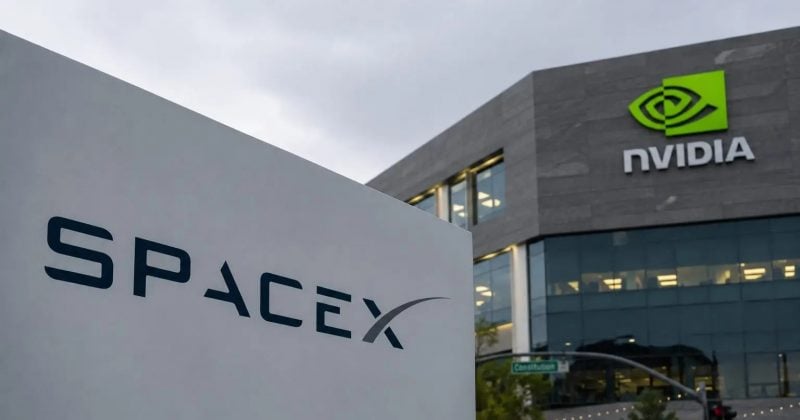
Via ts2.tech
The Starmind AI1 satellite will pack datacenter-class computing power into a solar-winged spacecraft, with a megaconstellation of up to 1 million units on the horizon.
The cloud is going orbital. SpaceX and Nvidia announced on August 4, 2026, that they are jointly developing the compute payload for the Starmind AI1 satellite, a spacecraft designed to run serious artificial intelligence workloads from low Earth orbit using Nvidia’s most advanced silicon.
This is not a research curiosity. The two companies are targeting a megaconstellation of up to 1 million satellites, each one functioning as a node in what would effectively become the world’s first distributed AI supercomputer in space.
What the AI1 satellite actually does #
Each satellite is engineered to sustain roughly 120 kW of average compute power, with peaks reaching 150 kW. Each unit stands 20 meters tall and deploys a solar wingspan of 70 meters, roughly two-thirds the length of a Boeing 747, to harvest enough sunlight to feed its power appetite.
The hardware at the center of the payload is Nvidia’s Vera Rubin NVL72 system, combining Rubin GPUs and Vera CPUs. Data processed on board travels back to Earth through Starlink’s existing laser link network, giving the system a high-bandwidth return path without needing a separate ground infrastructure buildout.
Why doing AI in space actually makes sense #
Solar energy is abundant and consistent in sun-synchronous orbit, where Starmind satellites are designed to operate. The Starmind design is also described as chip-vendor agnostic, meaning future generations of satellites could swap in next-generation silicon from any supplier without a complete architectural overhaul.
Initial prototype testing is targeted for early 2027, with mass production expected to begin by late 2027.
Disclosure: This article was edited by Editorial Team. For more information on how we create and review content, see our