A skill that needs a cloud model is hard to use on private code. I’m the Director of Engineering for Video at Stream, and I wanted to see how well one of our skills works when it runs on a laptop instead with cutting-edge local LLMs like Inkling 2 Mini.
Why Skills Should Run Locally #
Agent skills have become a popular distribution format since their introduction in 2025.
A major part of their appeal is that the definition of a skill is simple and easy to produce; it’s just a folder of Markdown files that teaches an agent to do one job. A skill can describe the tools it needs, but it has no say on the LLM that drives it. The actual effectiveness of a skill is a non-deterministic “best effort” situation (as with so many other things in today’s AI…) And since most skills don’t come with any measurements of what size of model they might need, most people take the easy route and apply them via foundation models that can handle the large amounts of loose prose often found in those skill Markdown files.
That’s nice for companies selling access to foundation models! But it’s not ideal for either the people using the skills, or the people providing skills to others. For the users, there are two somewhat orthogonal concerns: decentralization and sovereignty.
For software developers, **decentralization** often boils down to: “Can I run this in airplane mode?” If the skill needs a foundation LLM that’s only accessible in the cloud, or if it makes tool calls that require network access, then it has centralized elements that prevent you from running it fully locally.

## [What Sovereignty Means for Businesses](#what-sovereignty-means-for-businesses)
Sovereignty is a larger topic than just “does this run on my Mac”. It can apply on a wide range of levels, from governments to individuals. For businesses, there are three main layers:
- Compliance . Where does your data live? When hyperscalers like Oracle or AWS sell “sovereign cloud”, this is what they mean. It gives you guarantees about data residency and meeting regulations, but doesn’t touch the next two layers.
- Operational control . Who gets to decide what you run? Vendors can change terms, retire models, or get hit by export controls (as happened with Claude Fable 5 in June 2026, when it was withdrawn for a month). Hosted open weights models will avoid this supply chain risk.
- Model control . What really goes on inside the model? When you’ve got open weights, you can run them anywhere you want and finetune on your own data.
So, while running local LLMs on a developer MacBook is interesting enough, the real prize for companies is sovereign control over what models they run and where. Being able to take an off-the-shelf skill and run it on your own models is where the world is moving.
The Test Case: Stream’s Video Audit Skills #
Let’s dive in with a real-world example. At Stream, we provide a repo called video-audit-skills. These are read-only skills that can investigate your app’s code base and how it integrates with our Stream Video SDK.
This is a good test case for porting to a local LLM. The skill’s tool use is intentionally very limited (read only). It is already structured like a checklist, so it’s easy to see a porting approach that will make this palatable to smaller models. A code audit is also a good example of a case where companies have good reason to keep tight control and ensure the data never leaves their premises. Being able to run it on a regular MacBook Pro makes that easy.
The Two Models We Tested #
Many open-weight models can now rival foundation models at least for specific tasks like coding implementation.
In this post, we’ll be looking at two new open models. One is Chinese, the other made in the USA:
- Qwen3.8-27B by Alibaba (August 2026). This is a dense and deep model (64 layers) where every parameter sees every token. Its efficiency comes from optimizing attention layers towards a cheaper recurrent layer type. Its context window can fit 262,144 tokens by default.
- Inkling 2 Mini by Thinking Machines Lab (November 2026). This model is sparse and looped, which means that it uses about 1/8 of its parameters per token, and its middle layers are run repeatedly. It’s the first looped transformer from the much-hyped Thinking Machines, and so there’s been a lot of excitement around this model. It has a 1M token context window.
Both of these models can run on an Apple Mac with enough memory. For the benchmarks published here, we used an ordinary software developer’s workhorse: a MacBook Pro 14” with 48 GB RAM.
The Benchmark #
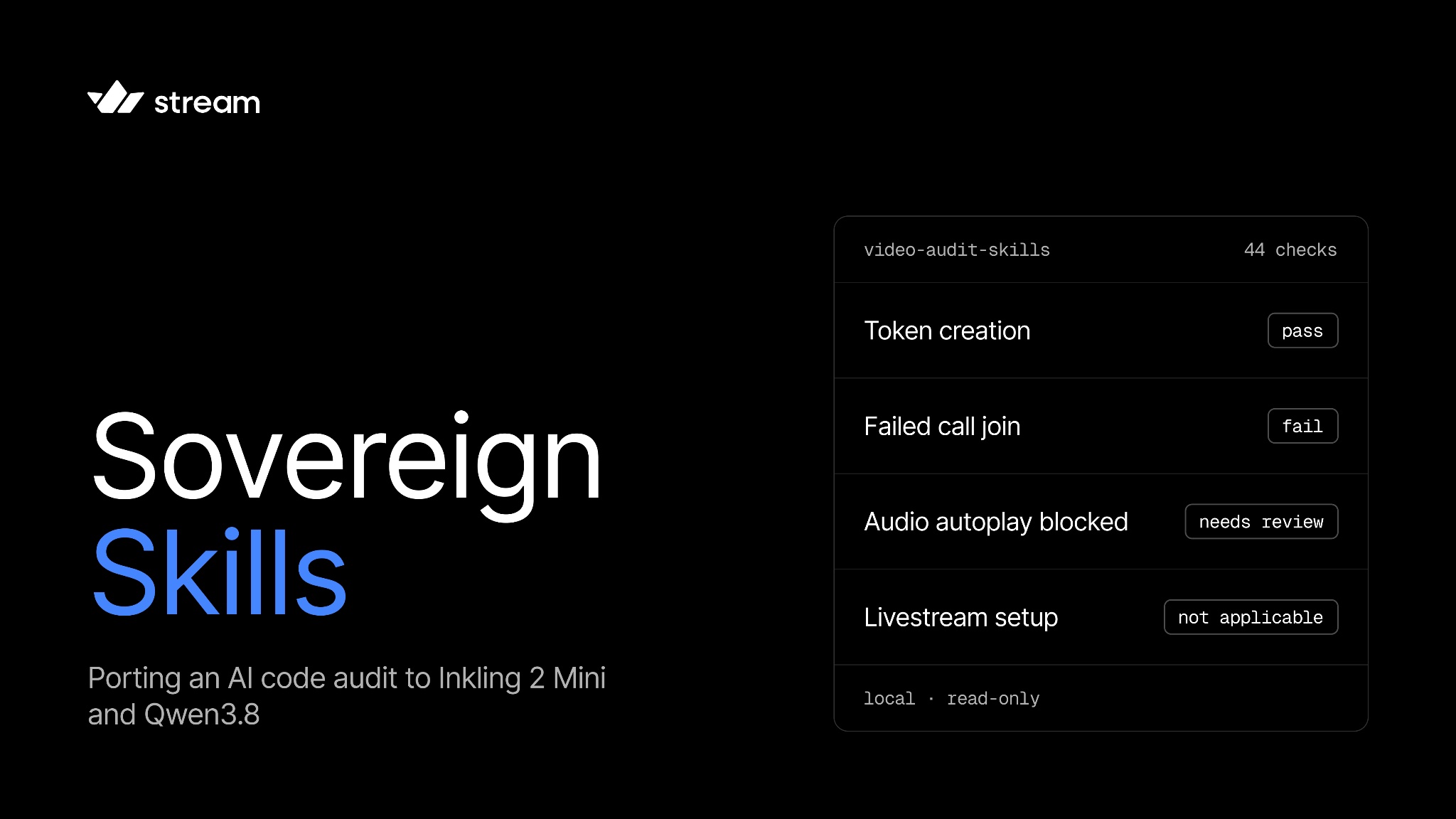
The video app audit skill checks a codebase using Stream Video’s web SDK against 44 known design problems on various levels. Things like where tokens are created, how to handle a failed call join operation, what the app does when audio autoplay is blocked in the browser, etc.
The output from the skill is a verdict that’s supported by file references and line numbers within them. The verdict can be one of four: pass / fail / needs review / not applicable.
So, for evaluating the ported skill on local models, we compared the small model’s verdict against Claude Opus 5.5 as reference. The match needs to be exact (a near miss like “needs review” vs. “fail” doesn’t count).
Six small test apps were used for the runs. Four other apps were used to choose between variants of the script. A larger app (almost a megabyte of code) was used to evaluate strategies for selecting code to be passed to the model.
Laptop runs were performed with temperature set to zero, so they are repeatable. We also did comparison runs of the small models on a hosted service.
Key Findings #
A note on the numbers:* the main runs total 264 checks, which is 44 checks for each test app.*
Here’s what we found benchmarking both Inkling 2 Mini and Qwen3:
- The laptop run is good enough to be useful , but still needs human review.
- Tested on multiple small sample apps, an audit took 13-19 minutes on the MBP.
- Of 264 checks, the foundation model agrees with its previous run on 252 instances (so there is already ambiguity in these checks, as befits a textual skill…) A broken model that just answers “pass” to everything would score 76.
- On the laptop, Inkling 2 Mini reached 224 matching verdicts. Qwen3 reached 218 but ran 24% faster (13 minutes vs. 17 min).
- Large apps can be supported with code selection using basic search patterns.
- This skill saw significant gains from porting into a Python script that manages the checklist and calls the LLM repeatedly.
- An initial test using the unchanged original skill scored only 158 / 264.
- Skills tend to rely implicitly on frontier model knowledge .
- In other words, the instructions were incomplete, but it hadn’t been noticed before because Claude Opus was able to fill in the gaps from its own knowledge.
- The two small models were failing the same check on multiple apps because the skill never stated an important fact about the SDK. A pass that read the Stream SDK’s open source code and patched two sentences into the skill was enough to make the local models pass.
- The difference between Qwen and Inkling wasn’t as significant as one might have expected.
- The script didn’t benefit from structural changes, but it needed a rewrite for the part that gets an answer back out of the model server.
- The published guidance for Inkling 2 Mini wasn’t useful in optimizing for it.
- We tried several redesigns based on information in the model card and architecture docs published by Thinking Machines Lab, but they didn’t improve performance. It’s important to constantly measure proposed changes, which was cheap to do in this case.
[Stream's latest video benchmark](https://getstream.io/blog/video-benchmark/).

## [From Agent to Script](#from-agent-to-script)
The obvious first step to porting was to look at the structure of the video audit skill. It asks the agent to read five reference Markdown files before finding the relevant code, and then perform 44 checks and write a report with 17 sections. Loose Markdown files are fine when you’ve got a big foundation model to chew through them, but it’s obvious that this could be improved by removing the LLM judgement from the high-level ordered process of running those checks.
We tested hosted Qwen3.8-27B on the original agent-driven skill, and while it was able to do the job on the test apps, the verdicts were poor: 158 of 264 on six apps. Of those differences, 63 were cases where the model should have answered “fail” but couldn’t reach a conclusion so it reached for something milder.
The Python script was produced with Claude Code. It scored 207 on the same hosted Qwen3.8-27B. Here’s what it does:
- Lists the source files, detects the SDK, numbers the lines, etc.
- Reads the skill’s own Markdown to extract the check descriptions. This way, the original skill stays unchanged and remains the reference. The script also searches for API names used in the checks.
- Eight model calls: one to describe the app, and rest are the checks grouped for efficiency.
- Verifies every cited location and assembles the report.
The script enforces that the model can’t use any tools, so it’s truly read-only. This is a nice benefit of the port; the original agent-driven skill defines this in its tool requirements, but it’s practically a soft hint for a harness. The ported version can never do anything but write its verdict.
We also ran a comparison of Qwen and Inkling 2 Mini on the laptop in the agent mode, without the script. While Inkling did better, it also suffered one complete failure, so neither of these models is usable without the script transformation of the skill:
- Inkling matched the reference on 171 of 220 verdicts vs. 143 for Qwen.
- Inkling took 22-60 minutes, and on one sample app it got stuck without producing a valid report. Qwen finished all seven apps in 10-49 min.
Inkling 2 Mini With the Script #
The script version was originally designed for Qwen. When Inkling 2 Mini was released on 20 Nov, we were excited to test it because it’s the same size model but has a significantly different architecture (sparse and looping, with reasoning always on). This way, we could better validate whether our port of the skill was compatible with a wide range of models, or whether we’d fitted it to Qwen.
The script needed a rebuild for Inkling. The original version constrains the model server’s output to a JSON schema, but this doesn’t work with Ollama’s newer engine (MLX) which is required to run the Inkling model. So instead, we changed the response into a function call the model makes. (We tested two other approaches - describing the schema in a prompt, and providing a form - but the function call won because Inkling is heavily trained on tool calls.)
The rebuild turned out useful for Qwen as well because it allowed us to use the new MLX engine and a different build of the weights. This delivered the same results in 66% of the time compared to previous Qwen runs.
Three test runs with hosted models got these verdict scores:
| Qwen3.8-27B | Inkling 2 Mini | |
|---|---|---|
| Schema version | 217, 222, 217 | 222, 219, 219 |
| Function call version | 220, 216, 220 | 221, 219, 225 |
And on the laptop:
| Qwen3.8-27B | Inkling 2 Mini | |
|---|---|---|
| Schema version | 214, at 19 min per audit | does not run (engine has no schema constraint) |
| Function call version | 218, at 13 min per audit | 224, at 17 min per audit |
Redesigning for Inkling 2 Mini Didn’t Work #
To go further than just the function call change, we tried redesigning the script in ways that were suggested by Inkling’s model card and known architecture. These changes didn’t improve the scores:
- One check per call. The original script design uses grouped checks. Thinking Machines’launch post says Inkling is not the strongest on instructions with many constraints, so we tested that. Breaking up the groups just produced worse scores: 213.7 vs 221.7 with grouped checks.
- Qwen was immune to this change, it scored 218.7 either way.
- Entire app in the 1M context window. This got the same score as selecting one tenth (see “Large apps” below).
- Recommended temperature.Guide on Unsloth recommends setting temperature to 1.0, but this didn’t have a meaningful impact so we kept it at zero to have repeatable runs.
- More reasoning. Raising the reasoning level helped slightly at first. Increasing the reasoning level past three resulted in one call out of nine failing to return an answer, and at the highest level it couldn’t finish.
So, was the port fitted to Qwen? It doesn’t look like it. The script worked on both models with only a rewrite of how it gets answers back from the model server, and none of the changes based on Inkling’s architecture improved the scores. The same script design holds up on two models with very different architectures.
Large Apps as Input #
One of the sample apps has 918 KB of code (about 380k tokens). With whole files, Inkling scored 22 and Qwen scored 28 out of 44. Modifying the script to select a relevant tenth of the code scored 35.7 (Inkling) and 32.3 (Qwen). Including the whole app in a 1M context window was also tested, and it scored the same as the pre-selected version but at the cost of 10x the input. So the selection is clearly useful.
What Small Models Still Didn’t Catch #
The reference has 68 “fail” verdicts on six test apps. This is how the small models performed on those (averages of runs):
| Qwen3.8-27B | Inkling 2 Mini | |
|---|---|---|
| Matched reference "fail" | 58.7 | 62.7 |
| Answered "needs review" | 5.0 | 1.7 |
| Answered "pass" | 4.3 | 3.7 |
To get a better idea of how those “pass” verdicts differ from the expected “fail”, we checked the sample app code. The reference model’s view of the code was accurate. Examples of these scenarios:
- The app makes a ringing call on the Stream Video SDK. It lists the call target as a member, but leaves out the caller in one of two places where calls are started.
- A clean-up function returns early for a specific type of participant, so its client doesn’t get disconnected. The full effect is only visible when examining three places in the file.
- Camera and microphone are enabled inside a single
tryblock. If the camera doesn’t start, the microphone is silently left turned off too.
These cases had something in common: the thing to check for is present in the code, but the model needs to follow across multiple steps within the code to see the full effect. The small models saw the code that looked superficially right and passed the app, with those line numbers cited.
In the other direction, the small models were also stricter than the reference: they answered “fail” where the reference said “pass” or “not applicable” 14.3 (Qwen) and 10.7 (Inkling) times per run, out of 151 such verdicts.
Final Thoughts #
In sum, a human reviewer still needs to always check the report. And for developers used to working with foundation models, this requires a different mindset when model errors are more common. On the other hand, the Opus 5.5 reference didn’t always agree with its verdicts either. For a code audit, the small model may even help keep the human reviewer on their toes and prevent them from blindly accepting the model’s verdict. The line number references provided by the small model make the human review task a lot easier than doing this kind of large manual checklist by hand.
With the script in place, this audit can run on a laptop without network access and without any code leaving the machine. That passes the airplane-mode test for decentralization and addresses the compliance layer directly. Open weights give you the operational and model control layers. No vendor can withdraw the model, and you can fine-tune it on your own data.
The cost is accuracy. The small models miss failures that a frontier model catches, so the script and a human reviewer carry more of the work.