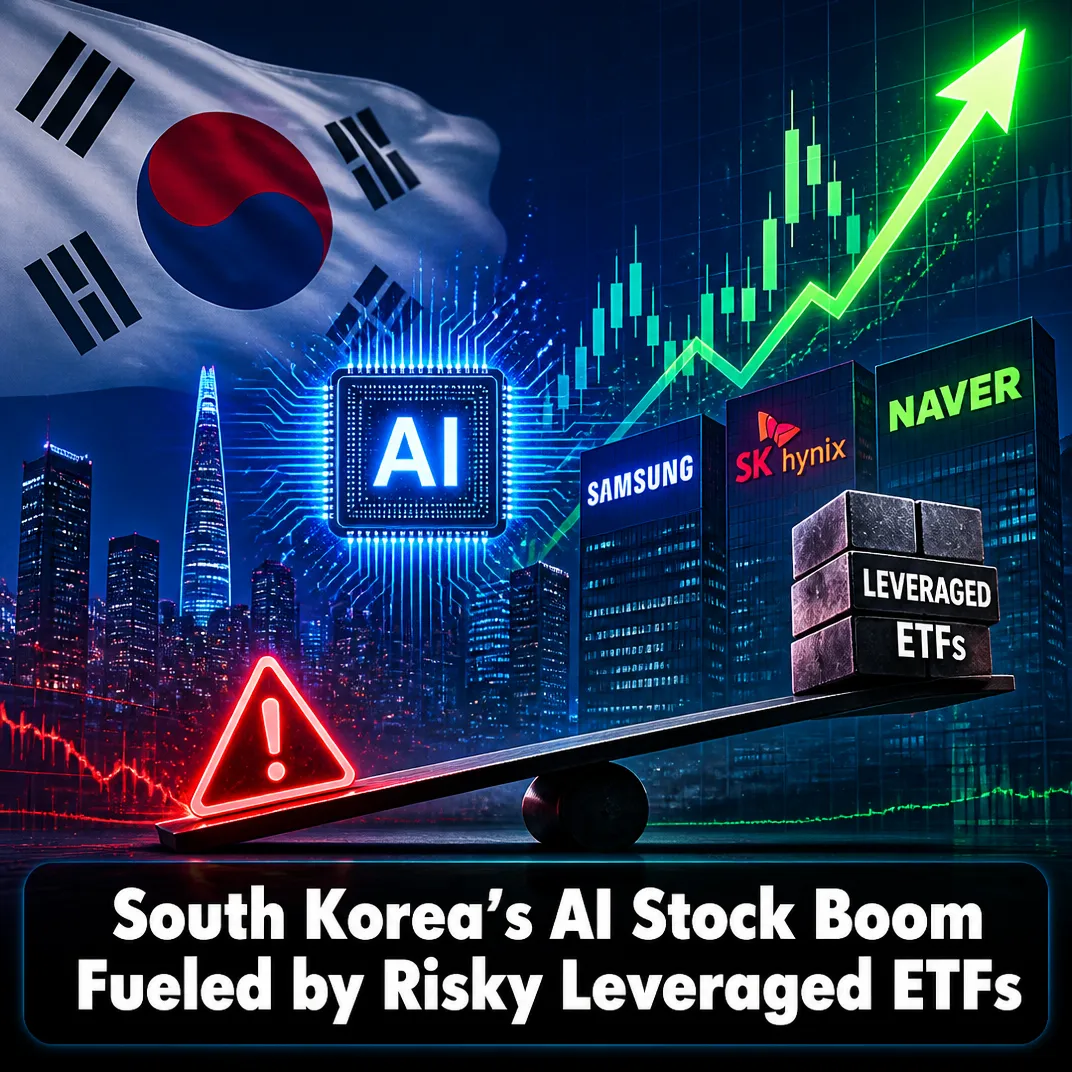
July 16, 2026, (Inside AI) — Leveraged exchange-traded funds are reshaping South Korea’s stock market, amplifying volatility in semiconductor giants Samsung Electronics and SK Hynix as retail and institutional money pours into these high-octane products. The funds, which use derivatives to multiply daily returns, have become a central force in the AI-driven rally, but regulators are now scrambling to contain the fallout.
Single-stock leveraged ETFs, first launched in the U.S. in 2022, arrived in South Korea in May 2026. They allow traders to bet on individual companies with two, three, or even five times the daily performance. In Asia, the products have exploded in popularity, particularly around AI chipmakers. The Hong Kong-listed twice-leveraged ETF tracking SK Hynix, offered by CSOP, has ballooned to HK$51.8 billion ($6.6 billion) in assets, making it the largest fund of its kind globally.
The mechanics are straightforward but volatile. These ETFs use futures or swaps to replicate a bet with borrowed money. If the underlying stock rises, the fund must buy more shares to maintain its leverage ratio; if it falls, it must sell. This daily rebalancing creates a feedback loop that can exaggerate price moves in both directions, injecting instability into the broader market.
In South Korea, the impact is magnified by the sheer size of the companies involved. Samsung and SK Hynix together command more than half of the benchmark KOSPI index, with market caps in the trillions of dollars. Their leveraged ETFs have become a dominant force in daily trading. According to Reuters calculations, the two stocks have accounted for over 80% of KOSPI trading volume on some days this year.
Michael Green, chief strategist and portfolio manager for Simplify Asset Management, described the situation as a self-reinforcing cycle.
“The combination is creating an incredible feedback loop that's driving volatility in the semiconductor space,” he said. “That's driving elevated levels of volatility on a single-stock level.”
The KOSPI’s volatility index, a measure of expected market swings, hit a record 97.99 on June 29, up from just 28.85 at the end of 2025. It stood at 89 on Thursday. SK Hynix’s recent Nasdaq debut has added another layer of turbulence, triggering a wave of new leveraged ETF listings in the U.S. that further tie the stock’s fate to derivatives-driven flows.
Regulators are sounding alarms. South Korea’s Financial Services Commission on Thursday announced measures to curb the frenzy, including banning promotional events for single-stock leveraged ETFs and advising against new launches. The move follows a rare admission from the Financial Supervisory Service last month that approvals had been “prepared hastily” as part of efforts to lure retail investors back from U.S. markets and support the won.
The products are officially aimed at professional traders, with disclaimers warning they are unsuitable for buy-and-hold investors. The cost of maintaining leveraged positions erodes returns over time, often causing the ETFs to diverge sharply from their targets. Yet retail investors have flocked to them, chasing amplified gains in the AI boom.
This dynamic is not entirely new. Leveraged ETFs have existed for two decades, but their application to single stocks is a recent innovation. The U.S. launched its first such funds in 2022, and Asia has quickly become the hottest market. The Hong Kong-listed leveraged ETFs for Samsung and SK Hynix, introduced in 2025, have seen assets surge—SK Hynix’s fund alone has grown twentyfold since the start of the year.
The situation echoes past episodes where structured products amplified market moves, such as the role of inverse ETFs during the 2008 financial crisis or the “volmageddon” event of 2018, when complex volatility-linked notes unraveled. In South Korea, the concentration of flows into just two stocks raises systemic concerns, as forced selling during a downturn could cascade through the entire KOSPI.
For now, the AI rally continues to fuel demand. But as regulators tighten rules and volatility spikes, the question is whether these instruments will remain a tool for sophisticated bets or become a trigger for the next market accident.