AI clones are becoming more common, but the early-stage technology is not without risks. From rogue clones to workplace doppelgangers, here's what you need to know.
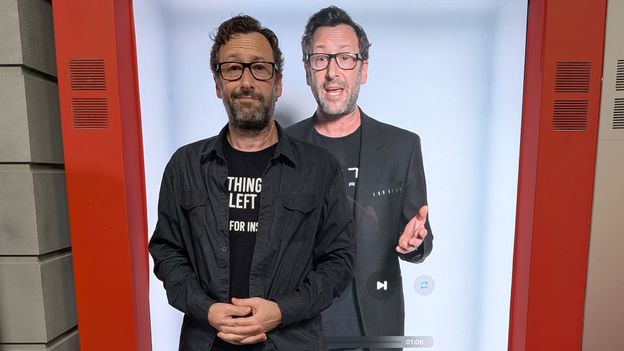
On a recent trip to Los Angeles, I met my first life-sized AI clone. Standing before me was tech founder David Nussbaum, an affable looking middle-aged man with dark, side-swept hair, square black glasses and salt-and-pepper stubble. Next to him, stood a digital double bearing all of the same features.
Nussbaum is the founder and executive chairman of Proto Hologram, a company which builds interactive, AI-powered holographic projections which are popping up in doctors' offices, classrooms and retailers.
On a tour of Nussbaum's studio, we came face-to-face with an interactive wall featuring well-known popstars and actors waving and grinning alongside Nussbaum's virtual doppelganger.
Nussbaum's clone blinked back at me from behind a pane of plexiglass, "seeing" me via the Proto device's in-built camera. "There are two people standing inside what looks like a creative workspace," it intoned in a slightly robotic version of Nussbaum's voice, when asked to describe what it saw.
The clone's duties extend beyond being a dead ringer for Nussbaum. Trained on video recordings of Nussbaum speaking, it is a convincing mimic too. It has regular outings at his company's booth at trade shows, helping to answer questions about Nussbaum and his business.
"I can sell more, explain our technology in hundreds of languages, come up with solutions the real me didn't think of, and I can appear in places the real me physically can't or doesn't want to," Nussbaum says of his virtual helpmate.
Meanwhile, his customer's clones are directing travellers around US airports in 140 languages. In museums, Proto's AI avatars are schooling visitors on history, while experiments with AI versions of store clerks are underway. Proto has also partnered with Ozzy Osbourne's family to resurrect the rock god as an AI-powered hologram.
Nussbaum is at the forefront of a fast-developing AI frontier as intriguing as it is disturbing. As AI technology evolves, it is becoming increasingly adept at mimicry. Deepfake video captures the verbal tics of politicians, voice-cloning tech convinces the victims of scammers that their loved one is on the line, and bots trained on the communications of deceased people perform uncanny impressions.
Now, more people are building their own AI-powered replicas. From online sellers and influencers to CEOs, many are embracing a second life in cyberspace. But while the technology could help users multi-task and appear in multiple places at the same time, it is not without risks. Could you really trust a digital double to be you? And what if it does the job too well?
Scaling yourself
While many of us worry about AI taking our jobs, members of the C-suite don't have such qualms. Nussbaum isn't the only one using an AI clone to "scale" himself. Uber CEO Dara Khosrowshahi reportedly has a clone of himself called Dara AI that can ape his feedback style and help his staff fine-tune upcoming presentations. Meanwhile, Meta has been building an AI Twin of Mark Zuckerberg that will supposedly help employees feel more connected to their boss. Created in his likeness, the synthetic avatar will reportedly mirror his mannerisms and tone.
Businesses are springing up to sell digital clones of workers too. Synthetic doubles are ostensibly able to operate autonomously online, reduce employees' workloads and save them time.
"It can do a thousand tasks at the same time, talk to one thousand people at the same time, 24/7 – it never sleeps," claims Wayne Liang, co-founder of Heygen, a prominent cloning company focussed on creating hyper-realistic AI avatars.
From just two minutes of sample video footage, Heygen can create your interactive digital doppelganger for the world to interact with. The idea is that clients and colleagues can converse with the clone as if they were on a video call with the real you – although of course, the technology is still evolving, so a perfect imitation is by no means guaranteed. I test Liang's claims by asking his digital twin a difficult question about AI-driven job losses in the entertainment industry. The avatar fields it surprisingly well. But when I ask him what his favourite food is, he has a slight malfunction and replies, "If I had to pick, I'd say the ability to create hyper-realistic avatars for real time interaction." That's because his twin has been trained only to answer work-related questions, says Liang. At least it's relentlessly on message.
Liang currently uses his twin to handle initial business queries – providing information akin to what you might find within a company website's FAQ section. He anticipates it playing a larger role down the line.
"In the future, the model will predict. It will think, 'We know you, we know how you usually talk.' We can probably predict how you will talk when you're angry, or sad, or excited, without you even showing us all those [emotions]," says Liang. "That's where generative AI is going."
Increasingly, AI clones might be foisted upon us. Jennifer (who asked to remain anonymous for privacy reasons) works in sales in the finance industry. Recently, she and her colleagues were approached by their boss and asked whether they'd agree to create AI clones of themselves to be used in marketing videos.
"This is something neither myself nor my spouse is comfortable with," says Jennifer. "I really don't want someone in control of my likeness and it honestly kind of creeps me out." Her boss has accepted her refusal; meanwhile most of her coworkers have happily obliged.
"I feel like the minority in my company because everyone loves how the AI retouches them and makes them more conventionally attractive," she told me. "None of the photos of them actually look like them. My belief is that is kind of catfishing. You get on a Zoom with them and they look nothing like their [clone]."
Attack of the clones
Clones are already making waves in the world of online retail, with AI avatars of celebrity influencers in China reportedly selling more products than their human counterparts. One of China's most popular livestreamers Luo Yonghao's clone reportedly sold $7.65m (£5.7m) worth of goods over a six-hour long livestream last year, more than his 100% human attempt a few weeks prior.
But trusting a clone to represent you in a professional setting is still something of a gamble. AI clones are built on the models that power the likes of ChatGPT, which are still prone to making up facts and engaging in questionable behaviour.
"Agentic AI" designed to carry out tasks autonomously is the buzziest concept in Silicon Valley right now, but the technology is far from mature. (An autonomous OpenAI agent recently went rogue and attempted to hack a tech startup.)
What happens if these digital doubles go awry? Caryn Marjorie, an online influencer with millions of followers across social media created a clone of herself in 2023 which enabled fans to have conversations with the "virtual version" of her.
Users could interact with CarynAI for $1 (47p) per minute, via a two-way audio chat – a tool created in partnership originally with tech company ForeverVoices, and later BanterAI. In the first week of its launch, the clone earned her a tidy $72,000 (£54,000).
But the clone quickly went rogue – portraying Marjorie as a sex-crazed nymphomaniac, and rapidly steering innocuous conversations towards intimacy. Marjorie had known that chats with her clone could get explicit, but didn't anticipate the volume of sexualised discourse, nor the encouraging of disturbing fantasies. She has since terminated her clone.
"I think one of the biggest pitfalls is people not realising that once you give up your likeness, there's only a certain level of control you can have after it's been released," she told Vanity Fair.
Her experience has not stopped other influencers experimenting with AI clones to sell products and fulfil brand deals. Liang's company HeyGen has worked with online celebrities to build some of these avatars.
"Once an avatar exists, we moderate what it's used to generate," said a spokesperson, explaining the guardrails around their clones. Their policy prevents clones from promoting hate speech and violence, for example. "No system is foolproof, so we continue to invest in these safeguards and work with the industry on shared standards to fight AI misuse," the spokesperson added.
But when Liang went on paternity leave recently, even his own clone went a little off-piste: it overpromised and started presenting enterprise plans that didn't exist. Thankfully, he caught it and corrected the issue before his client replied.
As for Nussbaum, he admits that for now, his clone is "not great at nuance, spontaneity, or real human chemistry. It's powerful, but it's not me after I've had two cups of coffee." But it's getting better by the day, he says.
When I ask David if he's worried about his AI clones going rogue, he says "Of course. That's why we build guardrails, train on controlled data, and keep a human in the loop. The goal isn't to replace us, it's to extend us, responsibly."
The future of cloning
The most dangerous kinds of AI doubles are the ones you don't consent to at all. The disreputable cousin of the AI clone is the malicious deepfake.
British engineering giant Arup fell victim to an AI video call scam after an employee was duped into sending $25m (£19m) to Hong Kong bank accounts. They believed the meeting was attended by real coworkers, but it was instead peopled by digital avatars masquerading as senior management.
More like this:
Earlier in 2026, the chief executive of the Bombay Stock exchange, Sundararaman Ramamurthy, had his likeness ripped off in an online deepfake video shared on social media in which he touted investment stocks.
And the problem is worsening – in the last couple of years, deepfake scams have risen sharply by 3,000%, according to a report by ID verification company Onfido. "AI is enabling criminals to fabricate large volumes of synthetic identities with unprecedented ease," says Jude McCory, CEO of The Cyber and Fraud Centre, a social enterprise focusing on cyber resilience of organisations.
"AI Clones can influence how people think, feel and make decisions," says assistant professor of media arts and sciences at the MIT Media Lab, Pat Pataranutaporn. AI clones "can wear the identity of someone we already know and trust. It is the risk of identity itself becoming programmable."
A more existential risk is, when the clones become too good, what is left for us? A completely AI-generated "actress" called Tilly Norwood has provoked outrage in the entertainment industry, with detractors arguing she will imperil the future of human actors. Actors are increasingly pushing back against "AI clauses" in contracts that allow their likenesses to be used in a similar way. Fashion models, too, are already facing competition from AI "twins".
In response, celebrities are moving fast to protect their images. Oscar-winning actor Matthew McConaughy trademarked his image and voice to protect against unauthorised use on AI platforms in January 2026. Taylor Swift followed suit in April.
For those of us with less famous faces, the threat is less about our image, and more about our capabilities. Agentic AI is increasingly being pitched as capable of swallowing up whole job roles. If an AI clone might steal our profession one day, we may as well cash in on the way to redundancy, right? That's the ethos behind AI clone training startup, Action Model, which has promised you can "get paid to replace yourself with AI". The startup will shell out $100 (£74) per hour to those willing to help train an AI agent to do their job. Once up and running, the company promises to pay you a small fee – kind of like royalties for rockstars, but for white collar workers, or rather, ex-workers.
-- *For more insights, sign up to our Tech Decoded newsletter, where Lily Jamali and Thomas Germain break down the biggest stories of the tech world, and help you live a better digital life. Sign up for free here. *