Experiment summary #
Snap sent only under-covered product-ad requests through an LLM retrieval path. In a two-week randomised production test, the company reports 27.6% more attributed click-and-purchase conversions while click-through rate stayed almost flat.
- Snap’s existing product-ad retriever used hundreds of features to match people with items from large advertiser catalogues.
- The new system first ran a cheap deterministic keyword search, inspected the products it found and called an LLM only when those results left a coverage gap.
- Offline tests found that 73% of users gained nothing from appending LLM queries, while quality peaked when about 10% were routed through the generative path.
- Snap reports a 27.6% relative lift in attributed click-and-purchase conversion rate in a two-week randomised A/B test. Click-through rate was 0.9% lower.
- The paper does not publish traffic volume, absolute conversion rate, statistical uncertainty, revenue, market mix or dollar inference cost.
Before Snap asked a language model to find more products, it looked at what the cheap search had already found. For most people, the answer was enough.
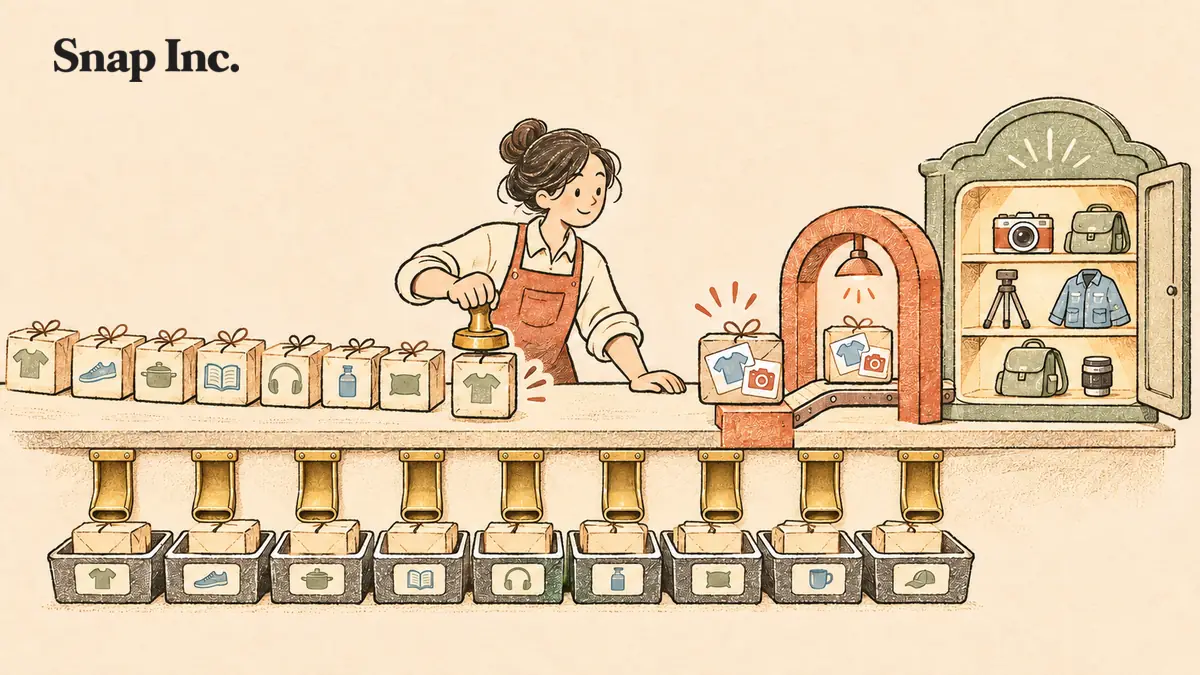
That observation changed the experiment. Instead of putting every ad request through a generative model, Snap’s team built a gate. The ordinary keyword route ran first. Only a request whose first results missed too much of the user’s shopping history could pass into the LLM route.
The operating point settled near one user in ten. Snap says that selective system used 90% fewer LLM calls than an always-on version. In a two-week test on live traffic, the company reported a 27.6% relative increase in conversion rate, defined narrowly as attributed click-and-purchase actions. Click-through rate moved the other way by 0.9%.
The expensive path was often unnecessary #
Dynamic Product Ads have two jobs that pull retrieval in different directions. Retargeting tries to resurface a product or category someone has already shown interest in. Prospecting tries to infer the next relevant category that has not appeared in that history. Both must work across catalogues containing millions of items.
Snap’s production control was already sophisticated. The SMART paper describes an optimised two-tower user-to-product embedding retriever that evaluated hundreds of features. The new system kept that bar in view and split retrieval between two tools.
The first tool was deterministic. It converted views, add-to-cart events and purchases into exact brand and category terms, giving those events weights of one, two and three. Those terms went into a BM25 lexical index. This was good at retargeting because the words matched the structured product catalogue.
The second tool used Gemini 2.5 Flash Lite to generate exactly three prospecting queries. Those queries searched a dense vector index, which could match a broader idea even when the wording differed. The candidates from both routes were merged, ranked for relevance and diversity, then checked against active advertiser product sets before an ad could be served.
The preliminary result argued against switching everything to the model. Rule-generated keywords beat LLM queries on category recall when both used lexical search. The generative path was better at semantic discovery when paired with the vector index. Neither method won outright. They were good at different jobs, a pattern Netflix also hit when testing two AI ideas that only worked as a pair.
The gate inspected the answer #
Most AI routers inspect an input and decide which model should answer it. Snap’s gate waited. It ran the keyword retrieval first, then examined the actual product set that came back.
A lightweight gradient-boosted classifier used 54 features across 11 groups. The most useful signals came from the search output, including product-set density, the number of categories returned, semantic coverage and result diversity. A simple coverage-gap measure asked how many categories in a user’s history were absent from the keyword results.
In the Snap LLM ad retrieval test, routing depended on one question: had the cheap attempt failed to cover enough of the user’s intent? If it had, the model and vector search were invoked. If it had not, the request stopped there.
Offline, 73% of users saw no change in the paper’s recall or relevance measures when LLM expansion was appended. Only 14.4% showed a clear improvement. Always-on generation therefore spent computation on many people whose first result set was already adequate, while also displacing useful products from a finite candidate pool.
Quality peaked before AI reached everyone #
The team swept the gate threshold from keyword-only retrieval to always-on SMART. Category recall peaked in the 5% to 15% routing band. At a 10% operating point, category recall at 200 candidates reached 56.6%, against 56.0% for keyword-only retrieval. The relevance score rose from 1.95 to 2.36, close to the 2.39 produced by the standalone LLM and vector route.
Sending every request through both routes was worse on category recall than stopping at 10%. The paper attributes that reversal to candidate noise. A downstream ranker can demote a weak item that remains in the pool, but it cannot recover a useful item pushed out before ranking begins.
The offline evaluation was not free of judgement calls. Prospecting relevance was scored by one model family, Gemini 3 Flash, rather than a human panel. The authors tested the gate on a held-out next day and checked delayed purchase labels over one week, but not over multiple seasons or long catalogue shifts.
The live result needs its denominator #
Snap then compared SMART with its production embedding retriever for two weeks. Live traffic was split uniformly at random between the two arms. The paper indexes the control conversion rate at 100 and SMART at 127.6. It indexes click-through rate at 100 for the control and 99.1 for SMART.
That pattern points to an AI ad conversion effect: the new candidate set was associated with more attributed purchases from roughly the same number of clicks. But the public evidence stops before the decision becomes a full unit-economics case.
The paper does not disclose how many users or requests entered the online test, the absolute conversion rate, confidence intervals or a significance test. It does not report revenue, advertiser return, order value, cancellations, geographic traffic mix, latency or dollar inference cost. Its conversion measure is an attributed click-and-purchase action, not independently verified realised revenue. The authors’ conclusion that the system produced higher-intent traffic is plausible, but it remains a company interpretation of its own experiment.
A smaller team can copy the decision #
Snap’s implementation depends on structured catalogue fields, real-time event histories, lexical and vector indices, a learned gate, a reranker and production experimentation infrastructure. Rebuilding that stack would require an experienced recommendation team.
The decision pattern is easier to reproduce. A software company could run a rules-based support search, lead enrichment pass or product match first. It could define one inspectable insufficiency score, such as missing required fields, low source coverage or failure to retrieve a known category. Only records below the threshold would call an LLM API.
The bounded test needs three arms where traffic allows. Keep the incumbent, add an always-on AI route and add a gated route. Measure the business outcome and the operating guardrails together. For product retrieval, that means conversion and margin beside call rate, latency, candidate diversity and attribution quality. Start with a rule threshold before training a classifier. The next useful experiment is whether that simple gate captures most of the value.
| Experiment detail | What Snap reported |
|---|---|
| Problem | Find relevant products across large catalogues without paying for an LLM on every request. |
| Control | Optimised production user-to-product embedding retrieval using hundreds of features. |
| Treatment | Keyword retrieval first, then LLM query generation and vector search only when an output-aware gate detected a coverage gap. |
| Routing point | About 10% of users sent to the LLM path, reducing generative inference calls by 90% versus always-on routing. |
| Offline finding | 73% saw no metric change from appended LLM queries; quality peaked in the 5% to 15% routing band. |
| Online design | Two-week production A/B test with traffic split uniformly at random. |
| Commercial result | Conversion rate indexed at 127.6 versus 100 for control; CTR indexed at 99.1 versus 100. |
| Not published | Traffic denominator, absolute conversion, uncertainty, revenue, market mix, latency and dollar cost. |
Sources and disclosure #
- Congfei Zhang and colleagues, SMART: LLM-Augmented Hybrid Retrieval for Dynamic Product Ads , first submitted 25 July 2026
- ACM RecSys, [official 2026 programme listing for the accepted industry paper](https://recsys.acm.org/recsys26/session-1/)
- Snap Inc., [2025 annual report filing and company information](https://investor.snap.com/news/news-details/2026/Snap-Inc--Files-Annual-Report-on-Form-10-K/default.aspx)
- [Congfei Zhang’s practitioner page](https://congfei.dev/) , identifying his Snap ads-ranking role and LLM systems work
The paper is authored by Snap practitioners and uses proprietary production data. It appears in the official RecSys 2026 programme, but Industry Contents found no public raw dataset or independent replication.
FAQ #
What did Snap change? #
Snap ran deterministic keyword retrieval first and inspected its coverage. Only requests with an insufficient result set were sent through LLM query generation and vector search.
Why did Snap route only about 10%? #
Offline threshold tests found the largest quality gains in the 5% to 15% band. Sending more traffic through the LLM introduced candidate noise and diminishing returns.
What happened in the production test? #
Snap reports a 27.6% relative increase in attributed click-and-purchase conversion rate over its production embedding retriever. Click-through rate was 0.9% lower.
Was the result statistically significant? #
The public paper does not provide online arm sizes, confidence intervals or a significance test, so readers cannot independently assess the uncertainty around the reported lift.
Can a team without machine-learning engineers copy it? #
Not Snap’s full stack. A smaller team can copy the audit-then-invoke decision with a deterministic first pass, a simple coverage rule, an LLM API and a controlled comparison that tracks conversion, cost and latency.
Compare more measured experiments in the Signal Index, browse the Growth Signal archive, or use the benchmark tools in the IC Lab.