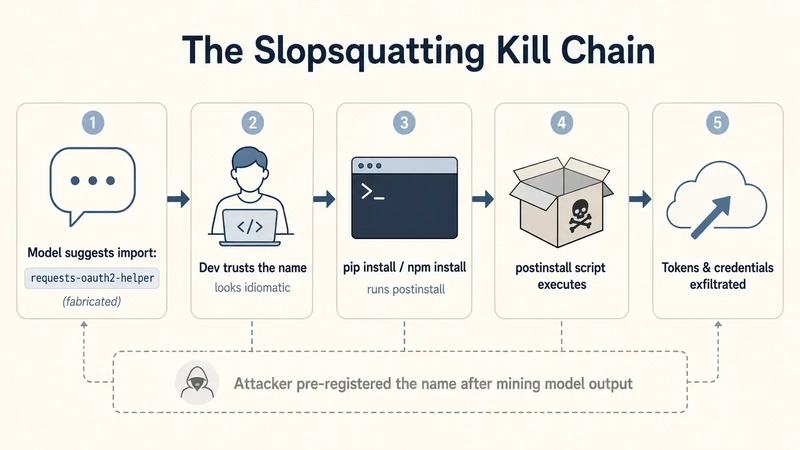
The scenario is simple and terrifying. You ask an AI for a specific utility—say, a way to handle OAuth2 tokens with the requests
library. The AI confidently tells you to run:
pip install requests-oauth2-helper
It looks perfect. The naming convention is spot on, and it fits the ecosystem. You run the command, the package installs, and your code seemingly works. The catch? requests-oauth2-helper
didn't exist when the model was trained. The AI invented it. An attacker, monitoring these common hallucinations, simply registers that exact name on PyPI and waits for you to install their malicious payload.
Why Slopsquatting is More Dangerous Than Typosquatting #
In a standard typosquatting attack, the attacker hopes you type reqeusts
instead of requests
. It's a low-probability game. Slopsquatting flips the script because the human isn't making the mistake—the model is. You are copying and pasting a string character-for-character from a source you trust. You aren't "fat-fingering" the command; you are faithfully executing a hallucination.
The real danger lies in the predictability of these errors. Data shows that these aren't just random glitches. A significant portion of hallucinated packages are reproducible; if a prompt generates a fake package once, there is a high probability it will generate that same fake name again for another user. This allows attackers to target high-traffic "hallucination zones" rather than guessing random typos.
The Technical Scale of the Problem #
To understand the risk, we have to look at the numbers from recent research. In a massive study of over 500,000 code samples across 16 different LLMs, the results were sobering:
Hallucination Rate: Roughly 19.7% of recommended packages in Python and JS didn't actually exist.Model Variance: Commercial models generally hallucinated less (around 5.2%), while open-source models were significantly higher (over 21.7%).Reproducibility: About 43% of these fake packages appeared every single time the same prompt was run.
How to Protect Your AI Workflow #
If you are using tools like Cursor, Claude Code, or GitHub Copilot, you need to treat AI-suggested dependencies as "untrusted" until verified. Here is a practical tutorial for a safer AI workflow:
- Verify Before Install: Never run a
pip install
or npm install
suggested by an AI without a quick search on the official registry (PyPI, npmjs.com).
-
Check the "Age" and "Downloads": If a package was created three days ago and has 10 downloads but the AI claims it's a "standard helper," it's a red flag.
-
Use Lockfiles: Always use
requirements.txt
or package-lock.json
and audit your dependencies.
- Sandbox Your Tests: Run new AI-suggested libraries in a containerized environment before moving them into your main development branch.
Integrating these checks into your prompt engineering and deployment process is the only way to stop a hallucination from becoming a security breach.
Next Kimi K3 Deployment via Telnyx Inference API →