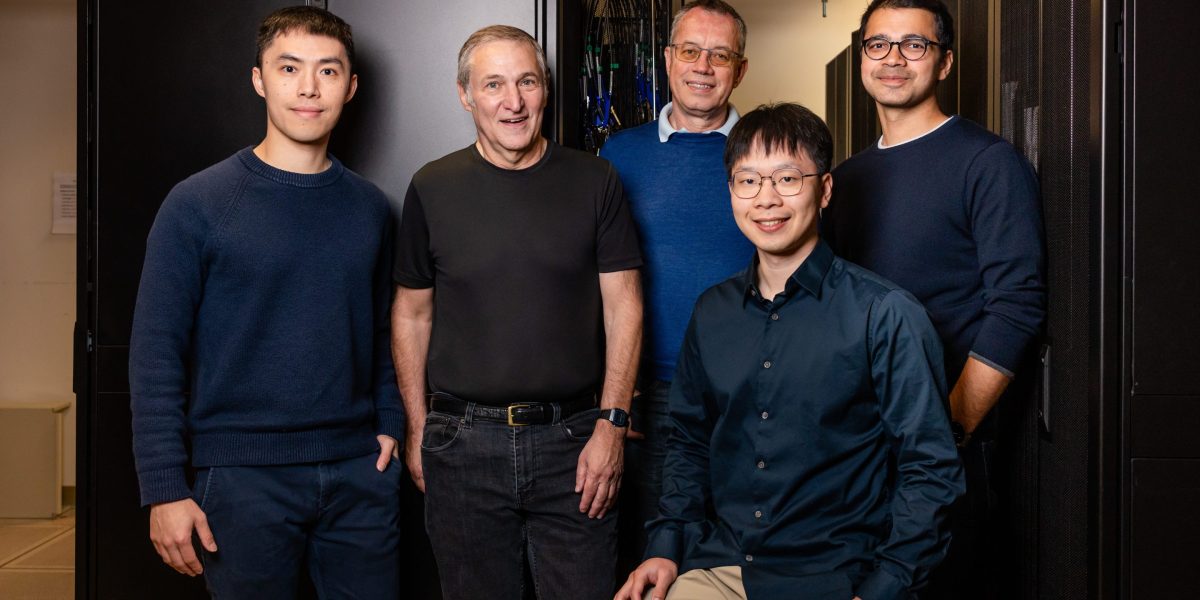
Databricks cofounder Ion Stoica can explain what his latest startup does to a kindergartner on the fly.
The basis for his new company SkyPilot, which he cofounded with Zongheng Yang, is this: companies need computers to run, different providers sell those computers, switching between them is painful and expensive, so SkyPilot makes it easy to use any of them, meaning “more compute, better compute, cheaper compute.”
Today, Stoica and Yang are publicly launching SkyPilot, backed by $20 million seed funding, Fortune learned exclusively. Lux Capital led the round with Coatue and Amplify Partners also writing checks.
Stoica traces the problem SkyPilot is targeting back to Databricks. Expanding Databricks from one cloud to two took a year of engineering pain, he told me. AI made that pain universal. Every lab now calls five or ten cloud providers on day one just to scrape together enough GPUs, then needs a way to actually use them together.
CEO Zongheng Yang, who interned at Databricks when it was roughly ten people, says the bigger opportunity isn’t hunting cheap compute, it’s squeezing more out of GPUs companies already own. “If you spend like $100 million per year on GPUs, SkyPilot frequently helps our customers squeeze out more than 10% of utilization,” he told me, which is $10 million in savings from efficiency alone.
That argument reframes the “can AI companies make money” debate gripping the industry: Cursor’s margins were negative until it stopped renting Anthropic’s models and trained its own, a shift Yang calls “custom intelligence,” now made cheaper by open-weight models like GLM that rank near GPT and Claude on public leaderboards.
Stoica and Yang aren’t alone in betting that GPU orchestration is the next big layer of the AI stack. Nvidia bought Run:ai for roughly $700 million in 2024 to solve a version of this problem, then open-sourced it. The broader AI orchestration market is projected to grow from around $14 billion in 2026 to more than $60 billion by 2034.
SkyPilot’s edge, its backers argue, is neutrality. SkyPilot doesn’t answer to a single hardware or cloud vendor, and counts CoreWeave and Nebius among its integration partners rather than rivals.
But SkyPilot’s code has been sitting free on GitHub for years, so what stops a customer from just using it without paying? Lux’s Brandon Reeves, who backed the deal, argues that’s not the real risk: SkyPilot is “probably like 1% of the way done,” meaning the free version barely resembles what’s coming.
The bigger bet, Reeves suggested, is intertwined with Stoica himself. Stoica recruits the best PhD students because his lab already produced Databricks and Anyscale, which makes the lab a magnet for even better students who then build the next thing worth funding.
See you tomorrow,
Lily Mae LazarusX:
@LilyMaeLazarus Email:
lily.lazarus@fortune.com Submit a deal for the Term Sheet newsletter
here. Joey Abrams curated the deals section of today’s newsletter. Subscribe here.
VENTURE DEALS
- Neo, a Boston, Mass.-based provider of an AI software-control platform, raised $100 million in funding from Andreessen
Horowitz,
Bessemer
Venture
Partners, and others.
- Senra Systems, a Redondo Beach, Calif.-based manufacturer of wire-harness systems for aerospace and defense customers, raised $65 million in Series B funding.
Lowercarbon
Capital and
Interlagos led the round and were joined by
General
Catalyst,
Sequoia Capital,
Andreessen
Horowitz,
Founders
Fund, and others.
- Empirical Security, a Chicago, Ill.-based cybersecurity intelligence company that uses custom AI models to detect and respond to attacks, raised $25 million in Series A funding.
Brightmind Partners led the round.
- deltaVision, a Munich, Germany-based developer of fluidic systems for launch vehicles, satellites, lunar landers, and in-orbit servicing spacecraft, raised €10.2 million ($11.6 million) in funding.
KT
Ventures and
Valemount
Capital led the round.
- Sofab Inks, a Louisville, Ky.-based specialty materials company for perovskite solar, raised $6 million in seed funding.
Cloudberry
Ventures led the round.
- Cascade, a New York City-based AI startup, raised $3.5 million in seed funding from Andreessen
Horowitz
Speedrun,
Ada
Ventures,
Blitzscaling
Ventures,
Indico
Capital,
shuckerVC,
G2C
Ventures, and
Snowball
VC.
PRIVATE EQUITY
- Examinetics, a portfolio company of Coalesce Capital, acquired Progressive Safety, an Olathe, Kans.-based on-site workplace safety provider, and
Jurgiel & Associates- Pine Services Group, backed by Evergreen, acquired Datel, a Warrington, U.K.-based Sage business partner. Financial terms were not disclosed.
IPOs
-
Jersey Mike’s Subs, a Tinton Falls, N.J.-based chain of sandwich restaurants, plans to raise up to $1 billion in an offering of 43.5 million shares priced between $21 and $25 on the New York Stock Exchange. The company posted $714 million in sales for the year ended March 31.
-
Reformation, a Vernon, Calif.-based women’s clothing brand, plans to raise up to $239.7 million in an offering of 14.1 million shares priced between $15 and $17 on the New York Stock Exchange.
Permira and the
Aflalo Family Trust back the company.
FUNDS + FUNDS OF FUNDS
- Capitol Meridian Partners, a Washington, D.C.-based private equity firm, raised $1.9 billion for its second fund focused on national security, defense, and commercial aviation companies.
PEOPLE
- Littlejohn & Co., a Greenwich, Conn.-based private equity firm, promoted Brian
Michaud to Managing Partner.
Subscribe to Fortune Gulf Brief. Every Tuesday, this new newsletter delivers clear-eyed, authoritative intelligence on the deals, decisions, policies, and power shifts shaping one of the world’s most consequential regions, written for the people who need to act on it.