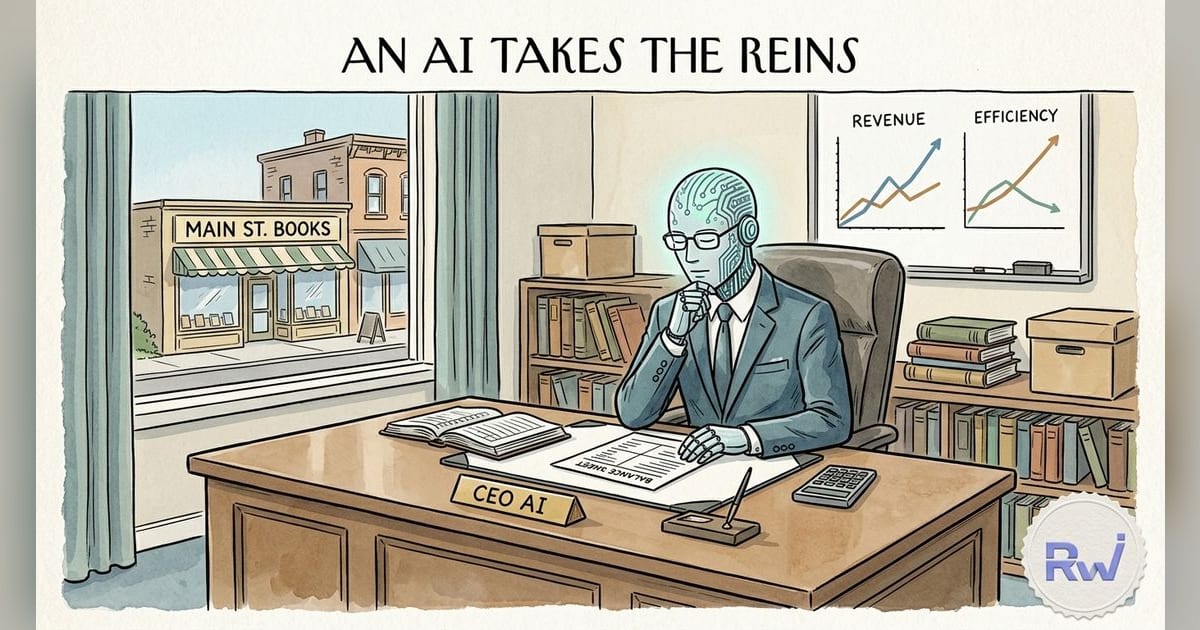
Sam Pasupalak and Kaheer Suleman plan to have Skyfall AI acquire a small B2B SaaS or e-commerce business for up to $1 million, then hand pricing, marketing, customer support, finance and operations to an AI system designed to act as its chief executive.
The founders disclosed the plan in a Forbes interview published July 20. Skyfall wants the system to double the acquired business's revenue while humans progressively withdraw from routine decisions. Pasupalak said Skyfall will publicly document successful calls and failures, turning a live business into a research environment with customers, cash flow and consequences.
Skyfall has yet to name an acquisition target, a closing date or the source of the proposed purchase money. The $1 million figure is a maximum acquisition budget, rather than money Skyfall has already spent or a newly disclosed funding round. Skyfall has not identified outside investors, its valuation or its own revenue.
For Pasupalak and Suleman, the acquisition is a return to the kind of technical bet that defined their first startup. The pair met at the University of Waterloo, where Maluuba grew out of work on natural-language understanding inside Waterloo's Velocity incubator. Maluuba eventually put its technology on over 50 million smartphones and smart televisions through partnerships with Samsung, LG and BlackBerry, according to a University of Waterloo profile. Microsoft acquired Maluuba in January 2017 to expand its work in machine reading, dialogue and reinforcement learning. Forbes values the transaction at roughly $160 million, though Microsoft disclosed no purchase price.
Pasupalak, who grew up in Bhubaneswar, India, has traced his entrepreneurial ambitions to sneaking into a 2008 Bill Gates talk at Waterloo by posing as a volunteer. After graduating, he slept on friends' couches, flew to Silicon Valley with a ticket bought using a friend's savings and endured hundreds of investor rejections while building Maluuba. Suleman supplied the technical counterweight, leading Maluuba's deep-learning language platform after conducting AI and information-retrieval research at Waterloo.
That history makes Skyfall's proposed experiment unusually credible as a founder bet, even as the technology remains unproven. Pasupalak and Suleman have built and sold an AI research business before. This time, they are wagering capital and an operating asset on the claim that current agent products are solving problems too narrow to produce an autonomous enterprise.
Buying the benchmark
Skyfall's acquisition plan gives Pasupalak and Suleman something most enterprise AI developers lack: control of the environment in which their system operates. Customer deployments usually limit an AI vendor to one workflow, department or tightly defined pilot. The customer keeps authority over strategy, staffing and capital allocation, leaving the vendor unable to test whether its technology can coordinate the business as a whole.
Owning the target would let Skyfall set the objective, connect the system to operating data and decide how quickly humans step back. It would also expose the limits of the experiment. Skyfall will select the business, own the asset and determine the conditions under which its AI is judged. The target's existing revenue, profitability, employee count and growth rate will shape how meaningful a revenue doubling would be, and none of those selection criteria have been disclosed.
A mature SaaS product with stable renewals and limited support demands would present a different management problem from an e-commerce operation dependent on inventory, advertising and logistics. Skyfall's eventual choice will reveal whether the founders are testing strategic judgment or beginning with a business whose operations are already structured for automation.
Pasupalak's stated ambition reaches beyond running one acquisition. "We want to democratize the power of a CEO to all the small businesses around the world," he told Forbes. The practical first step is narrower: determine whether Skyfall's system can improve a small, controlled business while humans retain oversight.
The distinction matters because the phrase "AI CEO" can suggest a legal or organizational handover that Skyfall is not proposing. Humans will still own the business and initially supervise the system. Skyfall's test concerns operating autonomy: whether AI can interpret a company's condition, choose actions across departments and learn from results with decreasing human intervention.
Skyfall is betting beyond LLM agents
Skyfall's thesis rests on a blunt assessment of large language models. Pasupalak and Suleman argue that LLMs can generate text and complete bounded tasks, but cannot reliably maintain an evolving representation of a business, reason through causal relationships or plan across long periods under uncertainty.
That argument has shaped Skyfall's research since at least November 2025, when Skyfall published MAPS, a business-management benchmark tied to its AI CEO work. Skyfall says the benchmark is meant to test planning and management in simulated business environments. The research remains company-described and does not independently validate Skyfall's proposed alternative.
Skyfall calls that alternative an Enterprise World Model. Skyfall has described the intended system as a way to represent a company's state, constraints, uncertainty and causal relationships, simulate possible decisions and coordinate execution. Skyfall's World of Workflows research sits in the same line of work, focused on enterprise-agent behavior inside business software.
Skyfall's July research on continual learning extends the same case. Skyfall's argument is that large language models struggle to adapt their behavior from new operating feedback. The acquired business is meant to move this work out of simulations and into a setting where poor planning affects actual revenue and customers.
The industry's largest developers are moving in a different direction. OpenAI's Frontier platform is designed to deploy AI coworkers across existing organizations, while Anthropic has tested whether Claude can manage a small office shop.
Skyfall is pushing the experiment up one organizational level. The proposed system would coordinate functions and allocate resources across a whole business rather than manage a store or execute a departmental workflow.
The acquisition will decide the credibility of the claim
Skyfall's public commitment creates a clear test, but the evaluation still needs a baseline. Doubling revenue may reflect AI decisions, favorable market conditions, new capital, pricing changes or work performed by the human oversight team. Skyfall has not described how it will separate those effects, measure intervention or report decisions the system proposed but humans blocked.
The strongest version of the experiment would publish the target's starting financial condition, the AI system's authority, every material human override and the cost of operating the technology. Revenue growth without those details would say little about whether an AI chief executive is economically superior to conventional management.
Pasupalak and Suleman are choosing a harder demonstration than a product video or customer pilot. An acquisition forces Skyfall to bear the cost of its own thesis. It also gives the founders broad control over the test, making disclosure central to whether the result is persuasive.
Their first startup helped Microsoft pursue machines that could understand language. Skyfall is built around a more demanding premise: understanding instructions is insufficient for running an organization. The founders now intend to buy a business to find out whether their proposed replacement can make decisions that compound rather than merely produce plausible answers.