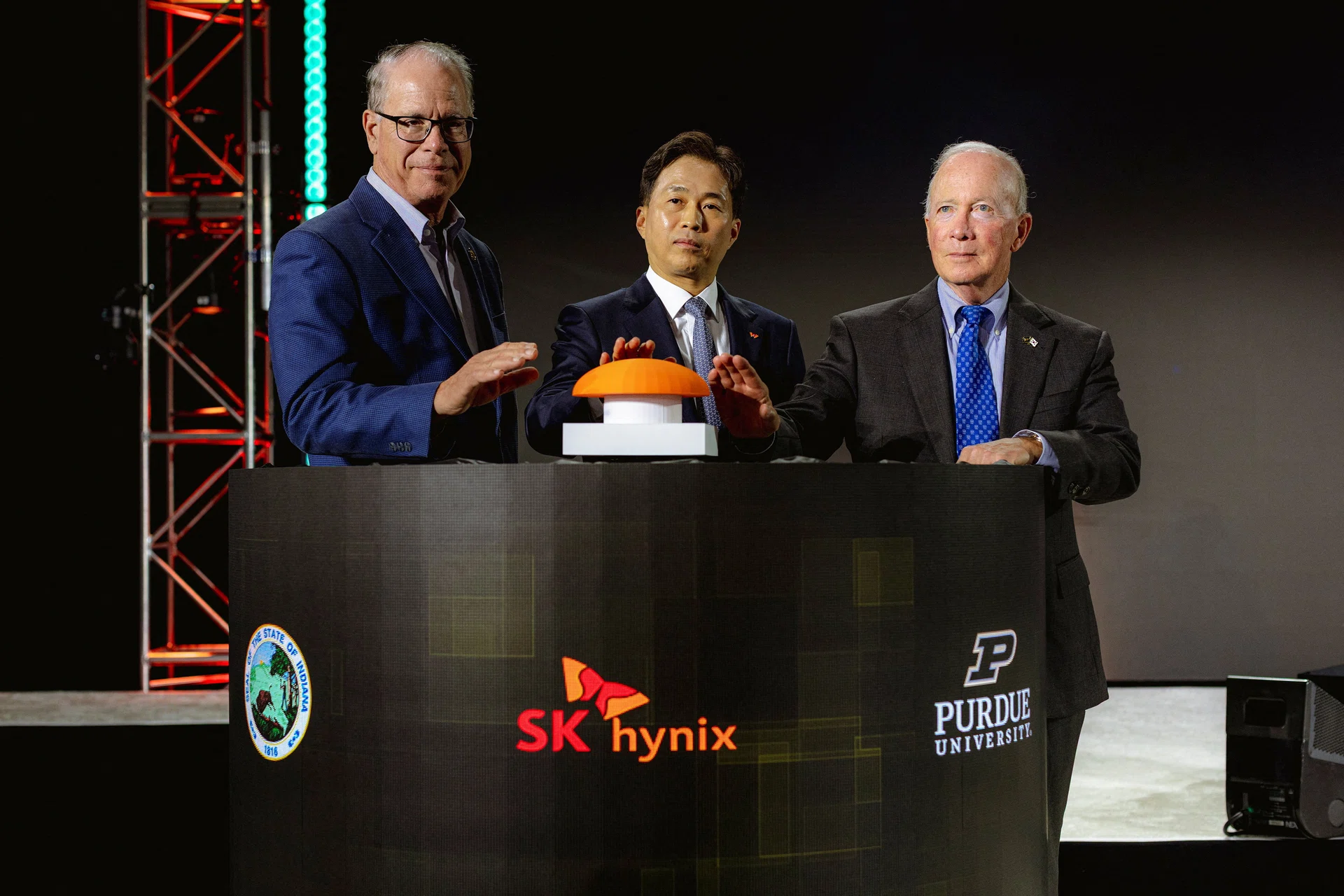
By 2030, the company expects Indiana to become a key high-bandwidth memory production base in the US
[WEST LAFAYETTE, Indiana] South Korean chipmaker SK Hynix said on Thursday (Aug 27) it plans to begin volume production of its next-generation HBM4E chips at its Indiana facility in the third quarter of 2029, as its chief executive said the company expects a current memory chip shortage to persist through the end of 2030.
Chief executive Kwak Noh-Jung expects the site to eventually reach annual capacity of hundreds of thousands of wafers.
The more than US$4 billion project marks a major expansion of SK Hynix’s US operations as surging investment in artificial intelligence drives demand for high-bandwidth memory, or HBM.
The chipmaker seeks to bring production closer to major customers including Nvidia, Microsoft and Alphabet’s Google.
Kwak said he saw no clear signs of a memory downturn and expected any eventual slowdown to involve moderating rather than sharply falling demand, adding that he was not concerned about the outlook beyond 2030.
Separately, asked whether SK Hynix had withdrawn plans for a US initial public offering of its Nand flash memory unit Solidigm, Kwak said it was still under discussion and no decision had been made to abandon the plan.
By 2030, the company expects Indiana to become a key HBM production base in the US. The facility, at the Purdue Research Park in West Lafayette, is scheduled to begin cleanroom operations in the second half of 2028, Kwak said.
A cleanroom is a highly controlled manufacturing space that keeps dust and other microscopic contaminants out during the chipmaking process.
The site will house a next-generation HBM packaging line as well as an AI semiconductor research and development facility.
It will be closely integrated with SK Hynix’s production facilities in South Korea, with advanced wafers produced there to be shipped to Indiana for packaging and testing before being supplied to US customers, the company said.
“As competition to expand AI infrastructure intensifies, the Indiana fab, which connects SK Hynix’s Korea-U.S. production system, is expected not only to help stabilise the US semiconductor supply chain but also to contribute to strengthening national economic and security in the AI era,” SK Hynix said in a statement.
Kwak said SK Hynix aims to build an advanced memory supply chain in the US. HBM is a specialised memory chip that stacks chips vertically to deliver faster data processing while consuming less power, making it well suited to the enormous computing demands of AI applications.
Unlike conventional memory products, HBM chips are tightly integrated with AI processors, creating higher technological barriers to entry and giving suppliers greater pricing power. The product has emerged as a major growth driver for memory chipmakers after the industry’s recent downturn.
Race to build data centres #
SK Hynix accounted for 58 per cent of the global HBM market by revenue in the first quarter of 2026, according to Counterpoint Research, well ahead of Samsung Electronics and Micron Technology, which each held a 21 per cent share.
Nvidia, a major customer for SK Hynix, forecast on Wednesday a 70 per cent jump in revenue in the next fiscal year, underscoring unabated demand for AI computing and reassuring investors about the durability of the AI spending boom, while Kwak’s comments suggest SK Hynix sees little evidence of a near-term reversal in the memory cycle.
SK Hynix expects the facility and related supply-chain investment to create about 7,000 direct and indirect jobs locally and contribute to semiconductor supply-chain resilience.
To help the company, the US government finalised US$458 million in grants and up to US$500 million in loans under the Chips Act in December 2024.
Separately, SK Hynix’s board approved earlier in August about 54.3 trillion won (US$38.30 billion) in investments through 2031, including 35.2 trillion won for the second phase of construction of its chip fabrication plants in South Korea. REUTERS
Decoding Asia newsletter: your guide to navigating Asia in a new global order. Sign up here to get Decoding Asia newsletter. Delivered to your inbox. Free.
Share with us your feedback on BT's products and services
TRENDING NOW NDR 2026: Singapore to create new Western island to support 'new generation of industries'
Russia’s ‘pivot to Asia’ takes a turn as it prioritises ties with isolated regimes over bigger economies
Singapore cannot assume economic growth will create as many jobs amid AI shift: Gan Kim Yong
Aster marks third Singapore deal with Changi Airport fuel infrastructure stake