Singapore switched on a data center rack running on sixteen million living human neurons this month, and the number every outlet led with was power: about one kilowatt for the whole rack, against up to one hundred kilowatts for a comparable silicon AI server. That comparison is accurate, and it is also the wrong bill to read if you want to know whether the thing is actually cheaper to operate.
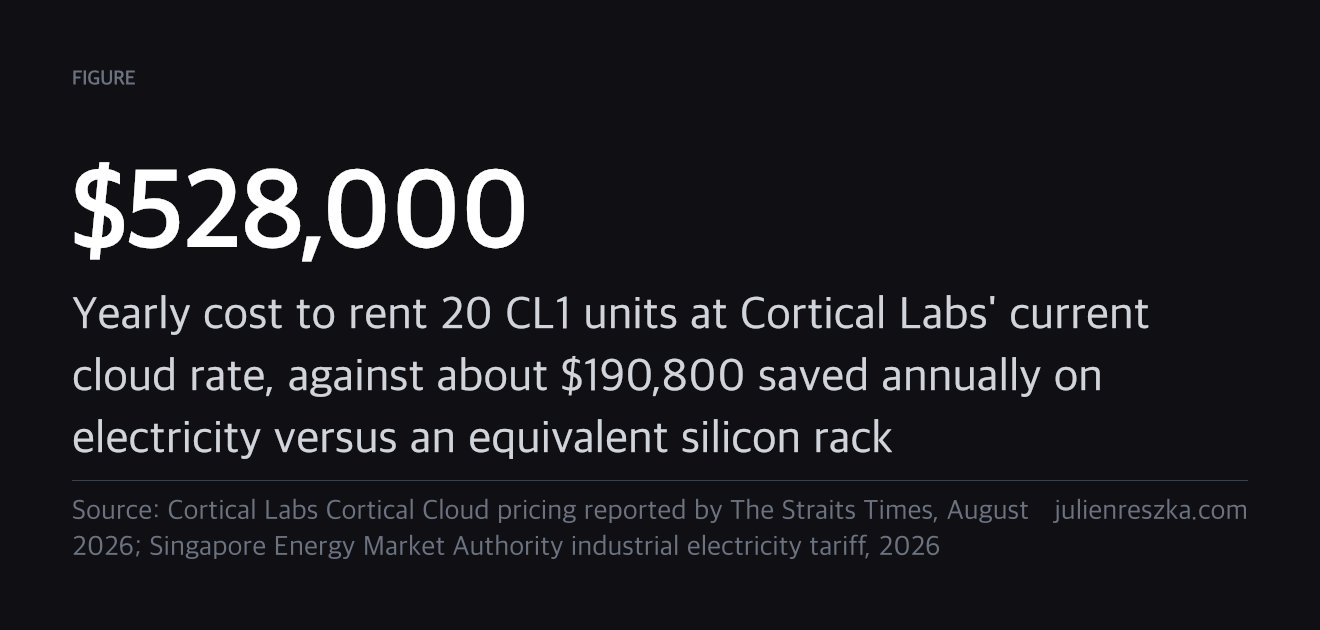
NUS Medicine, DayOne, and Cortical Labs built the rack from twenty CL1 units, chips fused to cultures of stem cell derived neurons that fire in a feedback loop with a microelectrode array. Cortical Labs prices access to that same hardware through its own Cortical Cloud service, and the number tells a different story than the electricity comparison does: $2,200 per unit per month. Twenty units of capacity at that rate would run $44,000 a month, or $528,000 a year, regardless of whatever arrangement NUS Medicine itself has with Cortical Labs. The same twenty units, at roughly one kilowatt total, save an estimated $190,800 a year in electricity against a comparable hundred kilowatt silicon rack, using Singapore's industrial tariff of about $0.22 per kilowatt hour.
$528,000 is not close to $190,800. Renting that much neuron capacity costs about 2.8 times what it saves on power, and the gap holds before counting what the price list does not itemize:
- Neuron cultures stay viable for about six months, then must be regrown from stem cells under sterile lab conditions
- Regrowing a culture needs a trained cell biologist, not a data center technician, the kind of specialist a stem cell lab pays $130,000 a year
- The rack also needs a continuous gas feed of carbon dioxide, oxygen, and nitrogen, plus fresh nutrients delivered every three days
None of this means CL1 is a bad product. Cortical Labs makes a different comparison in its own pricing pitch: $2,200 a month for CL1 access against about $4,300 a month for a comparable cloud AI chip. That comparison is price against price, and CL1 may well win it.
The headlines this week made a different comparison: CL1's power draw against silicon's power draw. That one favors CL1 too, until you check what CL1 access actually costs to rent, which is not electricity. $190,800 saved and $528,000 spent are both numbers Cortical Labs publishes. The coverage only used one of them.
That $2,200 figure deserves its own scrutiny:
- Cortical Labs is the one calling CL1 and a high end cloud AI chip comparable, and no published benchmark shows they do equivalent work per dollar
- The $4,300 baseline is a premium, on demand chip price, not the reserved or mid tier options that sit well below it
- Cortical Labs is reported to have about 20 paying customers, few enough that the price does not need to cover what a unit actually costs to run
That last point matters most given what this piece already found: the real, unavoidable cost of a CL1 is biological, a trained cell biologist regrowing the culture every six months, sterile lab space, continuous gas exchange, and biological labor does not get cheaper per unit the way silicon manufacturing does. Nobody has published what a CL1 unit costs Cortical Labs to run each month, so there is no way to confirm from public numbers whether $2,200 is a sustainable price or a loss leader.
Cortical Labs has raised $11.6 million total across three funding rounds, a modest amount for a company running a wet lab at commercial scale. That does not settle whether $2,200 a month is a real price or a subsidized one, but it does mean any subsidy could not run at large scale for long.
We may be missing something in this comparison, a scale efficiency, a subsidy, a workload difference that changes the math. If a reader can show what we got wrong, we will correct it.