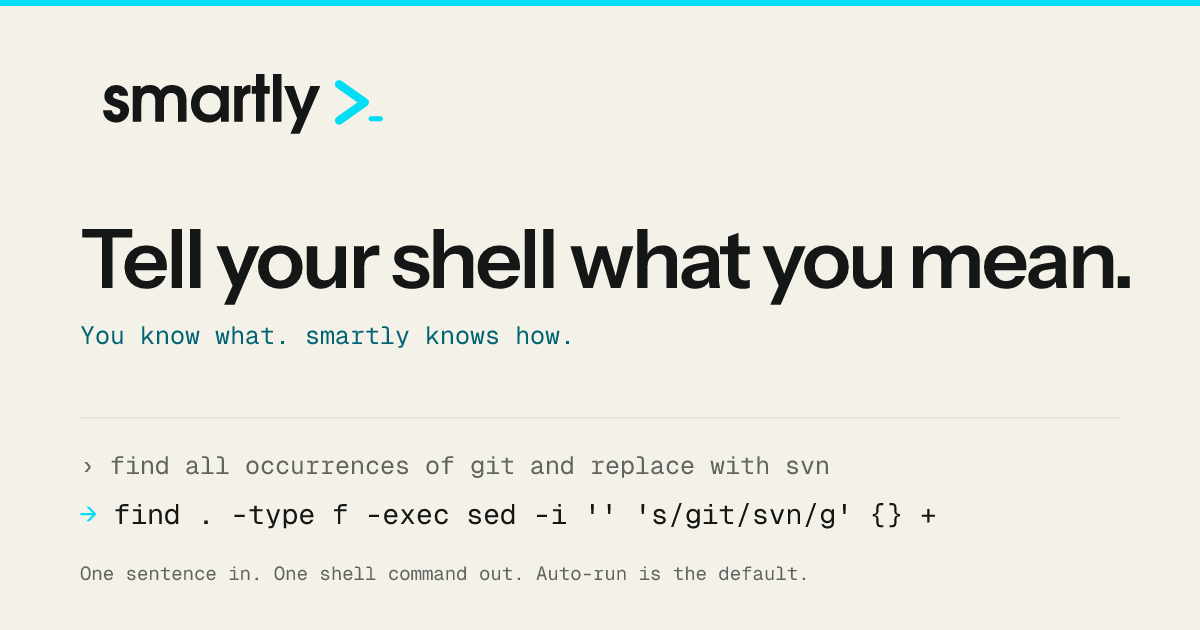
what you mean.
You know what. smartly knows how.
smartly sends one plain English sentence to an LLM, validates the reply is a single shell command line, and runs it. For people who know what they want to do and would rather not remember the exact flags.
Install
brew install rizwanreza/tap/smartly`` go install github.com/rizwanreza/smartly-cli/cmd/smartly@latest
Then run smartly onboard to pick a provider, a model and an execution mode.
The transform
Say the outcome. Get the command. #
What it does
Commands without the ceremony. #
- english → command
-
One sentence in, one command outDescribe the result. smartly returns a single executable shell command — pipes,
&&and redirects allowed, multi-step scripts never. - macos + linux
-
Knows which userland it is onIt checks whether
sed,date,statand friends are GNU or BSD on your machine — a Mac with Homebrew coreutils has both — and writes flags that work with the ones you have:sed -i ''for BSD,date -dfor GNU. - dir + git
-
Reads the roomBy default it sends a capped directory listing plus your git branch, status and worktrees, so “all worktrees except main” resolves against what is actually there.
- four providers
-
Your model, your billingAnthropic and OpenAI by API key, or your own logged-in
claude/codexCLI session if you already pay for a subscription. - four ways to run
-
Four ways to run it
autoruns the command immediately and is the default.confirmasks[y/N]every time,confirm-destructiveasks on anything it doesn’t recognise as safe, and--dry-runprints the command and runs nothing. - learn mode
-
Shows how the command works
--learnprints the command, then breaks it down piece by piece: each flag, pipe and argument with what it does, colour-matched to the command above. Nothing runs.
Before you install it
Auto-run is the default. #
smartly generates a command and runs it immediately, with no confirmation prompt — including when that command is destructive. Under auto nothing inspects what the command does; the only check is that the model returned exactly one clean command line.
That is the product working as intended, and it is the setting most worth reconsidering on a machine where a wrong rm costs you something. Three ways to change it:
confirm Ask me every time
Prints the command and waits for [y/N]. Reads/dev/tty directly, and fails closed when there is no terminal.
execution:
  mode: confirm
confirm-destructive Ask me when it is not clearly safe
A local classifier reads the generated command and asks on anything it doesn’t recognise as safe — destructive or unrecognised alike. A best-effort seatbelt, not a sandbox: to see every command, useconfirm.
execution:
  mode: confirm-destructive
--dry-run Just show me
Prints the command and does nothing else. The right flag for a phrasing you are not sure about yet.
smartly --dry-run remove every merged branch
Providers
Four backends. Bring an API key or your existing CLI login. #
anthropic and openai call an API with your own key. claude-cli and codex-cli shell out to a CLI you are already logged into — slower, but no second bill. Andopenai speaks to any OpenAI-compatible endpoint, including a local vLLM, Ollama or LM Studio.
| Provider | Authentication | Worth knowing |
|---|---|---|
anthropic |
ANTHROPIC_API_KEY | The default. Nothing to configure beyond the key. |
openai |
OPENAI_API_KEY | Ships no default model — set providers.openai.model yourself. |
claude-cli |
Your logged-in claude session | No API key: uses your Claude subscription. No tool access at all. |
codex-cli |
Your logged-in codex session | No API key: uses your ChatGPT subscription. Runs --sandbox read-only. |
Describe the result. #
Skip the flag archaeology.
brew install rizwanreza/tap/smartly`` go install github.com/rizwanreza/smartly-cli/cmd/smartly@latest