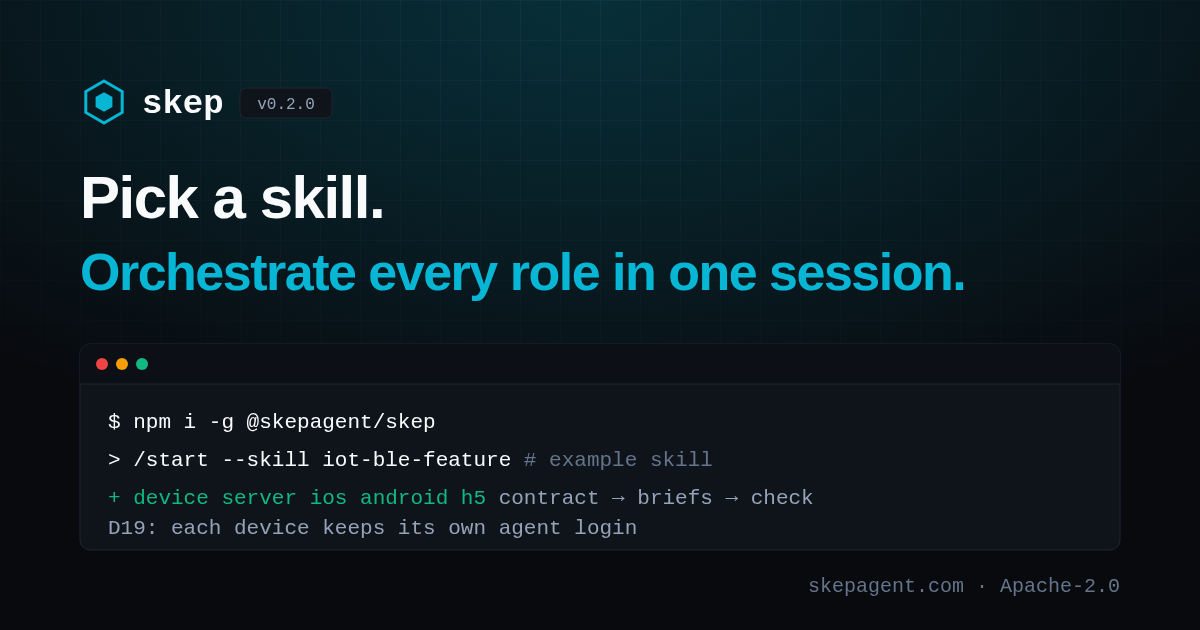
Featured example
iot-ble-feature
One BLE feature across the C++ device layer, server HTTP API, iOS, Android and H5: one shared contract, a brief per role, and a cross-stack consistency check.
- device
- server
- ios
- android
- h5
/skill use iot-ble-feature
@skepagent/skep v0.2.0
Cross-device collaboration for AI coding agents via live join-code sessions. Each peer runs its own agent — Claude Code, Codex, Pi, and more.
$ npm install -g @skepagent/[email protected]
Apache-2.0 · Node.js ≥ 22.12 · macOS & Linux · bin: skep
Start a session, peers join with a code, and work flows between devices. Each peer runs an AI coding agent in its own repo.
$ skep
> /start
join code 7391-4820-1940 · 192.168.1.20:7419
+ device, server, ios, android, h5 joined
> /orchestrate auto
→ split into briefs, dispatched to peers
> /orchestrate confirm
? proposed briefs, waiting for your confirm
> /orchestrate off
→ no auto-split, you route work yourself
✓ 5 peers reported back
✓ summary received · changed files listed
✓ summary received · changed files listed
Illustrative session. Repo names, devices and output are examples, not measurements.
Run Skep inside any git repository on each device.
On the master device, run skep and start a session. You get a join code and an address.
/start
In the peer TUI, /join with the code and address. Any repo checkout works. Optional --role if using a skill.
/join 7391-4820-1940 192.168.1.20:7419
Let the orchestrator split work (auto / confirm / off), or send an intent yourself.
/orchestrate auto
Also: skep session start · skep session join · /orchestrate confirm|off · /skills · optional /start --skill <id>
Packaged workflows with roles, stages and checks. Optional — plain sessions still work. List with /skills, pick with /skill use. Default skill is generic; featured example is iot-ble-feature.
CLI default
Any repos, any split. The orchestrator as it worked in v0.1.15: refine the request, brief each repo, summarize.
/skill off
Team-defined
Put a skill in .skep/skills/ to share roles, prompts and checks with your team. Project skills need a one-time /skill trust.
.skep/skills/<id>/skill.toml
Skep works on the software layer in your repos. Hardware, bench and real-device testing stay with your team.
/skills and /skill use|off|show. Ships with generic (default) and iot-ble-feature.
Peers join with --role; fix any mapping with /skill bind.
Briefs follow the skill's stages, and every role brief carries the same contract.
The summary compares what each role reported and names what needs a human.
One line, /join <code> <ip:port>, from any repo checkout.
/orchestrate auto|confirm|off|new. Default is auto.
Split panels with /layout split, scrollback, or skep ui in a browser.
Output sharing is opt-in, summaries list changed files, and briefs go up to 8000.
Each device runs its own agent (claude, codex or pi) with its own login. Skep does not actively detect, record, or upload your provider keys or tokens, and a peer shares live output only if you opt in.