📎 Run a site or newsletter? Use the Cite or Embed buttons just above to link to this tool or embed the live version on your own page, free, no signup, just keep the credit.
One step earlier: not sure you should buy hardware at all? Our cost calculator compares buying vs renting cloud GPUs vs just paying for an API, with break-even math for your usage.
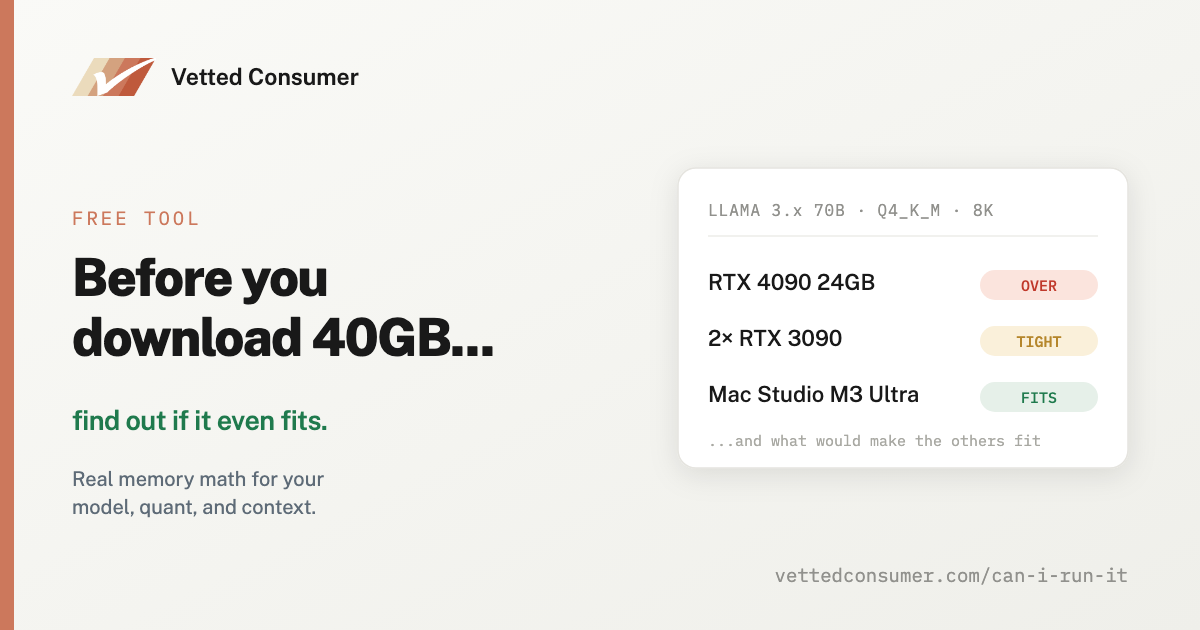
Two ways to use it: leave "Your machine" empty to shop across everything we track, or pick the hardware you already own (or enter its memory) to get a personal verdict, including, when it doesn't fit, the exact quant, context, or KV-cache change that would make it fit.
How the estimate works #
The tool uses the same math from our guides, shown in the open because that's the point of this site. A model's memory cost has three parts:
Weights, parameters × bits-per-weight ÷ 8. A 70B model at Q4_K_M (~4.8 bits/weight) is about 42 GB. Quantization choices are covered in ourplain-English quantization guide.KV cache, grows with every token of context. We assume a GQA-typical attention shape and an FP16 cache; the KV-precision selector in the tool shows exactly what a Q8 or Q4 cache saves. Full math inThe KV cache, explained.Overhead, a flat ~1.5 GB buffer for the runtime and activations.
For Mixture-of-Experts models, memory follows total parameters but speed follows active parameters, that's why a 120B MoE can be fast on a box that would crawl on a dense 70B. The one-line rule: buy memory for the total, expect speed from the active (MoE, explained). The "gen ceiling" column is memory bandwidth ÷ bytes streamed per token, a theoretical upper bound from the fact that token generation is bandwidth-bound, not compute-bound (why that is). Real speeds come in below it.
Honest limits #
These are estimates, not lab measurements. Real usage varies by runtime (llama.cpp vs vLLM vs MLX), KV-cache precision, batch settings, and model architecture. Unified-memory machines share RAM with the OS, so we subtract an 8 GB reserve; discrete GPUs lose ~1 GB to the desktop. When a result says "tight fit," believe it, within 10% of capacity means long context or background apps will push you over. Hardware listings come from our methodology; affiliate links never influence what appears or how it ranks.