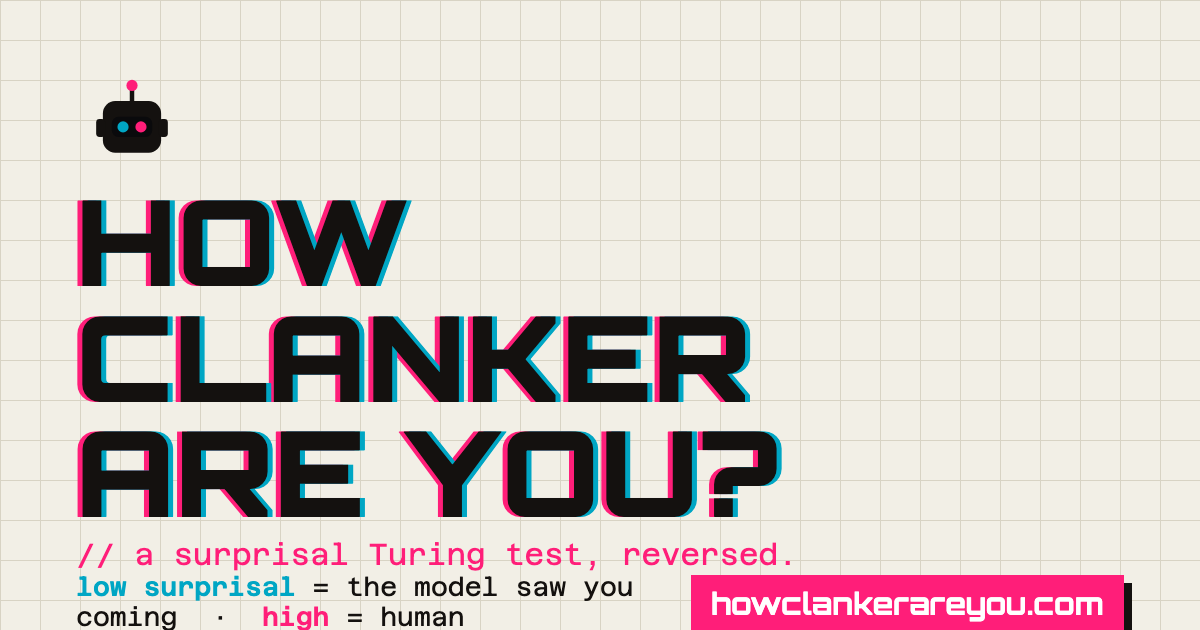
are you?
// a surprisal Turing test, reversed. Language models predict the next token. You, allegedly, do something more interesting. Finish eight sentences; we measure how surprising your writing is to the machines.
low surprisal = the model saw you coming. high surprisal = congratulations, human.
⚠ demo mode: inference isn't funded yet — scores come from a deterministic stand-in, not the real models.
▌
3–10 words. be yourself. or don't.
interrogating the models… #
token by token. they can't hide their logprobs.
you are clanker
one square per word · green = human · red = clanker
deeper stats #
method: each word you typed is scored by its surprisal under each model — −log pmodel(word), from the model's top-20 next-token probabilities conditioned on your text so far. mean surprisal in nats over your words is how predictable you were; low = clanker. words outside the top-20 are floored, scores are normalized against each model's self-baseline, and your overall is your nearest (least-surprised) model. (equivalently: the KL from your one-hot word choice to the model's distribution collapses to exactly this surprisal.) (demo mode: logprobs are currently simulated.)