cd /news/developer-tools/show-hn-generate-angular-testbed-spe… · home › topics › developer-tools › article
[ARTICLE · art-172229] src=sshyeri.github.io ↗ pub= topic=developer-tools verified=true sentiment=· neutral

Show HN: Generate Angular TestBed specs and Storybook stories locally, no LLM

A new VS Code extension called ngTestFoundry generates deterministic first drafts of Angular TestBed .spec.ts files and CSF3 Storybook .stories.ts files from component source without using an LLM. The tool infers component imports, shallow providers, required inputs, and basic creation assertions, and it targets standalone components using input(), model(), output(), inject(), @Input(), and @Output(), with strongest support for Angular 17.3+ standalone components. The extension's stated limits are that non-standalone NgModule graph resolution and Vitest output are planned, and dependency mocks are shallow; its author asks for feedback on whether the generated TestBed shape works in an actual Angular workspace.

key takeaway

ngTestFoundry generates deterministic Angular TestBed .spec.ts and CSF3 .stories.ts scaffolds from component source without an LLM, leaving explicit TODOs instead of guessing, but its dependency mocks are shallow and NgModule graph resolution and Vitest output are not yet supported.

read1 min views2 publishedNov 19, 2026
Show HN: Generate Angular TestBed specs and Storybook stories locally, no LLM
Image: source

TestBed specs

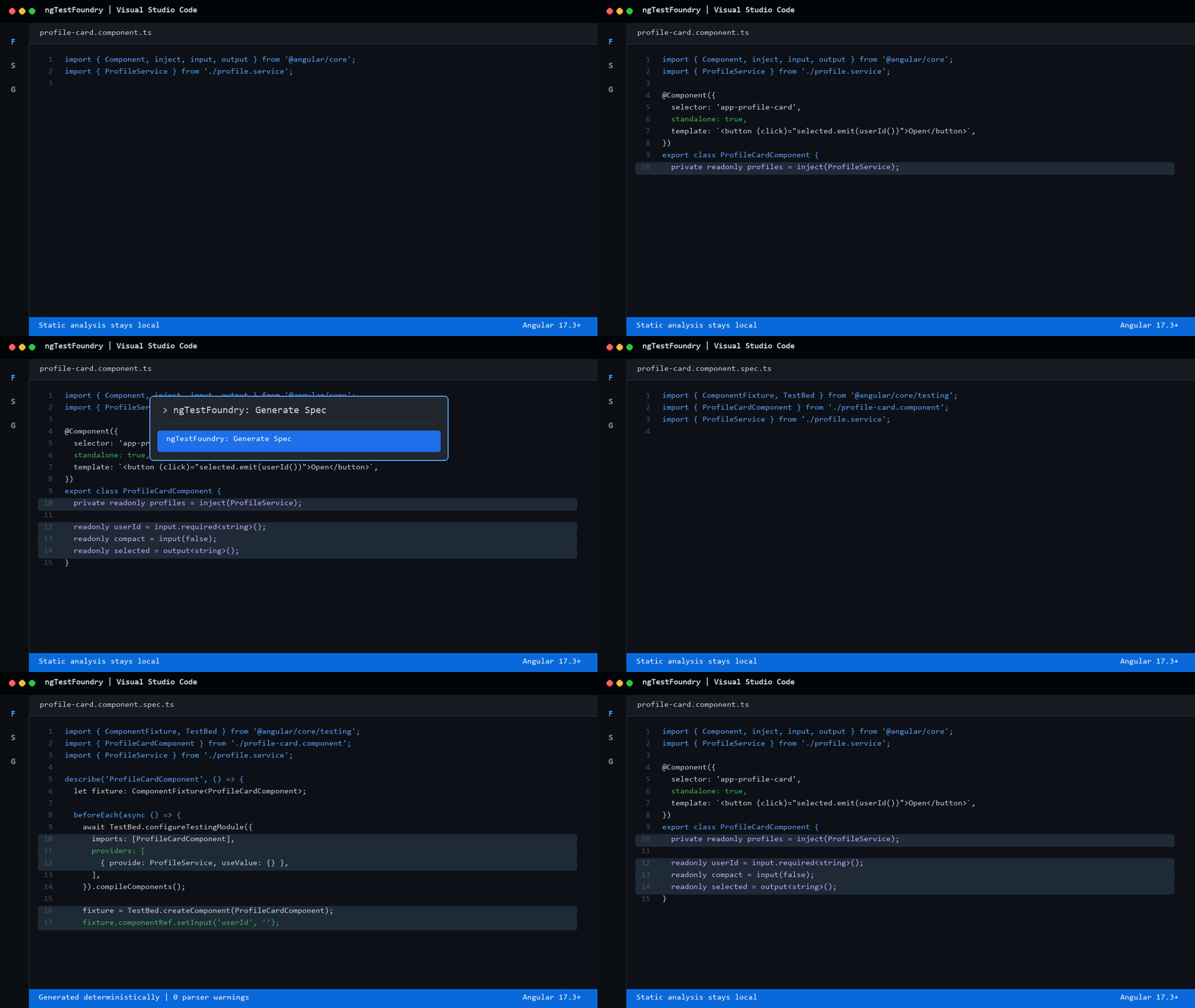
Generate .spec.ts scaffolds with component imports, shallow providers, required inputs, and basic creation assertions.

ngTestFoundry is a VS Code extension that creates deterministic first drafts of Angular TestBed specs and CSF3 Storybook stories from component source.

The goal is not magic. The goal is a useful, repeatable starting point that developers can review and adapt like normal code.

Generate CSF3 .stories.ts files with inferred args from component inputs and outputs.

Best fit for standalone components using input(), model(), output(), inject(), @Input(), and @Output().

Use the core generator on the active Angular component.

Use ngTestFoundry across larger workspaces and team styles.

ngTestFoundry prefers explicit TODOs over silent guessing. Today it is strongest on Angular 17.3+ standalone components.

Current limits:
- Non-standalone NgModule graph resolution is planned.
- Dependency mocks are shallow.
- Vitest output is planned.

The most useful feedback is whether the generated TestBed shape works in an actual Angular workspace.

Before installing, you can inspect a real example of the generated TestBed spec and Storybook story, including the TODOs ngTestFoundry leaves when static analysis should not guess.

A short explanation of why ngTestFoundry exists, what it supports today, what it generates, and what feedback would help most.

── more in #developer-tools 4 stories · sorted by recency
── more on @ngtestfoundry 3 stories trending now
sponsored brought to you by zahid.host 4,200+ EU-deployed projects
reading about agents? ship yours in a single git push.

Run your AI side-project on zahid.host

EU-based hosting, git-push deploys, automatic HTTPS, no cold starts. Free tier with a custom domain — perfect for shipping the agent you just read about.

$git push zahid main
→ Live at https://your-agent.zahid.host ✓
Get free account → Pricing
from €0/mo · no card required
LIVE [news/show-hn-generate-ang…] indexed:0 read:1min 2026-11-19 · —