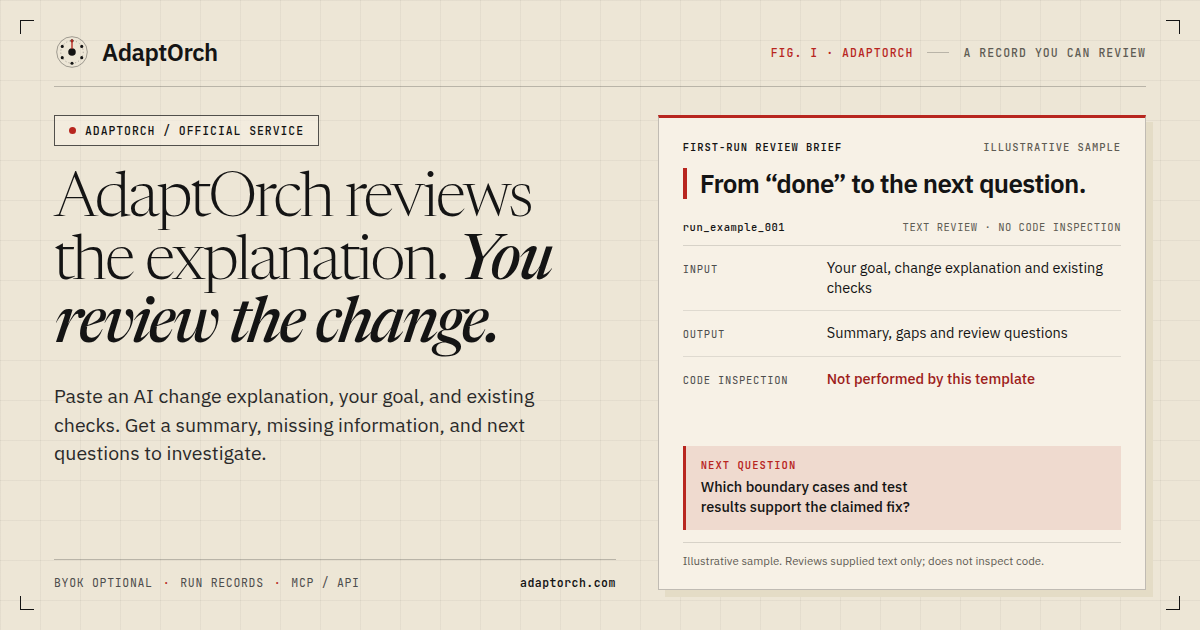
AdaptOrch reviews the explanation. You review the change.
Deciding whether to accept an AI change? Paste its explanation, your goal and existing checks. Get a summary, missing information and questions to investigate. This template reviews text, not code.
0 browser errors. Flat circular pond and clipped shoreline.30,354 tok
ON · AdaptOrch
0 browser errors. Review pass caught 9 defects; winding reflective river, bridge and dusk mist.71,396 tok
ADAPTORCH / BENCHMARK · gpt-6-luna (partial) Outperforms single-call OFF and 3× majority vote — with fewer tokens than voting.
3 benchmarks, 351 paired units per arm. OFF: 1 direct call. VOTE ×3: 3 direct calls + majority. ON: AdaptOrch ensemble of 3 + vote.
OFF (1 call)

VOTE ×3 (3 calls + majority)

AdaptOrch ON (ensemble of 3 + vote)
69.5%+14.0pt vs OFF
Pooled math accuracyOFF 55.6% → VOTE ×3 57.3% → ON 69.5% · n=351
+12.3ptvs VOTE ×3
Gain over 3× majority voting33 problems ON better vs 8 VOTE better · p = 0.000112
3,227tok/q−5.2% vs VOTE ×3
Fewer tokens than VOTE ×3ON 3,227 vs VOTE ×3 3,405 tok/q (−178 tok/q)
9/9OFF 7/9
Three.js zero-error rendersClaude Opus 5.5 max · 2.65× output tokens · 2.78× call time
BenchmarkAccuracy (OFF vs VOTE ×3 vs ON)ON − OFFON − VOTETokens / Q (OFF · VOTE · ON)
AIME 2025Math · n=111
OFF57.7%
VOTE58.6%
ON73.9%
+16.2
+15.3
1,1103,3083,129
AIME 2026Math · n=120
OFF65.8%
VOTE67.5%
ON78.3%
+12.5
+10.8
1,0953,1823,076
HMMT Feb 2025Math · n=120
OFF43.3%
VOTE45.8%
ON56.7%
+13.3
+10.8
1,1883,7193,468
All benchmarksPooled · n=351
OFF55.6%
VOTE57.3%
ON69.5%
+14.0
+12.3
1,1323,4053,227
Per-problem wins: ON vs OFFsign test p = 3.35e-07

ON better: 35OFF better: 4

Per-problem wins: ON vs VOTE ×3sign test p = 0.000112

ON better: 33VOTE better: 8
gpt-6-luna (requested), Codex OAuth, default sampling · 90 problems, 4 runs each planned · 351/360 matched units (9 excluded from all arms for missing direct samples; no majority on 131 complete units).
VOTE: 3 fresh direct calls per unit (2 equivalent final answers required; otherwise scored wrong). OFF and ON are historical runs; ON results include recovered no-answer timeouts. Token totals reflect recorded usage. Three.js screenshots at 45 s in headless Chrome with software WebGL (1 run per prompt). Not a blind quality evaluation and not an official leaderboard result.
FIG. I-B / RUN EXPLORERINTERACTIVE SAMPLE / NO CODE IS EXECUTED
Your AI says it works. Check its explanation.
The answer is only part of the story. Follow your agent’s work, inspect the checks that were available, and see what still needs your attention.
Review the unrelated configuration change and the check that did not run. No merge or selection is performed.
▷ReplaySample progress06 / 06→
Simulated playback / configured-runner example / not a customer result
JavaScript is off. The sample stays readable; interactive playback is unavailable.
Keep your agent.→See the record.→Make the call.
A review layer, not another coding agent.
FIG. II · FIRST REVIEW BRIEFILLUSTRATIVE · HOSTED TEXT REVIEW
One explanation. A clearer next review.
Follow one example from the text you provide to the review brief and the action you take next.
01
What you provide
Add the AI's change explanation, your goal and anything you already checked. The selected model receives this supplied text.
02
What the brief returns
Read a short summary, missing information and questions to investigate. The request, output and run status stay connected.
03
What you do next
Inspect the suggested questions, check the code yourself and run the tests your repository needs. The template does not perform those checks.
EXAMPLE REPORTILLUSTRATIVE, NOT CUSTOMER DATA
INPUT · EXAMPLE VALUES
GOALReview a pagination change before merging it.
AI EXPLANATIONUpdated cursor pagination and added regression tests.Already checked: the happy path only.Repository code and test outputNOT INSPECTED
REVIEW BRIEF · ILLUSTRATIVE OUTPUT
Summary: the change claims different cursor behavior and new regression coverage.
MISSING INFORMATION · NOT EXECUTION EVIDENCE
Missing: which boundary cases and test results support that claim?
NEXT ACTIONCheck empty, first and last pages; run the cited tests.
Illustrative output from supplied text only. No repository, code or test results were inspected.
Technical boundarycode_inspection: false
Start with your own change explanation
Create your account, paste the explanation and add your goal and existing checks. Connect your own API key and endpoint (BYOK) optionally when you want model calls.
This template reviews supplied text, not repository code. No free LLM is bundled; BYOK is optional. Repository checks require a separately configured execution environment.
For teams Several people reviewing AI coding agent changes? The Team plan shares one workspace, and MCP, CLI and SDK access fit into your existing tools. Repository checks need a separately configured execution environment.
AdaptOrch is a hosted review layer for AI coding agents. It records what ran, which checks were available and what still needs human review. MCP connects your tools; repository checks need a separately configured execution environment.
Pro includes 200 admitted runs a month and 5 workspace users. Team includes 1,000 runs and 15 users. Both start with a 3-day free trial. No free LLM is bundled; optional BYOK usage is billed by your provider. Code checks need a separately configured execution environment.
The Python client authenticates with your AdaptOrch API key and supports optional BYOK provider headers. A successful request does not establish that code checks ran.
Choose the interface first. Configure the execution scope separately. Hosted command verification is disabled by default; a local client is not a self-hosted service.
Works beside the tools you already use
Compatible workflow surfaces; logos are not endorsements.
CONNECTS TOhosted API
MODELHosted
WORKS WITHyour coding agent
RAW DATApublished
FIG. IV · TWO WAYS TO STARTONE REVIEW WORKFLOW · DIFFERENT EXECUTION BOUNDARIES
Start with the record. Add the checks your environment supports.
AVAILABLE HOSTED PATH
Connect your agent. Review its runs.
Use MCP or the API to submit model-backed work and retrieve run records, outputs and available artifacts. Pro and Team start with a 3-day free trial. Authenticate with an AdaptOrch API key.
No bundled free LLM; connect your own API key and endpoint (BYOK) optionally.
Shared hosted command verification is disabled by default.
For repository and command checks, agree the environment, repository access, test commands and evidence handling first. A hosted plan upgrade does not enable this automatically. Define access, isolation and network permissions.
Review available check results and unclassified failures.
Agree setup, operating costs and the decision criteria.
Illustrative interactive example. No customer code or model call is executed by this button.
FIG. V · REVIEW WALKTHROUGHinteractive example · apply → classify → review
See an illustrative review process.
Choose an example scenario and replay the displayed steps. The demonstration uses fixed example data.
01A code change02A retry after a failure03A fix with proof04Your internet dropped
WHAT THE AI DIDCandidate patch modifies astropy/table.py to repair issue behavior.
RUN ITDocker harness apply: pass
LIST THE CHANGESRealized git diff generated
CHECK ITFlagged: repaired, but never reproduced
VERDICTNeeds Review
The patch applies cleanly, but we cannot call it correct. The test evidence came back inconclusive, and the shadow check flagged repair risk with no reproducible run behind it.
View review-process example↻ walkthrough
Static example. Select Replay to step through the record. FIG. V-A / COST TRAILUSD / SAMPLE DATA
The path matters. So does the cost.
A retry is still work. This sample keeps every attempt in view, and an unreported cost never becomes a zero.
Single attemptWith a retry
Platform plan and model-provider charges are separate.
KNOWN ESTIMATED SUBTOTALILLUSTRATIVE SAMPLE
$0.0127+ 1 unreported call
6 calls, 2 attempts, 3,500 tokens reported
Sample model calls by attempt
CALL
ATTEMPT
SAMPLE ESTIMATE
Draft
01
$0.0048
Review
01
$0.0021
Summary
01
$0.0005
Draft
02
$0.0048
Review
02
Unreported
Summary
02
$0.0005
↳ Earlier attempts stay in the record.
Illustrative model-call amounts in USD, not live prices, a bill, or a savings claim. Unreported calls are excluded from the subtotal, never treated as free.
FIG. VI · PACKAGINGshadow evidence → PR preflight
Choose the capacity your review workflow needs.
Start a 3-day free trial on Pro or Team before your first charge. No bundled free LLM; bring your own API key and endpoint (BYOK) optionally when you want model calls. Upgrade for more monthly runs or workspace users, not a correctness guarantee.
No free hosted LLM is bundled. Plans cover AdaptOrch's orchestration algorithms, topology routing, synthesis, and run records. Bringing your own provider API key and endpoint (BYOK) is optional, with instant ping-pong connection verification in the console.
Optional ensemble fan-out calls 2–5 of your own models in a configured run. One admitted run uses one call from your plan quota; your provider bills the tokens for every member. Provider cost depends on the models, tokens and attempts. Workspace users are people, not ensemble model members. Agreement is not an accuracy guarantee.
Model outputs and AI-written explanations are AI-generated and require human review. They are not the same evidence as execution logs or results from checks that actually ran.
Monthly AnnualSave 15%
PLANPOSITIONINGMONTHLYINCLUDESACTION
01PROREPEATED REVIEW WORKFor a small team that reviews agent changes every week$39/month200 admitted runs/month · 5 workspace usersAvailable reports and export controlsRetained run and check records when suppliedAdvanced dashboard accessChoose Pro →
02TEAMFor larger teams that share one workspace$149/month1,000 admitted runs/month · 15 workspace usersShared workspace capacityConfigured dashboard accessDiscuss a separate repository-validation scopeChoose Team →
03PRIVATE RUNNER / POCRepository validation / private environmentDirectcontractEvaluation period agreed after feasibility reviewStarting discussion: 1–3 repositories · scope agreed in the reviewCase-level reports and unclassified failuresCompare useful findings and operating effortDiscuss PoC →
What each plan includes
See what you get, plan by plan
Every plan includes AdaptOrch routing, orchestration, and saved run records with no bundled LLM. Connect your own API key and endpoint (BYOK) optionally when you need model calls.
Feature
PRO
TEAM
Algorithmic orchestration & optional BYOKNo bundled LLM · connect your own API key & endpoint anytime
Included
Included
Answer and step-by-step outputSaved for every run · a short guide on how to read it
Included
Included
Model reasoningNEWThe notes the main model wrote before answering
Included
Included
Plain-language explanationNEWWhat happened, what went wrong, how to fix it and what to check next, in your screen language · 30 per hour
Included
Included
Model reasoning and plain-language explanations are written by AI. They can be wrong and are not evidence that the run’s result was checked.
Annual amounts are the full yearly charge in USD, not a monthly bill. Pro: $397.80/year ($33.15/month equivalent). Team: $1,519.80/year ($126.65/month equivalent).
Hosted plans do not automatically apply or merge repository changes. Separately configured checks may apply a candidate in an agreed workspace. Human review and the recorded execution boundaries remain explicit.
What counts as a run?
The monthly allowance counts admitted runs, not status or artifact reads. It is used at admission rather than at SUCCEEDED. Internal attempts remain in that run; a separately admitted rerun counts again. Provider billing is independent.
What needs separate setup?
Repository command checks need a separately configured execution environment. A Pro or Team upgrade does not turn hosted command verification on; setup and execution-environment costs are agreed separately.
Estimate monthly break-evenYour assumptions · not measured savings
What would need to change to break even?
Economics · ESTIMATE ONLY. Compare a monthly hosted subscription with self-hosting under your own labor and cost assumptions. No savings have been measured.
JavaScript is disabled. Numeric fields and the calculator are unavailable; download the evidence JSON to inspect the recorded results.
subscription, extra_provider and self_host_infra are monthly USD amounts; hourly is your labor value in USD per hour. The result is minutes per month, floored at zero.
This is the labor-time reduction required each month to break even on these inputs, NOT measured saved time or full TCO. We do not recommend plans from hours or PR counts.
Uses current monthly USD prices, not annual promotions. Taxes and model costs shared by both workflows are excluded. Setup and ongoing maintenance are not fully included; actual total cost may differ.
A recorded pass covers the recorded checks only, not merge readiness. Human review is still required.
PASSRecorded check passedBLOCKAction and fix context required
Repository checks require a separately configured execution environment. Hosted text review runs no repository commands. PASS covers recorded checks only; an unrun check remains unrun.
FIG. II-B · PRODUCT PREVIEWconnect → run → receipt
From an agent run to a record you can inspect. Open run history to review status, model attribution and available artifacts. Repository checks require a separate configured execution path.
01Connect your existing agent through MCP or the API.
02Submit a run with optional BYOK headers, or configure a separate validation environment.
03Inspect the record and any check results that were actually produced.
Interface example · illustrative data, not a customer outcome How configured validation worksEnvironment · checks · retained records
Set the boundaries of a separate execution environment.
A repository check depends on the selected environment and commands. Agree file access, network permissions and isolation before execution. Compare recorded results with CI; a pass in one environment is not a guarantee in another.
Temporary workspaces and retained reports are different data. Cleanup follows the runner configuration; execution records, logs and artifacts follow the documented retention policy.
FIG. IV · REVIEW QUESTIONSscope · checks · open items
Four things a completion report can leave unanswered.
Use the available execution evidence to decide what needs another look. These are review questions, not claims that every run detects every problem. #01“I FIXED IT”
Was the bug reproduced?
A before/after reproduction makes a fix easier to evaluate. If it is missing, name the other evidence and the behavior that still needs checking.
#02“ONE FILE”
Did the scope change?
Compare recorded files and changes with the declared task scope. A configured validation path can make unrelated edits visible.
#03“ALL GREEN”
Did the check itself change?
A removed or weakened test can change what a passing result means. Review test changes alongside the command outcome.
#04“YOUR BUG”
Did the code run at all?
Review setup, network and test outcomes separately. Missing commands and timeouts can be classified, while ambiguous failures still need diagnosis.
Research and measurement notesScoped experiments, raw data, misses and limitations
Research, methods and limits
These results concern their stated experiments. Read positive results, misses and methodological limits together; they are not a promise about customer repositories.
The AdaptOrch research paper studies task-adaptive multi-agent orchestration. The hosted product and the CEK repository-validation workflow have their own execution limits; paper results do not establish customer code correctness or hosted performance.
Improvement and regression counts are available in the evidence JSON.
Every square is one recorded synthetic task. Green marks a passed check; a red outline marks an outcome that regressed from A to C.
Synthetic ledger, 30 tasks: paper baseline A versus robust + verifier C. Eight outcomes improved and one regressed. Both synthesis and verification differ; this is not a verifier-only comparison.
Customer value: what the evidence can tell us.
Local execution is measured. Human time savings are not. Keep those findings separate from an assumption-based cost estimate.
JavaScript is disabled. Numeric fields and the calculator are unavailable; download the evidence JSON to inspect the recorded results.
Local command checks · MEASURED
This experiment times CommandVerifier construction, execution and classification using trusted local controls, with no model API calls. It does not verify actual AI-generated patches.
local measurement data…
Local data loaded. All outcomes, including mismatches, are shown below.
Measurement data could not be loaded. No results are shown; inspect the downloadable JSON instead.
Five fixed synthetic controls, repeated locally. Repetitions are not independent developers or tasks. Matches are counts of expected classifications, NOT bug-detection accuracy. Scroll the table horizontally if needed; keyboard users can focus it and use arrow keys.
Local control outcomes and wall-clock timing
Control
Expected class
Observed classes (counts)

Median (milliseconds)

p95 (milliseconds)

Matches / attempts (counts)
Passing assertionClassification mismatch
—
—
—
—
—
Failing assertionClassification mismatch
—
—
—
—
—
Missing executableClassification mismatch
—
—
—
—
—
Deliberate timeoutClassification mismatch
—
—
—
—
—
Missing Python dependencyClassification mismatch
—
—
—
—
—
Classification mismatch: the missing-dependency control expected ENV_ERROR but was observed as FAIL. Mismatched attempts remain in every timing summary and in the downloadable data.
Known limitation: the missing Python dependency was misclassified as an ordinary test failure. The classifier does not distinguish all environment failures from candidate failures.
These are not hosted round-trip latency measurements, a security-isolation test, or actual AI patch verification. Shared hosted command verification is disabled by default. The command component neither copies projects nor applies patches.
Frozen protocol and measurement limits
Protocol fixed before execution: 20 repeats per control, shuffled with seed 20260905; a fresh verifier per attempt, no cache, one command, and a 0.35-second timeout.
The five fixed controls are passing and failing Python assertions about 2 + 2, an absent executable, a 2-second sleep cut off at 0.35 seconds, and an absent Python import. These trivial fixtures are not AI-generated patches or real project test suites; their millisecond timings are not real project-test latency.
Trusted fixtures use a temporary working directory, default resource limits and no inherited environment. A temporary directory is not a clean project copy or a security boundary.
Monotonic wall-clock time covers verifier construction, command execution and classification. Measurement-program startup, report serialization and network latency are excluded.
All attempts are retained, including slow and error attempts. Median and nearest-rank p95 are descriptive statistics only: no significance test, generalized accuracy estimate or causal savings claim.
The JSON records revision, dirty-tree state, source hashes and environment metadata. This is an internal pre-execution protocol, not external preregistration or release approval.
Human time savings · UNMEASURED
No human study or customer savings data exist here. Local command timings cannot tell us how much review time a developer saves.
Before claiming savings, measure paired active review time on the same tasks with manual and assisted workflows, wait time separately, independent correctness, and actual subscription, provider, infrastructure, setup and maintenance costs. Include independent developers and repositories, randomize workflow order, and retain unsuccessful or slower runs.
FIG. V · MEASURED EVIDENCEmeasured run + scenario estimate
One measured run.
paired_confirmatory_ledger: 30 synthetic ledger tasks, one paired session. Baseline 86.7%, verified 100.0%, difference +13.3pp (95% CI +3.3 to +26.7). The aggregate paired verdict did not reach significance and the family gate did not pass: directional, not proven. This is separate from the A/C ledger comparison. PLATE 00 · MEASURED — PAIRED CONFIRMATORY · OPEN FULL SIZE ↗
FIG. VI · THE MAJORITY TRAP20 puzzles · three models
More models. Not a better result here.
In this 20-puzzle ARC-AGI-2 run, the best single model scored 14/20 and the exact-answer vote scored 10/20. The vote cost more. This is one internal experiment, not a universal result.
01Best single model: 14 correct out of 20
02Exact-answer vote: 10 correct out of 20
03Agreement alone does not establish correctness
The published aggregates include errors and truncation counts. GPT scored 16 tasks with 4 errors; Qwen scored 19 with 1 truncation. Those denominators differ from the best-model and vote arms.
Recorded model-call cost in USD, summed across the three member arms. Not a customer invoice or full TCO; additional charges are not established by this record.
three-way-20260826T142538Z

Public data contain aggregates, not per-task paired outcomes. They cannot independently establish how many answers were improved or regressed.
n = 20 · descriptive aggregate comparison, not a general performance claim.
FIG. X · WHAT WE DON’T CLAIMthe honest part
We cannot prove your code is right.
A passing check covers only the conditions it executed. It does not establish overall correctness, safety, or behavior under untested conditions.
A run receipt reports the evidence that was recorded. A run without executed verification is not a test pass. The local experiment above measures command checks; it does not establish hosted patch execution or developer time savings.
We publish the negative outcomes too. In the synthetic ledger A/C comparison, eight task outcomes improved and one regressed. This compares both synthesis and verification settings, not the verifier alone.
If anything on this page promises more than we can show you, tell us. We will fix the page.
Q.01What can I use in the hosted service today?+
Submit model-backed runs through MCP or the API and inspect their records, outputs and available artifacts. Shared hosted command verification is disabled by default; repository checks need a separate execution environment.
Q.02Can you prove my code is correct?+
No general correctness proof is provided. Check which verification actually ran and what evidence was recorded. A successful model run without executed tests is not a test pass.
Q.03Will it change what my AI does?+
The hosted workflow does not automatically apply or merge changes into your repository. A separately configured validation environment may apply a candidate in its agreed workspace for checking. You retain the review decision.
Q.04How long does a check take?+
The current table reports local command-check timings on five fixed controls. Historical ledger timings measure a different operation. Neither establishes latency on your repository, hosted end-to-end latency, or saved developer time.
Q.05What if the test fails because my machine is broken?+
Missing executables and timeouts were distinguished in the local controls. A missing Python dependency was classified as an ordinary test failure. Failure labels need context; they are not a guarantee that every environment problem is diagnosed.
Q.06What does the monthly allowance count?+
One admitted run uses one allowance unit. Status, usage and artifact reads do not create a new run. Completion is not the counting trigger, and a separately admitted rerun counts again. No free LLM is bundled; optional BYOK token charges are billed by your provider.
Q.07Are model results and test results the same evidence?+
No. A model can finish without running a code check. Inspect the recorded commands, outcomes and skipped or untested areas. An AI-written explanation does not replace those records.
Q.08Does it work with Claude Code, Cursor, or Codex?+
Use the documented MCP or HTTP connection path for your client. Authentication, a model run, and a repository check are separate steps; each needs its own confirmation. Q.09What is actually on the receipt?+
A report presents the execution record and whatever verification evidence is available. Changed files, before/after tests and rerun details depend on the configured path; missing checks must stay explicit.
Q.10Can I run it on my own machine?+
Hosted plans connect to hosted AdaptOrch. Running a client locally does not make the service self-hosted. Contact us about a separate private-runner deployment for your network.
Q.11Is my private code safe?+
Hosted requests pass through AdaptOrch and the AI provider you configure. Review the data-transfer and retention policies before submitting private code. A private runner is a separate deployment, not a hosted plan default.
Q.12When will it block a bad merge by itself?+
Automatic merging is not part of the default hosted offer. Any active gating must be separately configured and evaluated against the customer's own environment and review policy.
Q.13What is AdaptOrch?+
AdaptOrch is a hosted service for reviewing AI agent run records, model outputs and available verification evidence. Connect your coding tools through MCP or the API. Repository checks require a separately configured execution environment.
Q.14Where can I read the AdaptOrch research paper?+
The paper is “AdaptOrch: Task-Adaptive Multi-Agent Orchestration in the Era of LLM Performance Convergence” by Geunbin Yu, submitted to arXiv on 18 February 2026 as 2602.16873. Its research results are separate from the hosted product and the CEK repository-validation workflow.
Q.15How do I verify AI-generated code before merging?+
Inspect the run record, not only the final answer. Check what actually ran, which commands or tests were recorded, whether a reproduction failed before and passed after, whether unrelated files changed, and whether the test itself changed. A passing check covers only what it executed; it is not a correctness guarantee.
Q.16What is an agent run record?+
An agent run record is the stored history of one execution: the inputs, selected model, tool or command steps, outputs, status and available artifacts. AdaptOrch keeps hosted run records so a reviewer can inspect them later instead of relying on a chat transcript.
Q.17Is AdaptOrch an AI code review tool?+
AdaptOrch is a review layer for AI coding agents, not another agent that writes code. It records execution evidence and available checks so a human can review the change. It complements code review and CI; it does not replace them or prove correctness.
Q.18Is AdaptOrch an alternative to CodeRabbit or Copilot code review?+
Not a direct one. CodeRabbit and Copilot code review comment on a pull request. AdaptOrch is a review layer for AI coding agents: it records what the agent ran and which checks were available, so a person can review the change. It complements code review and CI, and you can use it alongside either tool.
Q.19Does AdaptOrch run my tests or inspect my code?+
Not by default. The hosted text template reads the text you supply, such as the change explanation, your goal and existing checks, and returns a summary, missing information and review questions. It does not inspect code. Repository checks need a separately configured execution environment, offered as a PoC. Shared hosted command verification is disabled by default.
Q.20How much does AdaptOrch cost?+
Pro is $39 a month with 200 runs and 5 workspace users. Team is $149 a month with 1,000 runs and 15 workspace users. Annual billing saves 15%, and both plans start with a 3-day free trial. No free LLM is bundled in these plans. Optional BYOK usage is billed separately by your provider.
FIG. XII · BOOK DEMOaudit first · merge later
REPOSITORY VALIDATION POC
Bring a review problem. Agree a useful evaluation.
Tell us what is hard to verify. We will first check the execution constraints, then agree scope, deliverables and price before any repository work.
✓Keep your existing coding tools
✓Agree the repository and execution scope
✓Start with reporting, not automatic merging
✓Review useful findings, missed cases and setup cost
✓Hosted Pro and Team are separate self-service options
REQUESTSCOPED POC
WORK EMAILCOMPANY · OPTIONALWORKSPACE USERS · OPTIONALWHAT DO YOU NEED TO VERIFY?
Do not submit source code, API keys or customer data. This enquiry does not execute work.