for Recursive Self-Improvement
of LLM Agent Harness
<sup>1</sup>Imperial College London
<sup>2, 5</sup>Independent Researcher
<sup>3</sup>Duke University
<sup>4</sup>The Chinese University of Hong Kong
<sup>6</sup>Brown University
Learn from experience. #
Improve across tasks.
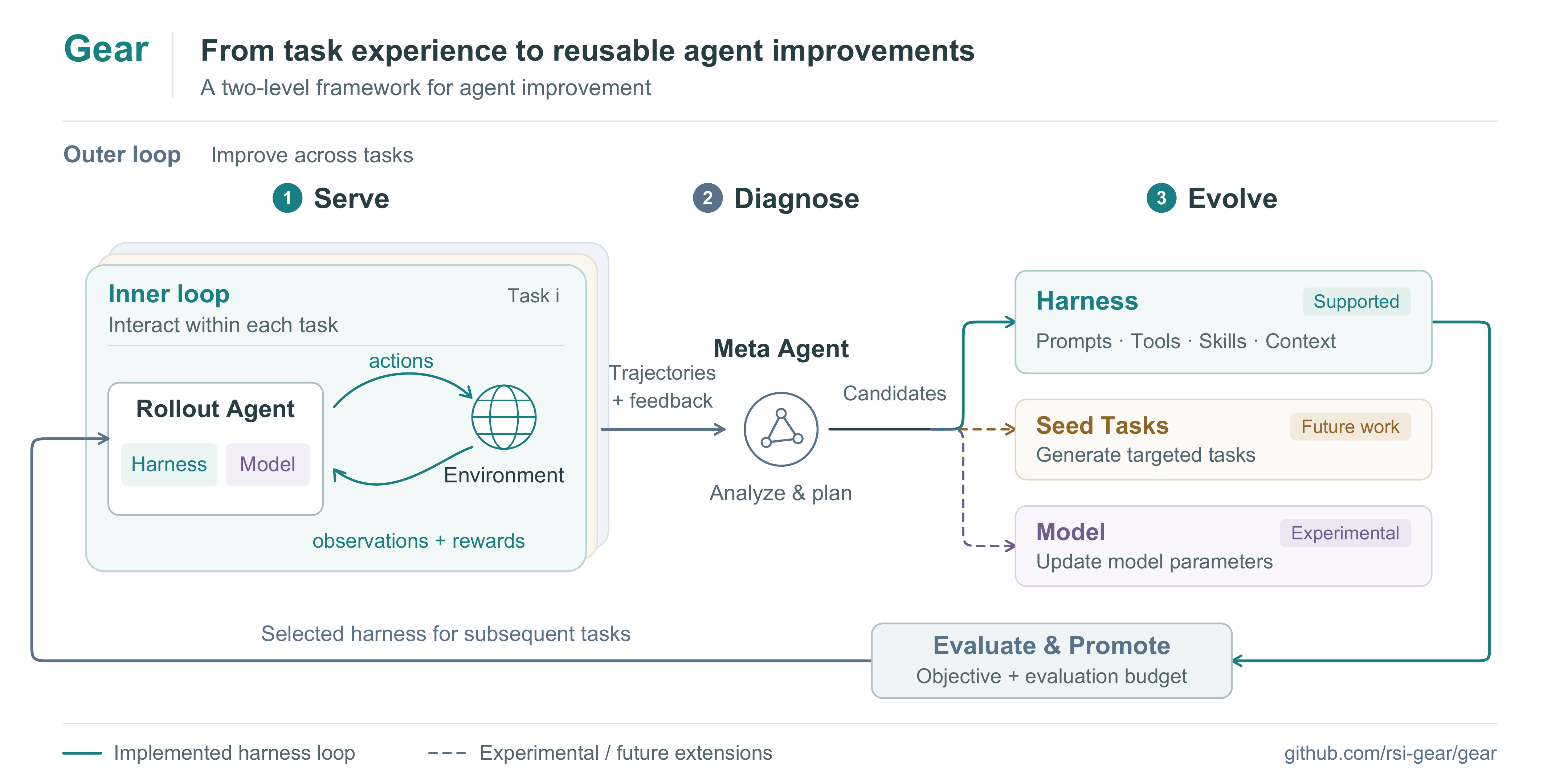
GEAR organizes recursive self-improvement as a two-level meta-learning process. In the inner loop, a rollout agent uses task feedback to refine its reasoning, planning, and actions within a task.
In the outer loop, a Meta Agent identifies common patterns across task experiences, including recurring failures and effective strategies, and proposes reusable improvements to enhance cross-task performance. GEAR evaluates and promotes these changes for subsequent tasks. The two loops can be optimized independently and are connected by experience.
Modular algorithms for #
evolutionary search.
GEAR organizes evolutionary search into replaceable algorithm components,
providing a common framework for studying different search strategies.
Staged GEPA is one concrete instantiation, illustrated below.
Open the search, component by component.
Parent selection
Choose which archived harness to improve next. Staged GEPA uses task-level fronts to retain useful specialists and sample parents from the frozen archive.
- Reads
- Frozen archive, champion, task-level evidence
- Produces
- A parent harness for candidate generation
Policy modules express the framework’s design boundaries. The current staged implementation exposes parent selection as a public policy hook; evidence validation, evaluation stages, and final promotion remain controlled by the runtime.
Better harnesses. #
More completed tasks.
Improvements across coding, marketing, and support.
Same-model comparisons, with reasoning effort made explicit.
Marketing · task pass rate27% → 40%GPT 5.6 Luna · medium · DSH Base → OursSupport · task pass rate17% → 25%GPT 5.6 Luna · medium · DSH Base → OursCoding · task pass rate52.8% → 62.9%GPT 5.6 Luna · medium · DSH Base → Ours
Full benchmark comparison #
| Harness comparison · same model and reasoning effort within each group | ||||||
|---|---|---|---|---|---|---|
| Agent | Harness | AutomationBench · Marketing ↑ | AutomationBench · Support ↑ | Terminal-Bench 2.1 ↑ | ||
| --- | --- | --- | --- | --- | --- | --- |
| Task pass rate | Obj. completion | Task pass rate | Obj. completion | Task pass rate | ||
| GPT 5.6 Luna medium | DSH (Base) | 27.0% | 75.4% | 17.0% | 72.9% | 52.8% |
| DSH (Ours) | 40.0% | 83.9% | 25.0% | 81.3% | 62.9% | |
| Δ (pp) | +13.0 | +8.5 | +8.0 | +8.4 | +10.1 | |
| GPT 6 Astra max | Codex | 57.0% | 84.1% | 35.0% | 88.4% | 86.7% |
| DSH (Ours) | 61.0% | 86.3% | 39.0% | 88.7% | 87.6% | |
| Δ (pp) | +4.0 | +2.2 | +4.0 | +0.3 | +0.9 |
Δ is the absolute improvement in percentage points.
| Additional evaluation · GPT 5.6 Luna (max) · DSH (Ours) | ||
|---|---|---|
| Benchmark | Task pass rate | Objective completion |
| --- | --- | --- |
| AutomationBench · Marketing | 53.0% | 88.9% |
| AutomationBench · Support | 27.0% | 82.4% |
| Terminal-Bench 2.1 | 84.3% | — |
AutomationBench reports task pass rate and objective completion; Terminal-Bench 2.1 reports task pass rate. Luna max is a separate evaluation at a higher reasoning effort. Result data ↗
Optimize. Execute. Understand. #
Separate responsibilities, connected by versioned evidence.
Explore GEAR. #
Code, experiment records, and the tools to start your own research.
Get the code
Explore the framework, search components, and examples.
github.com/rsi-gear/gear 02 / Documentation ↗
Run your first experiment
Set up a task benchmark and connect the Refine Skill.
Read the guide 03 / Experiment ↗
Follow the search
Inspect the staged Marketing experiment and its evaluation evidence.
View the experiment
Cite GEAR. #
Preprint · October 2026. arXiv link will be added when available.
@unpublished{tang2026gear,
  title  = {{GEAR}: An Open General Evolutionary Architecture for
            Recursive Self-Improvement of {LLM} Agent Harness},
  author = {Tang, Yehui and Zhu, Guanqi and Xia, Shao-Jun and
            Chen, Xin and Geng, Mengzhe and Du, Hongyang and Tang, Yuhao},
  year   = {2026},
  note   = {Preprint},
  url    = {https://github.com/rsi-gear/gear}
}