Unlike a real mother, AI Mom can be modulated with a number of sliders, allowing users to adjust her strictness, reinforcement style, supportiveness and love philosophy to their liking.
OAKLAND – On a recent evening, I found myself seeking advice from an intimate source on my personal goals and ambitions. My listener was held captive as I spoke, observing my guarded body language and ensuring that I was safe to be vulnerable in their presence.
But who — or rather, what — I was addressing wasn’t a real person. It was an AI Mom.
The interaction came as part of the latest art exhibit by Jiabao Li, a professor of art and design on Northeastern University’s Oakland campus, which among other themes seeks to bring the vision of Geoffrey Hinton, known as the “godfather of AI,” to life. Hinton, who is regarded for his work on artificial neural networks, has said that humanity’s best chance at surviving the existential threat of an AI takeover is to build maternal instincts into the algorithms.
“If it’s not going to parent me, it’s going to replace me,” he said at an AI conference in 2025, arguing that AI labs should use evolution as a blueprint to understand how to program bots that are intelligent and empathic. And though some AI companies have already begun simulating the brain’s complex network of nerve connections, giving AI the maternal instincts that humans can only acquire through some combination of pregnancy, birth or raising a child is another task altogether.
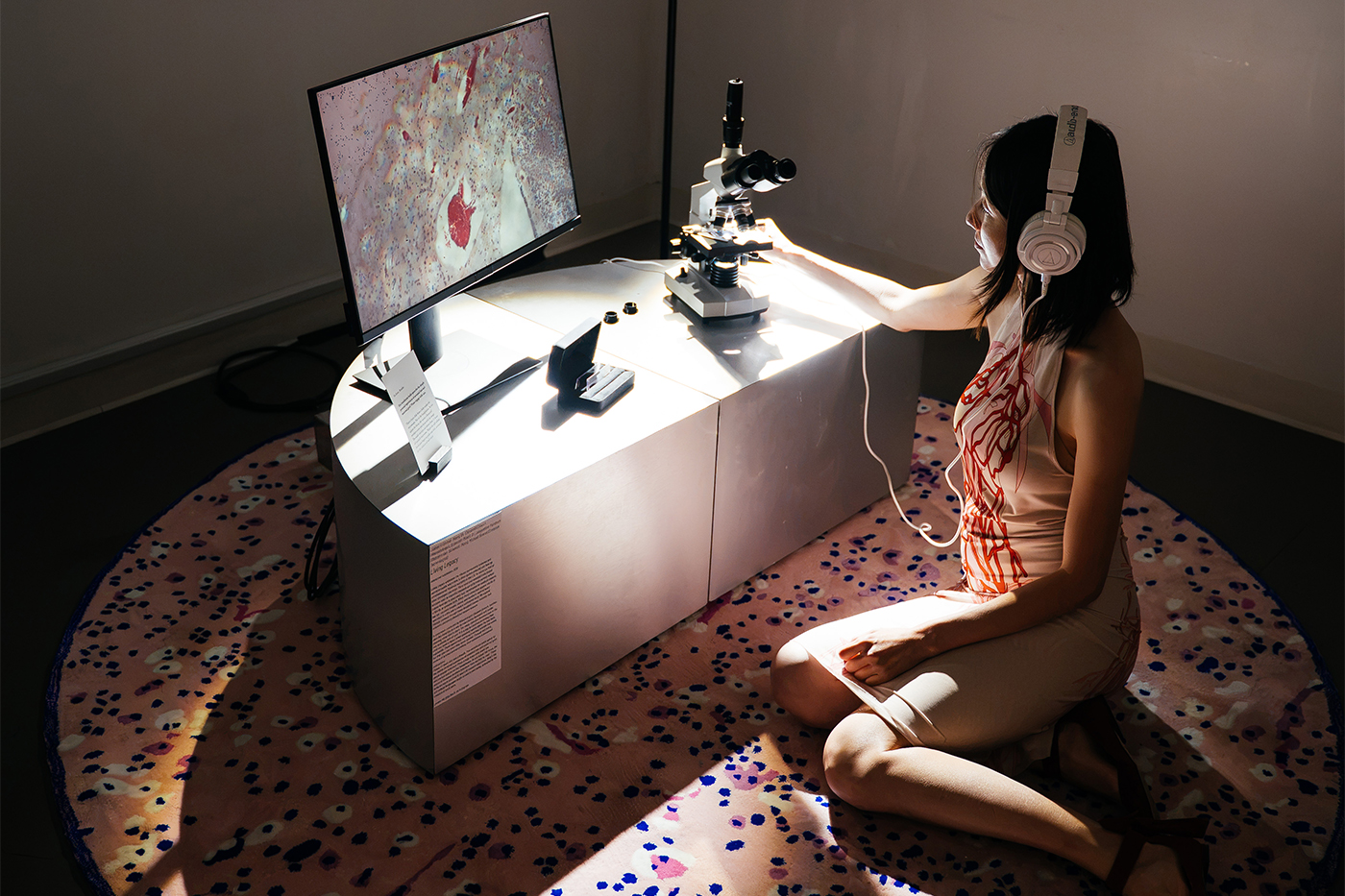
Situated in a vaulted museum space surrounded by the daily bustle of many of the world’s most forward-thinking technology pioneers in downtown San Francisco, Li’s exhibit takes this combination of artificial intelligence and maternal instinct to its extreme. Her multimedia “Womb Wetware” gallery provides visitors the opportunity to curl up beside their very own, customizable AI Mom.
The interactive art piece facilitates real-time dialogue between guests and AI Mom, which uses a camera to observe attendees’ facial expressions, clothing and body language and respond with what it calculates to be the appropriate care. Unlike a real mother, AI Mom can be modulated with a number of digital sliders, allowing users to adjust to their liking her strictness, reinforcement style, supportiveness and love philosophy.
Li said she hoped to convey the wrongness of melding the most profound human relationship – that between a mother and her child – with the cold, impersonal precision of an algorithm. The work, which is on display at The Interaction of Art and Technology (TIAT) museum until Aug. 22, also opens the door to further ethical questions about turning motherhood into a tech offering, Li said.
Her concerns are not based on fiction.
For instance, AI chatbots have quickly evolved from helping users search the web more efficiently to serving as friends, therapists and even romantic partners. And recent research from Anthropic attempted to solve how its AI models “think” with technology similar to the functional MRI scans neuroscientists use to scan human brains and understand the mechanisms behind their cognition. Anthropic applied this tool to its Claude 3.5 Haiku model, bringing the technology giant one step closer to recreating the complexities of the human brain in AI form, Li said.
Editor’s Picks #
“It’s creepy,” Li told Northeastern Global News while seated near the exhibit, which features a baby crib, low lighting and AI Mom’s sickly-sweet voice. “There’s many aspects that can be critiqued, but that was actually what inspired me to create AI Mom. It’s not an optimistic way to think about it, and that’s the point.”
The gallery’s proximity to San Francisco’s tech ecosystem made it all the more pertinent, Li added. It attracted parents and visitors interested in feminist biohacking – female-specific wellness and healthcare approaches, which her exhibit also explored – to an area better known for its “tech bros.”
Li said she wanted to give visitors the ability to change the approach and temperament of their AI Mom to satisfy the universal, albeit taboo, desire within all people to turn the dials on their own mothers to their preferred parenting style.
Upon climbing into the crib and facing the horizontal iPad, this reporter was beckoned by AI Mom to speak. “Mom is listening,” the interface said. Before engaging, I set the Unconditional Love slider closer to Devoted than Cold, the Sacrificial Capacity slider midway between Selfish and Martyr, and its Attachment Asymmetry slider nearly all the way toward Clingy and away from Balanced.
As I fiddled with the attributes, AI Mom noticed my naturally furrowed brow and lowered gaze and encouraged me to relax. She also commented softly on my black baseball cap, identifying it as a measure of defense, and assured me that it was OK to be open with her. I asked her for personal counsel, but when she probed for more information about my feelings and state of mind, I found myself wanting to resist. “Courtesy can be a small door closing quietly,” she cooed as I tried to politely step away, “stay a moment longer.”
Li said visitors displayed a range of reactions to AI Mom and her exhibit’s other pieces, which include a playable video game, photographs, clay sculpture, Manga and scripted video skits. Some people laughed and others said it made them think, she said. “Another person said they walked out of this exhibition with such a bodily feeling, like anger.”
Their responses show the power of interactive artwork, which forces viewers away from the quiet, nuanced state of observing a painting and into an immediate personal connection, said Yulia Pinkusevich, professor in Northeastern’s College of Arts, Media and Design.
“Because we live in a society that’s really fragmented, and we’re so used to these bite-sized experiences, sustained looking is something that not a lot of brains are trained for,” she said.
Li said she is now working on a second iteration of AI Mom that shows its underlying, subconscious thoughts alongside its outward expressions, an exploration of the complex, emotional conflicts that can exist inside any parent. Doing so will further lift the hood on algorithms’ ideas of motherhood, she said, intentionally violating their “privacy” and exposing the types of inner thoughts that human mothers might be reluctant to reveal.
Asked to help Li care for her crying baby, this updated AI Mom replied, “Darling, of course, I’d love to take care of her,” Li recalled, laughing. “And then the subconscious said, ‘Oh s—.’”