Jake Stauch and Alex McLeod are betting code-generating agents can loosen ServiceNow's grip on corporate IT.
By RuntimeWire Staff · Published
Primary source: Forbes
Why it matters #
Serval is moving the enterprise AI contest from answering help-desk tickets to rebuilding the workflows behind them. Generated code still has to overcome years of customer-specific integrations, permissions and operating history.
Serval co-founders Jake Stauch and Alex McLeod launched Catalyst into general availability on August 20th, giving enterprise administrators an AI agent that mines ticket histories and drafts the code, permissions and workflows needed to automate recurring work. Serval detailed the release in a product announcement, while Stauch used an interview with Forbes to make the larger pitch: Serval intends to replace ServiceNow inside large companies.
That is a direct challenge from two founders who spent nearly five years working together at Verkada before starting Serval in April 2024. Stauch led product units including video security, environmental sensors and alarms. McLeod led engineering for alarms across backend software, mobile apps, embedded systems and computer vision. Their time building new product lines inside an enterprise hardware and software vendor became a five-year test run for their own partnership.
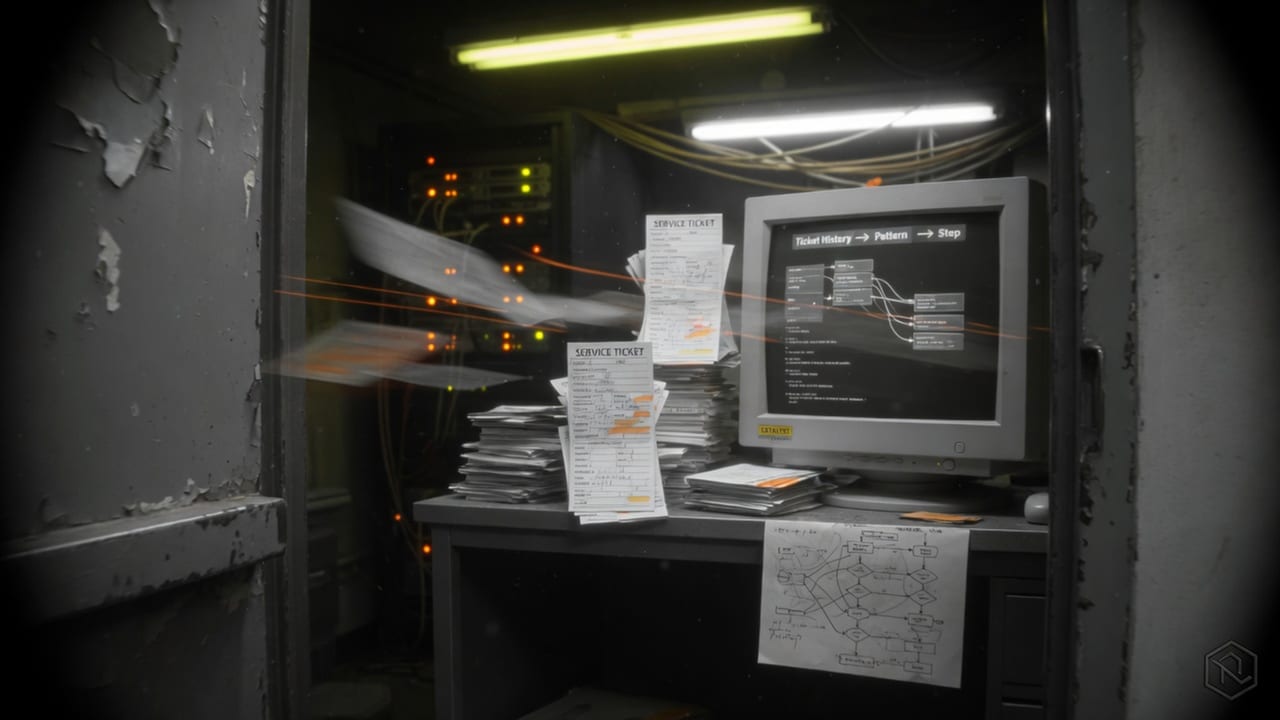
Catalyst extends the thesis Stauch and McLeod started with: permanently automating a repetitive task should take less effort than completing it manually once. Instead of waiting for an administrator to decide which workflow to build, Catalyst searches existing tickets for recurring problems, checks what connected systems and their APIs can do, and assembles the relevant workflows, forms, skills and access controls.
"Catalyst focuses on the problem, not the solution," Stauch told Forbes. Serval says Catalyst evaluates the underlying request and generates an automation around the available systems rather than copying the steps a technician took to close an earlier ticket.
Automating the automation work
Serval announced Catalyst on June 30, 2026, when it introduced the product in beta. Administrators can give the agent an existing ticket archive, a natural-language instruction or a standard operating procedure. Catalyst produces a draft that can span multiple workflows, forms, integrations and approval processes.
The draft requirement is central to Serval's enterprise pitch. Catalyst inherits the permissions of the person using it, stays inside the relevant workspace and cannot publish an automation directly into production. An administrator can inspect each step, change the generated code, restrict access and require approval from named people or groups before deployment.
Serval also says Catalyst can create background agents that inspect connected systems on a schedule. Those agents require approval before applying a proposed fix.
Serval said more than 90% of its customers used Catalyst during the beta, and that Ramp built workflows 50% faster with the product. Those figures come from Serval, which has not published the measurement methods behind them. Its pricing page offers custom quotes and promises customers a 50% ticket automation rate, placing an unusually concrete commitment beside the usual enterprise AI sales language.
Stauch's second founder swing
Stauch studied neuroscience at Duke University and worked with EEG data before leaving to start NeuroPlus, which developed brain-controlled games intended to help children with attention problems. The venture failed to reach the scale he wanted, an experience he has discussed plainly. He joined Verkada in 2019 to learn how a startup with stronger product-market fit built and sold multiple enterprise products.
McLeod brought a previous founder chapter of his own. Before Verkada, he was the founding CTO of Myagi, a software product for training and communicating with frontline workers. Rallyware acquired Myagi in 2023.
When Stauch and McLeod began exploring ideas for Serval, their early interviews with IT leaders produced little urgency. Stauch changed the question. Rather than asking executives for their largest pain point, he asked what work they would hand to another employee. Repetitive help-desk requests kept coming up.
That recurring work became Serval's opening. Stauch has described one expense-approval rule that took an IT leader two months and hundreds of steps to implement in Okta Workflows.
The founders first tackled a natural-language automation builder, then built the ticketing system, workflow builder and access-management system in quick succession, according to First Round Review. Their first version confused prospective customers because it exposed a powerful builder without enough surrounding structure. Stauch and McLeod kept assembling the broader service-management platform until buyers could see where generated workflows fit.
ServiceNow has the context Serval still needs to win
Catalyst gives Serval a sharper technical argument against ServiceNow. Generated TypeScript can be inspected, versioned and presented to auditors, while Serval's draft-and-approval model gives administrators control over what reaches production. Serval can also synchronize with an existing ServiceNow deployment, offering customers a way to test its automation layer before replacing the underlying ticketing system.
Replacement remains the harder sale. ServiceNow installations contain years of business rules, integrations, permissions and institutional knowledge. Generating code faster does not automatically reconstruct that context or make a migration safe. Serval must prove that Catalyst can understand enough of each customer's operating environment to rebuild critical processes without creating a second automation layer that administrators must maintain.
ServiceNow also has its own agentic products and a formidable distribution base. In its second-quarter 2026 results, ServiceNow reported $3.88 billion in subscription revenue, up 24.5% year over year, and said its AI products had crossed $1 billion in annual contract value. ServiceNow also said the number of customers running its agentic AI in production increased ninefold over nine months.
Those figures provide a measurable counterweight to Stauch's claim that fewer than 10% of the ServiceNow AI products purchased by customers are deployed. Stauch based that estimate on conversations with buyers; Serval has not provided data that independently establishes it.
$127M funds a direct enterprise attack
Serval's challenge is backed by $127 million in disclosed financing. A $47 million Series A led by Redpoint Ventures was announced in October 2025, with First Round, General Catalyst, BoxGroup, Bessemer Venture Partners and Chemistry among the participants. A $75 million Series B, led by Sequoia Capital and announced on December 11th, included Redpoint, Meritech Capital, First Round, General Catalyst, Evantic, Sound Ventures and Radical Ventures.
Serval said the Series B valued it at $1 billion. That headline figure needs qualification: TechCrunch reported that an earlier Series A extension valued Serval below $400 million, part of a broader venture practice in which different investors can buy into the same financing at different prices.
The financing lets Stauch and McLeod pursue large enterprises immediately rather than spending years moving up from smaller customers. Catalyst is the product expression of that strategy. It turns the slowest part of enterprise automation - deciding what to build and configuring it safely - into the job of an agent.
ServiceNow has spent two decades becoming difficult to remove. Serval is betting that the same accumulated complexity has made it difficult to change. Catalyst will be judged by how many administrators trust its drafts enough to publish them, and how many customers eventually let Serval become the system where those workflows live.