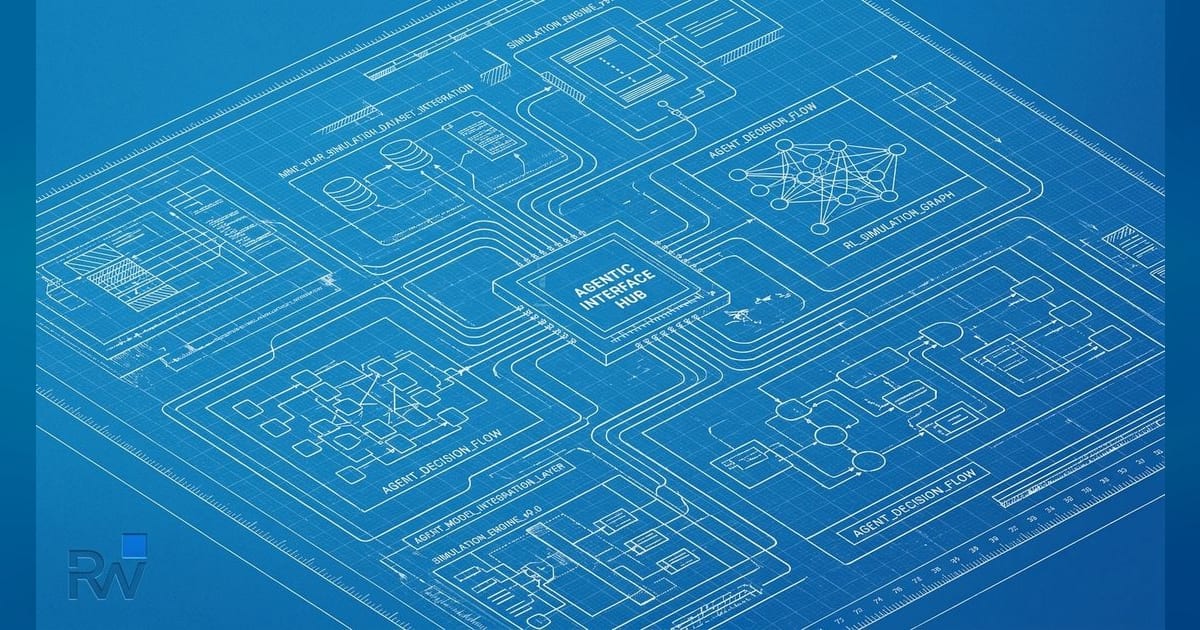
Qasar Younis announces a unified "agentic layer" for simulation and AI tooling
On July 21, 2026, serial entrepreneur Qasar Younis (@qasar) posted on X that his team has completed a major integration effort spanning more than nine years of work. "For 9+ years we’ve been building simulators, data engines, data pipelines, scenario editors, RL environments, what's now world models... and dozens of other products. Now we’ve connected them all under one agentic layer," Younis wrote, adding a link to a broader description of the effort.
The tweet was accompanied by a short video (available at the post’s video URL) and has already garnered 125 likes, 34 retweets, and over 23,000 views. No additional press release or blog post accompanied the announcement, leaving the community to piece together what the "agentic layer" actually delivers.
The components that have been stitched together
Younis enumerated a suite of technologies that have traditionally been built as separate stacks:
Simulators – virtual environments that model physical or logical systems for training or testing AI agents. Data engines – pipelines that ingest, clean, and transform raw sensor or log data into formats usable by downstream models. Data pipelines – the orchestration layer that moves data through stages of processing, often leveraging tools like Apache Airflow or Prefect. Scenario editors – authoring tools that let engineers design specific, reproducible situations within a simulator, useful for safety testing or curriculum generation. Reinforcement‑learning (RL) environments – the interface exposed to RL agents, typically adhering to OpenAI Gym or DeepMind Lab standards. World models – learned representations of an environment that allow agents to predict future states without running a full simulation.
By themselves, each of these pieces requires specialized engineering talent and substantial infrastructure. Companies building autonomous vehicles, robotics, or large‑scale game AI often cobble together ad‑hoc solutions, leading to fragmented workflows and duplicated effort.
What an "agentic layer" means in practice
While Younis did not provide a technical whitepaper, the phrasing suggests an orchestration tier that abstracts the above components behind a single programmable interface. In effect, developers could issue high‑level commands to the layer – for example, "run a safety‑critical scenario with this world‑model and capture the resulting telemetry" – without manually wiring simulators, data stores, and RL loops together. The concept mirrors recent trends in AI infrastructure:
Auto‑GPT‑style agents that chain together tools and APIs to achieve a goal, requiring a reliable back‑end that can spin up simulations on demand. Meta’s Segment Anything Model and other foundation models that aim to be reusable across domains, but still depend on consistent data pipelines. Unity’s ML‑Agents platform, which bundles a physics engine, a training API, and a visual editor, yet leaves the data‑engineering side to third‑party services.
Younis’ claim that the new layer is "not just another harness but also the broader" suggests an ambition to become a foundational service rather than a niche SDK. If the platform can truly expose all six subsystems through a unified API, it could reduce time‑to‑experiment for AI labs and lower the barrier for startups that lack deep engineering resources.
Why the timing matters
The announcement arrives at a moment when large‑scale language models are increasingly being paired with embodied agents. OpenAI has demonstrated GPT‑4‑based agents that can plan in simulated environments, and DeepMind continues to publish breakthroughs in world‑model‑driven planning. However, the supporting infrastructure has lagged behind; most teams still build bespoke pipelines for each project.
By consolidating these pipelines, the new layer could address a choke point that investors and enterprise customers have repeatedly highlighted: the cost and complexity of moving from a virtual test to a real‑world deployment. Companies in autonomous driving, aerospace, and industrial robotics have publicly cited "simulation‑to‑deployment friction" as a key hurdle.
Open questions and next steps
Younis’ post does not disclose pricing, target customers, or a public beta timeline. The linked URL (shortened to https://t.co/Fk3U3feQ5i
) appears to point to a more detailed description, but the content behind the redirect was not captured in the original tweet. Until the broader documentation is released, the community will have to monitor subsequent communications for:
Technical specifications – supported simulation engines (e.g., Unity, Unreal, Gazebo), data‑format standards, and API authentication models. Performance guarantees – latency, fidelity, and scalability metrics for running complex RL workloads. Integration partners – whether the layer will ship with connectors for major cloud providers or ML‑ops platforms. Business model – subscription versus usage‑based pricing, and whether the offering is aimed at enterprise customers or open‑source communities.
The founder’s track record
While the X post provides no explicit background, Younis is known in the startup ecosystem for prior work on large‑scale data infrastructure and AI tooling. His previous ventures have focused on building platforms that abstract away low‑level engineering, a pattern that aligns with the current announcement. (Further details on Younis’ past companies can be traced to earlier coverage in tech media, but those sources are outside the scope of this article.)
Outlook
If the integrated agentic layer delivers on its promise, it could become a de‑facto standard for AI research labs that need to iterate quickly across simulation, data, and model training. By eliminating the need to stitch together disparate components, the platform may accelerate both academic research and commercial product cycles, particularly in domains where safety‑critical validation is mandatory. Stakeholders—venture capitalists watching the AI infrastructure space, operators building autonomous systems, and developers seeking faster experiment loops—will be watching closely for a public rollout or beta program. Until then, the tweet stands as the only official word on what could be a pivotal piece of the emerging "agentic AI" stack.
*Source: *Qasar Younis on X