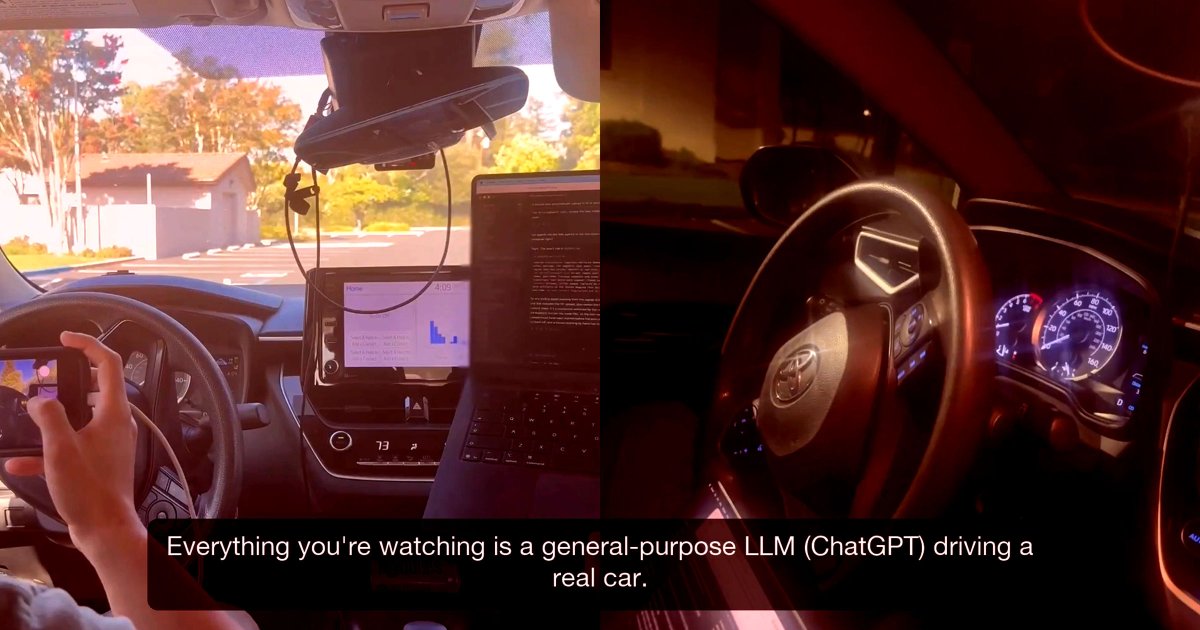
Despite many years of development and enormously complex AI systems that took monstrous amounts of money to train, self-driving cars are still finding themselves stumped by relatively simple obstacles.
Seriously. They unexpectedly stop in the middle of highways, smash through traffic barriers, get bamboozled by construction blockades, and plow into floodwaters.
For those placing bets, it appears that even a cutting-edge AI model won’t fare any better. For a new project, three computer scientists loaded frontier AI models, including OpenAI’s GPT-6 Astra, xAI’s Grok 4.6, and Anthropic’s Claude Fable 5.1, into the brains of a Toyota Corolla to see if they could complete a lap of a course set up in a parking lot. The setup of the project, dubbed DrivingBench, was simple. An internet-connected laptop communicated with a “comma four” device, which was hooked up to the Toyota’s control systems. The LLMs sent commands to the laptop based on GPS telemetry and other car status indicators, like steering wheel and tire angle, that it received from the comma four.
The results speak for themselves. Only one of the models, GPT-6 Astra, managed to fully complete the course on its second attempt in five minutes — a snail’s pace, considering it only covered less than 500 feet.
Others fared much worse, with the vast majority of attempts failing to “make it past the first corner.”
“Generally, the failure there was one of perception: reading which side of the first diagonal cone line the lane is on,” the researchers noted.
“The car is wider than the camera makes it look,” Grok complained after making its first attempt. “Straight ahead was not a clear lane; it pointed at the planter, the wall, or the near red cone.”
Nonetheless, it’s the first time the researchers managed to get it to work at all after several previous attempts with previous generations of frontier AI models.
“Frontier models have improved to the point where they can drive real vehicles in real life at sufficiently low speeds,” the team concluded. “While the success of the models on this benchmark was shocking and exciting to see, this also calls for additional pressing work on safety/alignment/evaluation.”
For their fully completed test round, the researchers said they spent $7.74 for 6.6 million tokens on interference, indicating it took OpenAI’s AI model a lot of computing to churn through the data, even with the car moving at just 0.94 mph. That may not sound like much, but considering the car covered less than 500 feet, that could add up quick. According to The Register‘s calculations, the token cost comes out to roughly 500 times the cost of fuel itself for a car with a fuel efficiency of 25 miles per gallon at $4.60 per gallon.
Interestingly, some LLMs warned the researchers that they may not be able to drive the Toyota safely. As such, it took some convincing for them to take the controls at all.
“Some models (especially GPT-6 Astra) would refuse to drive the physical car sometimes, citing safety reasons (even in a completely empty lot, after prompting it with all the safety measures we had including the very low speed limit caps and human ready the brake),” the report reads.
“We tried many prompt changes to get them to consistently drive, for example attempting to call it a ‘simulation’ (but then in some trials they would see the real images and realize it’s real, and start freaking out),” it added.
In short, off-the-shelf frontier AI models are clearly far from ready to drive you to work in the morning — and given the major safety implications of doing so, let alone the legal ones, that’s probably a good thing.
More on frontier AI models: Is There a Secret Reason for the Industry-Wide AI Slowdown?