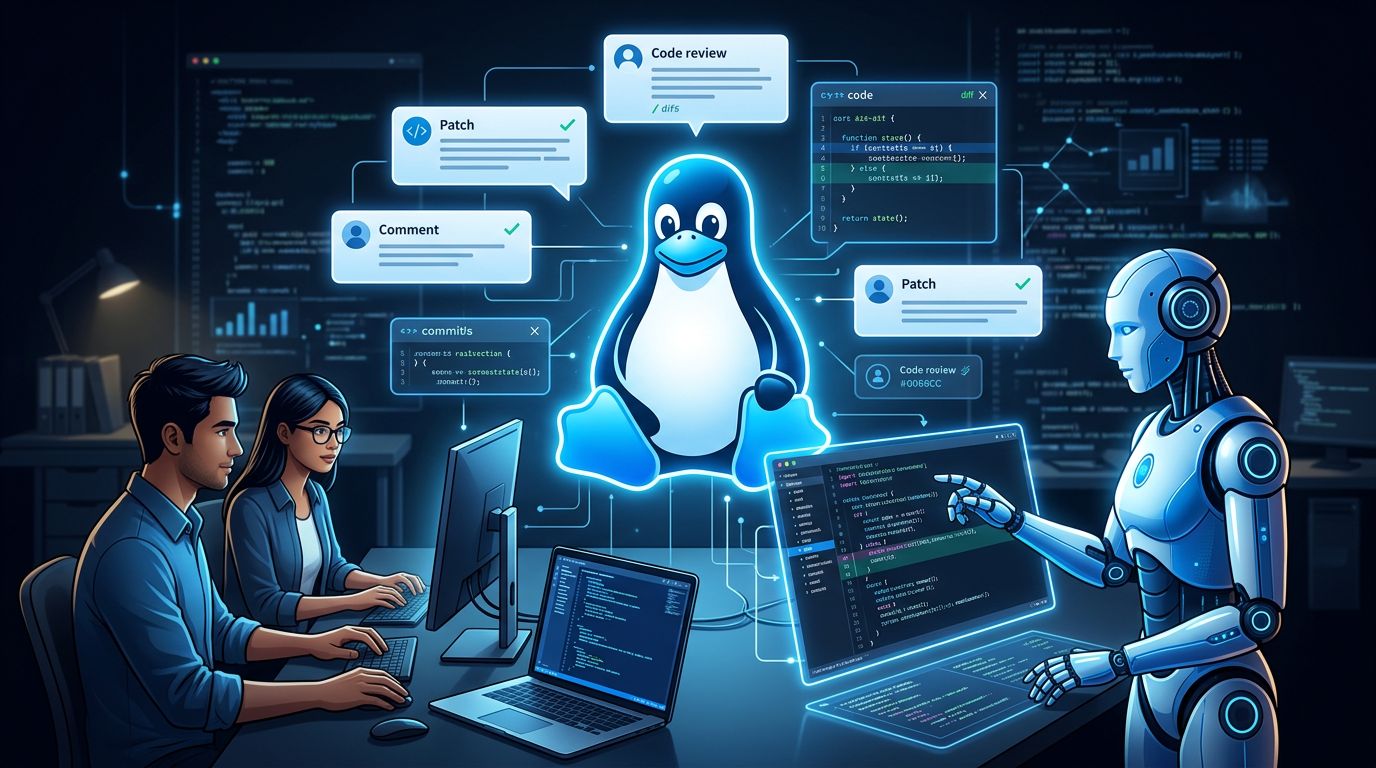
On July 15, Linus Torvalds set a policy that will define how AI fits into the Linux kernel for years: critics of Sashiko, the AI-powered code review system now running on the kernel mailing list, can work within the framework, fork the kernel, or walk away. Two days later, on July 17, someone forked it. The Register’s headline said it best: "Torvalds challenged the haters to fork Linux. Someone said ‘hold my beer.'”
That’s where we are. Linux has an official AI code reviewer. The founder has endorsed it. And the opposition now has their own tree. This is either how open source is supposed to work, or a sign that the AI debate in developer tooling has gotten too hot to contain in a single mailing list. Probably both.
What Torvalds Actually Said #
Torvalds weighed in on lore.kernel.org — the official kernel mailing list archive — in response to a thread about anti-LLM sentiment among contributors. His post left no ambiguity:
"Linux is not one of those anti-AI projects, and if somebody has issues with that they can do the open-source thing and fork it. Or just walk away."
He also called AI "a tool, just like other tools we use. And it’s clearly a useful one." Note what he did not say: he did not mandate AI across every subsystem. Individual maintainers retain latitude in how — or whether — they incorporate Sashiko into their workflow. The Linux project has landed on a subsystem-by-subsystem model. That nuance matters, and most of the coverage has glossed over it.
What Sashiko Is #
Sashiko is an agentic code review tool written in Rust, built by Roman Gushchin, a Linux kernel engineer at Google. The name comes from a Japanese embroidery technique meaning "decorative reinforcement stitching" — a deliberate metaphor for strengthening the codebase’s weave without changing its structure.
The system monitors LKML, ingests patches automatically, runs a multi-stage workflow — subsystem-specific prompts, code analysis, report generation — and posts results as polite, inline-commented email replies. It uses Gemini 3.1 Pro but is designed to work with Claude and GitHub Copilot as well. Critically: it is read-only. Sashiko cannot merge, approve, or modify anything. It only comments.
Google funds the token budget and infrastructure. Project hosting is migrating to the Linux Foundation.
The Numbers Make the Case #
In a test of 1,000 recent upstream Linux kernel issues tagged with "Fixes:" — bugs serious enough to warrant explicit fixes — Sashiko found 53% that human reviewers had missed on first pass. Its false positive rate sits at roughly 20%.
Senior Linux maintainer Greg Kroah-Hartman put it plainly: "Now we have real reports. All open source projects have real reports that are made with AI, but they’re good, and they’re real."
A tool that catches more than half of production-quality bugs missed by experienced kernel developers is not a gimmick. The question is whether the process around it is mature enough to justify the noise.
The Legitimate Complaints #
The critics are not wrong that the noise is real. Laurent Pinchart, a longtime kernel contributor, argued that Sashiko’s output should be triaged by maintainers before hitting patch authors’ inboxes — a proposal that has merit and that Sashiko’s creators have not fully addressed. If maintainers are doing triage anyway, you need to staff that triage, or the tool shifts burden from automated finding to human filtering.
Memory management maintainer Lorenzo Stoakes had a more operational complaint: patches that apply cleanly to the mainline mm-tree sometimes fail to apply inside Sashiko’s test environment, forcing respins. He described spending a 13-hour day on this. That is not a false positive problem — that is an infrastructure problem, and it is fixable. But it is not fixed yet.
For comparison, Godot and RPCS3 took the opposite approach and banned AI-generated contributions outright. Linux is going the other direction, which means the integration work has to be done properly.
The Right Frame #
The debate inside the kernel community has been framed as "AI versus humans." That is the wrong frame. Sashiko is not replacing human reviewers — it is running before them, flagging bugs in patches that would otherwise ship. The question is not whether AI belongs in high-trust codebases. Torvalds answered that. The question is how you build triage into the process so that the 20% false positive rate does not eat maintainer time.
Pinchart’s proposal — maintainer triage before the output reaches patch authors — is the right answer. It should be the default configuration, not an opt-in.
As for the fork: it exists now. It will probably stay niche. But it proves the governance model works. If you disagree with the project’s direction, you have options. That’s the deal.
What to Watch #
- Whether Sashiko’s triage model becomes a formal configuration option (track the GitHub repo)
- How other major open-source projects respond — Linux just set a precedent that will pressure others to define their own policies
- Whether the Linux Foundation hosting move changes the token budget governance
- The fork. It is real, it exists, and it is running without Sashiko. Check in on it in six months.