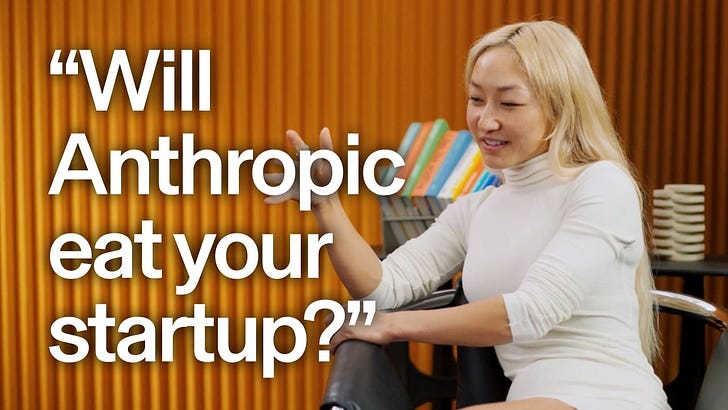
Two thirds of this year’s venture money went to four companies. Her entire firm exists on the premise that this is the wrong place to be standing.
The loud version of the AI story in 2026 is a story about 4 companies.
Anthropic, OpenAI, xAI and Waymo absorbed roughly 65 cents of every venture dollar deployed in the first quarter, out of a record $300 billion. Anthropic alone went from a $9 billion revenue pace in January to a $47 billion run rate five months later.
The obvious conclusion is that** the labs win while everyone else rents**.
However, one of the best-positioned **early-stage investors **in the industry read those same numbers and put close to a billion dollars on the opposite outcome.
Her name is Sarah Guo, her firm is Conviction, and she has never owned a share of either large lab.
What makes her worth studying is not the contrarian position, which plenty of people hold for free. It is that she has stated publicly the conditions under which she loses.
brought to you by Alumni Ventures:
Guo’s whole thesis is that the returns sit in the layer above the labs. Getting there means seeing those companies early.
Alumni Ventures gives readers access to
, co-investing alongside firms like a16z, Bessemer, and Y Combinator:[AI, deep tech, quantum computing, and cybersecurity deals]
▫️ Curated deal flow of AI-first startups ▫️ AV is already investing alongside the lead firms in these deals
▫️ No cost to see deals, no obligation to invest
Table of Contents #
-
Four Companies Took Most of the Money This Year
-
The Company That Died While She Was Building Hers
-
Why the Frontier Models Became Infrastructure
-
The 27th Priority Problem
-
She Is Not Predicting Thousands of Winners
-
The Three Ways This Bet Breaks
1. Four Companies Took Most of the Money This Year
Concentration on this scale has no real precedent in venture capital, and it makes the size of Guo’s operation look like a rounding error.
An eight-person firm in a trillion-dollar market
Conviction employs 8 people. 4 of them invest.
The office sits on York Street in the Mission District of San Francisco, a few blocks from the building Elon Musk leases for xAI and a short walk from Mira Murati’s Thinking Machines.
Guo launched the firm in October 2022 with a $101 million first fund. FTX collapsed 5 weeks later and ChatGPT was released 3 weeks after that, which is either the best timing in modern venture or the luckiest.
A second fund closed at $230 million alongside the hire of Mike Vernal, previously a partner at Sequoia and before that one of Facebook’s most senior product leaders. There are 3 funds now, totalling close to a billion dollars.
The position she could not buy
She has been direct about why the labs are absent from her book. By 2023 the fund was too small and the companies too large, and she has said plainly that nobody was an early-stage investor in Anthropic or OpenAI during this period.
The distance turned out to be useful rather than merely unavoidable. An investor holding an enormous position in one lab starts reading the whole ecosystem through it, and** in a rising market that error compounds**, because people making money tend to mistake their returns for judgment.
Her results without those positions are not marginal. She debuted at number 56 on the 2026 Forbes Midas List, and of the roughly 21 AI-native companies that have crossed $10 billion in valuation on revenue run rates above $100 million, Conviction has backed 6.
2. The Company That Died While She Was Building Hers
Her tolerance for holding a concentrated position against far larger opponents is not a personality trait she acquired in venture. She grew up inside a company that **spent 20 years **doing exactly that.
From fifty dollars to the Nasdaq and back
Her father, Jerry Guo, arrived in the United States from Hunan in 1987 with $50 and a transcript from Tsinghua, having placed first in the country on the gaokao. Her mother, Lucy Xie, an engineer, followed a year later. And they were both hired by Bell Labs.
He left for a string of startups rather than a career, and in 2003 founded a broadband equipment company called Casa Systems in Andover, Massachusetts. Guo built its first website at 14 and was pitching the business to investors at 19.
Casa went public in December 2017 at an implied market capitalisation of $1.2 billion, then peaked the following year and slid for most of a decade. Her father stepped down as chief executive in March 2023, the Andover headquarters sold for $6.4 million that August, and the company filed for Chapter 11 the following year.
The lawsuit that cost more than a year of revenue
The formative episode came much earlier. A large incumbent sued Casa on what turned out to be no real legal grounds, the case settled for nothing, and the legal fees that year exceeded the entire revenue of the business.
What she took from it was not that good companies win. It was that a company always** feels like it could die tomorrow**, and that the only advantages genuinely available are speed, product, and the **focus **that comes from treating every quarter as wartime.
That is the posture she brought to a fund competing with organisations worth close to a trillion **dollars **each.
She expected the bankruptcy to devastate her parents. But it did not, and she has said she finds that reassuring.
3. Why the Frontier Models Became Infrastructure
The first link in her thesis is also the oldest, and she was making the argument well before it was safe to make.
Fewer than ten companies should train their own model
In mid-2023, when the fashionable pitch was a 9-figure seed round to train something from scratch, Guo put the number of companies for which that made sense at fewer than 10.
She named the cost structure as** 20-30 researchers who actually know how to do the work**, 10 thousand or more GPUs, and months of calendar time.
Everyone else, in her view, should apply the models, fine-tune them, or build elsewhere in the stack. Her sharper point was that the hard question is never whether you can train the model, but whether anybody wants the thing you would build with it.
The metaphor she reaches for is the utility. Inference is sold by the token the way power is sold by the kilowatt-hour, which makes a lab a metered input to other people’s businesses rather than a competitor for end-user preference.
What happened when the labs raised prices
Infrastructure here means **positional **rather than cheap. Guo does not argue the labs become low-margin, and she has said she would happily take Anthropic stock at market price.
What follows for a startup is that the lab is a dependency.
Dependencies get hedged. Token prices rose this year, in some cases by a factor of a 100, and enterprise buyers began objecting in public.
Open-weight models out of China and Europe now land within reach of the frontier at a fraction of the cost, giving those buyers a credible alternative.
Baseten is the clearest expression of this. She backed it in 2019, 3 years before ChatGPT, when the category was called* MLOps* and by her own description was not a good one.
The business exists so companies can run their own models on their own terms.
When prices spiked, demand went vertical. Revenue grew 20x in 12 months, inference volume grew 40x, and the company repriced from $5 billion in January to $13 billion five months later.
One of her founders said he had “no intention of spending his career drinking Anthropic and OpenAI’s water.”
4. The 27th Priority Problem
If the labs are infrastructure, the question that decides her entire fund is whether they also occupy the floor above themselves. And Sarah’s answer rests on an argument about how large organisations actually behave.
Only one A-team per company
Guo calls it “organisational physics”. Any large company has exactly one A-team, and the vast majority of its product surface is not staffed by it.
If your product is Google’s 27th priority, you are not competing with Google. You are competing with a funded but unloved product group. Applied to the labs, her read is more precise than the usual version. Anthropic’s A-team is the modelitself, with a thesis centred on code and self-improving systems, and she treats the decision not to build video and image models as evidence of focus rather than only of safety policy.
Her claim about **applications **is carefully worded, saying that the labs have tried to build horizontal and vertical products and have not yet succeeded, which in her view is not because they fail to see the enterprise value, but rather because knowing what customers want, winning distribution, and rebuilding continuously around capability that is not your own are all genuinely difficult.
The market is labor, not software budgets
The second half of the argument is a call she made in **2023 **that has aged better than anything else she said that year.
Legal is a services market rather than a software market, and doing** the low-level work** is a bigger pie than selling tools to the people who currently do it.
Harvey is the proof. The company is valued at $11 billion, revenue tripled in the past year to $300 million, and more than 100,000 lawyers run work through it.
Guo wrote the first cheque personally, before Conviction had a fund, to two founders on a bad Zoom call with no slides and no prototype.
The complication is instructive. Harvey, the company built to do the work of lawyers, employs 200 lawyers of its own, many of whom teach other lawyers in person how to let the software do their jobs. What it actually sells beneath the product is trust, and trust still gets delivered by people.
That is her most counterintuitive observation and the one worth stealing. As the models improve, the work of helping a human extract value from them gets larger rather than smaller.
5. She Is Not Predicting Thousands of Winners
The version of her thesis circulating secondhand ends with a long tail of winners displacing a handful of lab s. That is a misread, and correcting it changes what the thesis actually recommends.
More markets, not more winners per market
Pressed on whether convergence toward fewer, larger companies is bad for venture returns, Guo conceded the convergence inside existing software markets and said flatly that there should not be as many SaaS companies as there are. She volunteered that venture has always been an outlier business and is becoming more of one.
Her counter to the consolidation worry is narrow. There are far** more markets **now addressable by software, because willingness to pay is being drawn from budgets that were never software budgets. Legal work, clinical judgment and education were all priced as labour.
Her allocation confirms which claim she believes. 27 investments in 3 years, 6 board seats, and a stated view that a couple of genuinely important companies per cycle is enough to return the fund. Nobody concentrates like that while expecting a long tail.
What she reversed on when the money got serious
Because Guo is so honest about her work, it makes her **reversals **worth recording.
In 2023 she preached constraint, said she could have raised half a billion and deliberately did not, and argued that** scarcity disciplines investors **the way it disciplines founders. She also called reserves nonsense and committed to leaving money on the table in later rounds.
By 2026 there are three funds near a billion dollars, she has invested in every Baseten round with each cheque larger than the last, and she co-led a $1.5 billion Series F.
Her stated regret is that the early positions were sized too cautiously. She has also abandoned the classic progression from feature to wedge to platform, which she now says correlates very little with success in either era.
6. The Three Ways This Bet Breaks
Everything above balances on a** single assumption**, and Guo laid it out.
- The labs cannot build everything*. Not that they will choose not to, but that** they are unable to**, because the work above the model is harder than it looks from underneath.
That assumption has already taken damage when OpenAI seeded Harvey in 2022 and led the seed round in Cursor, back when the labs still funded the ecosystem above them.
Both now sell legal tools of their own, OpenAI bought Remotion out from under her, and Andrej Karpathy, who worked out of her office, joined Anthropic in May.
The first failure mode sits inside her own argument.
If the labs’ bet on code and self-improving models lands, the cost of shipping the* 27th-priority product* falls every quarter, and not being staffed by the A-team stops meaning what it meant when shipping software required a staffed team. Organisational physics is a claim about how attention is allocated today, dressed as a claim about structure.
The second she volunteered herself.
Asked whether agent pricing holds when agents are priced against labour rather than software, she said** a company with genuine uniqueness keeps value-based pricing** and everyone else drifts toward the cost of compute or intelligence plus a margin, with most of the surplus ending up with customers.
That is a **commoditisation **forecast about the application layer, delivered by the person whose fund is the application layer.
The third is the bear case she named against her own strategy.
Early-stage venture may now function as a sourcing funnel for late-stage platforms with a lower cost of capital who can subsidise competitiveness at seed out of growth fees.
Her rebuttal, that she needs only a couple of important companies per cycle, is an assertion about her own selection ability rather than an answer to the structural point.
Really, the most fascinating thing about Sarah Guo is that she says things against her own interest constantly.
She has said that raising money is now considerably easier than making money, that the current expansion will not end well for returns, and that a founder arguably should not want their investor’s multiple to be high, because it came out of their dilution.
Every one of those observations points outward.
She tells founders to** assume the music stops **and model what it does to the business, and she has never once applied the same test in public to Conviction’s own entry prices, ownership percentages or portfolio marks, nearly all of which were set by other venture investors during the largest deployment quarter on record.
Her single moment of exposure runs 4 words long. Discussing the bubble, she noted that some investors and founders will lose a great deal of money because it was not rational in retrospect, and added: hope that’s not us.
Her earliest hire at the firm has put the honest version on the record, which is that everything so far is prologue, because not one company in the portfolio has yet rung the bell on a public exchange.
Until one of them does, the most rigorously argued position in venture capital is still a very expensive opinion held with unusual… * conviction*.