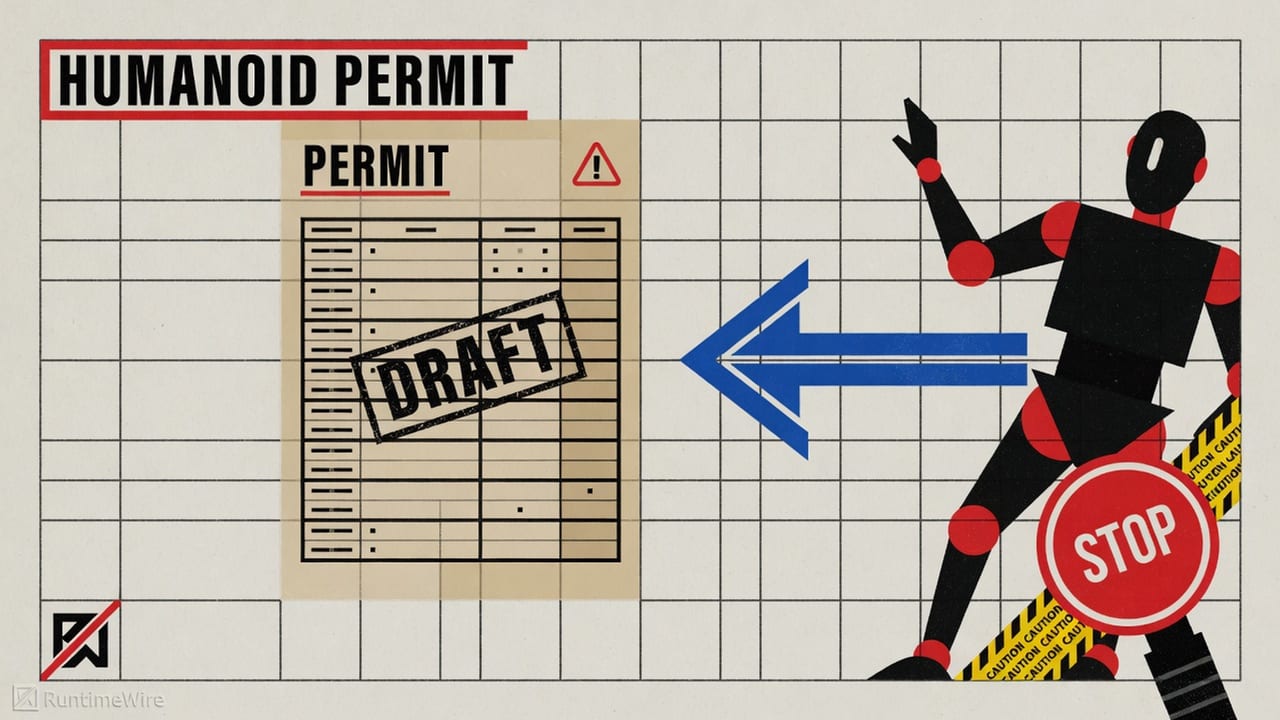
San Mateo County's Board of Supervisors approved a resolution on August 11th directing county staff to write a permitting ordinance for commercial humanoid robots, opening a local regulatory front over how physical AI can operate around workers and the public.
The measure, sponsored by District 3 Supervisor Ray Mueller, tells the County Executive's Office, County Attorney and relevant departments to return with a comprehensive permit system. Humanoids Daily flagged the resolution on Saturday, focusing on a proposed condition that could undercut remote teleoperation: a trained human supervisor physically present wherever a robot is working.
The official county record lists the resolution as passed. It directs staff to consider a broad package of safety, labor and enforcement provisions, though those provisions are not law yet. Staff still must draft an ordinance and bring it back to the board.
Mueller's focus on employment costs follows his earlier work on AI and labor policy. His official county biography credits him with introducing an AI workforce protection policy covering county employees. The humanoid resolution extends that approach to private businesses deploying machines in restaurants, hotels, stores, logistics operations, security, maintenance and customer service.
A human may have to stay in the building
The sharpest operational provision in the four-page resolution directs staff to consider requiring every commercial humanoid to be supervised at all times by a trained, on-site human.
That condition would reshape the economics of early service deployments. Many humanoid systems still depend on people who remotely monitor a robot, take control when autonomy fails or guide it through unfamiliar tasks. A centralized operator may oversee machines across multiple customer sites. San Mateo County's proposed model would add a local worker at each site, even when a remote operator remains involved.
The requirement would increase labor costs for businesses buying robotics as a way to reduce repetitive work or fill staffing gaps. It would also force vendors to decide who employs and trains the on-site supervisor: the robotics provider, the customer or a contractor.
The county has not settled those details. The resolution asks staff to consider the supervision rule "to the extent feasible," leaving room for the eventual ordinance to narrow it, define different levels of supervision or create exemptions.
Other proposed safety requirements include accessible emergency kill switches, compliance with disability-access and sanitation standards, and reviews of a manufacturer's safety record. Permit applicants could have to show that a robot is free of active recalls or recurring catastrophic failures, or demonstrate that the underlying problems have been addressed.
Labor policy enters the robot permit
The resolution reaches beyond conventional equipment certification. San Mateo County wants staff to consider requiring an Economic Impact Assessment that projects how many jobs a proposed deployment could eliminate.
Businesses could then have to certify how they will address those effects. The resolution lists three possible mechanisms: moving affected workers into other roles, providing mandated severance or paying into a County Automation Impact Fee fund for worker retraining.
That framework would make labor displacement part of the permit review instead of treating it as a consequence left entirely to the employer. It could also create a direct cost for replacing workers with machines before the county has evidence of widespread commercial humanoid deployment. The county's board memo acknowledges that mobile humanoids are not yet widely deployed in commercial settings.
The proposal also targets lithium-ion battery fires. Businesses could face annual cost-recovery fees dedicated to first-responder training, hazardous-material equipment and the extended containment required when batteries enter thermal runaway. County officials argue that those incidents can involve rapid ignition, repeated re-ignition and toxic gas emissions that exceed the demands of an ordinary structural fire.
Battery certification requirements could become part of the permit application, alongside emergency-response planning and mandatory incident reporting after a permit is issued.
The ordinance still has to be written
The board's action starts the drafting process; it does not establish permits, fees or penalties. Staff must decide which robots qualify, where the rules apply, how inspections work and whether different standards are needed for autonomous, semi-autonomous and continuously teleoperated machines.
The resolution asks staff to consider administrative fines and civil and criminal penalties for violations. It also calls for ongoing reporting of safety problems after deployment, which could give the county a local incident database before broader state rules exist for humanoid robots in publicly accessible commercial spaces.
The eventual jurisdictional reach will matter. San Mateo County includes incorporated cities with their own permitting authority as well as unincorporated communities where county departments directly administer business and land-use rules. A rule confined to county-administered areas would have a narrower effect than a countywide standard adopted with local cities.
For robotics vendors, the immediate issue is the template. A permit that combines hardware certification, mandatory on-site staffing, projected job-loss accounting and automation fees would make commercial humanoid deployment resemble a regulated operating license rather than an ordinary equipment purchase. If other local governments copy that structure, robotics companies will have to build regulatory compliance into the product before their machines reach meaningful scale.